Genomes within a species at Higher Level: The same statement as SL. HL builds on it with genome diversity between species and with sequencing, so be clear what a genome is and what a SNP is.
Practise this as you read
- Define a genome.
- Outline how individuals of one species differ in their genomes.
Free preview
This is the free notes preview
You're reading the free notes. Aimnova Pro unlocks the full study experience — and you can try it with your first topic free to keep:
- FlashcardsLock in vocabulary and key terms with spaced repetition.
- Practice questionsAnswer exam-style questions and get instant AI marking.
- Mock exams & past-paper vaultSit full mocks and see exactly how examiners award marks.
- Personalised study planA daily plan built around your exam date and weak areas.
The big idea: A genome is all of the DNA of an organism — its complete set of genetic instructions.
Reading a genome
- Reading that entire sequence, base by base, is called whole genome sequencing.
- Once we can read a genome, we can compare organisms, study disease and even trace how living things are related.
From a single base up to a whole genome
- Base — one letter of the code (A, T, C or G)
- Gene — a length of DNA that codes for one product (e.g. a protein)
- Chromosome — one very long DNA molecule carrying many genes
- Genome — every chromosome together: the organism's complete DNA
The nested scale: a base sits inside a gene, which sits inside a chromosome, which together make up the genome — all the DNA of the organism.
Interactive diagram
Explore the labelled diagram, charts and maps for this topic in full study mode.
Genome vs gene: A gene is one instruction.
A genome is the whole instruction book — all the genes plus the DNA in between.
Study smarter, not longer
Most students waste 40% of study time on topics they already know. Our AI tracks your progress and optimizes every minute.
- Genome
- All of the genetic material (DNA) of an organism — its complete set of instructions.
- Universal genetic code
- The same DNA bases code for the same amino acids in (almost) every living thing.
- Common ancestor
- An ancestral organism from which different species have descended.
Why the shared code is powerful evidence: The genetic code is almost universal — a given codon means the same amino acid in a bacterium, an oak tree and a human.
The simplest explanation is that all life descended from a common ancestor and inherited the same code. This shared, universal code is strong evidence for common ancestry.
So a complete genome does not need the whole organism:
Where to find a whole genome: A complete copy of an organism's genome sits in the nucleus of (almost) any one of its body cells — for example a single white blood cell.
You do not need the whole organism, and you do not need a sex cell — a gamete carries only half the genome.
The big idea: Members of one species share most of their genome, but small differences in the base sequence make each individual unique.
The points to remember
- The genome is all the genetic information of an organism.
- Individuals of one species share most of their genome: the same genes in the same order.
- Here and there one base differs: a single-nucleotide polymorphism (SNP).
- SNPs give the diversity within a species, alongside variation in traits.
- So genomes show unity (shared) and diversity (SNPs) at the same time.
Remember it as: Same book, a few letters changed.
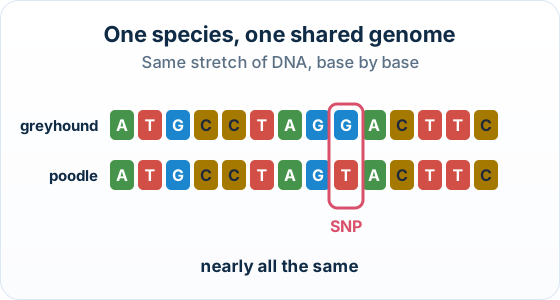
Real example: dog breeds: A greyhound and a poodle look nothing alike, but they are one species and share nearly all of their genome. Variants in just a few genes, such as one for body size, explain much of the difference between breeds.
Practice with exam-style questions
Answer exam-style questions and get AI feedback that shows you exactly what examiners want to see in a full-marks response.
How it is tested: Paper 1A asks which term means all the genetic information of an organism, or which cell would give a complete copy of it.
Which term describes all of the genetic information of an organism: gene, genome, allele or gene pool?
Model answer plan
See the answer broken into clear points, with guidance on how each point earns marks.
Genome is not gene pool: A gene pool belongs to a population; a genome belongs to one organism.