Genome sizes at Higher Level: The same statement as SL. HL papers ask for a four-mark Discuss, so learn the evidence on both sides and one real example of a very large genome.
Practise this as you read
- Discuss genome size and complexity, for four marks.
- Compare sizes read from a table.
Free preview
This is the free notes preview
You're reading the free notes. Aimnova Pro unlocks the full study experience — and you can try it with your first topic free to keep:
- FlashcardsLock in vocabulary and key terms with spaced repetition.
- Practice questionsAnswer exam-style questions and get instant AI marking.
- Mock exams & past-paper vaultSit full mocks and see exactly how examiners award marks.
- Personalised study planA daily plan built around your exam date and weak areas.
Start Studying Free Full access to Aimnova Pro · cancel anytime
The big idea: Compare genome sizes across groups and a pattern appears, but it is not a simple link with complexity.
Genomes vary enormously in size between species. But — and this surprises many students — a bigger genome does not mean a more complex organism.
The points to remember
- Prokaryotes tend to have smaller genomes than eukaryotes: evidence for a link.
- Much of a eukaryote genome is non-coding, and eukaryote genes contain introns.
- Within eukaryotes there is no relationship with complexity: evidence against.
- Some plants and amphibians have genomes far larger than the human genome.
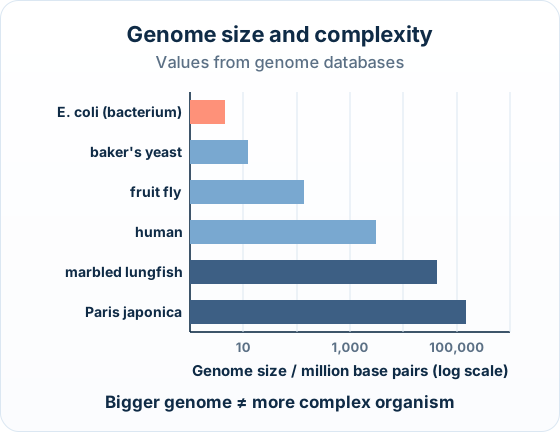
Real example: plants and amphibians: Some plants and amphibians have genomes larger than a human's, yet are not more complex. Much of the extra DNA does not code for proteins.
| Organism | Genome size | Number of genes |
|---|---|---|
| Bacterium (E. coli) | very small | few thousand |
| Fruit fly | small | ~14 000 |
| Human | large | ~20 000 |
| Some plants & amphibians | huge (bigger than human) | not many more |
Real example: Paris japonica: The canopy plant Paris japonica, from Japan, has the largest genome known: about 149 billion base pairs, nearly 50 times the human genome.
Know your predicted grade
Take timed mock exams and get detailed feedback on every answer. See exactly where you're losing marks.
Try Mock Exams FreeYour first topic is free to keep • No credit card required
The big idea: Genome databases list the genome size of thousands of species, so groups can be compared.
The points to remember
- A genome database (such as the one at the US NCBI) gives each species' genome size.
- Sizes are given in base pairs: Mbp (million) or Gbp (billion).
- Pick species from different groups (bacteria, fungi, plants, animals) and list their sizes.
- Then compare: do the sizes rise with complexity? Look for exceptions.
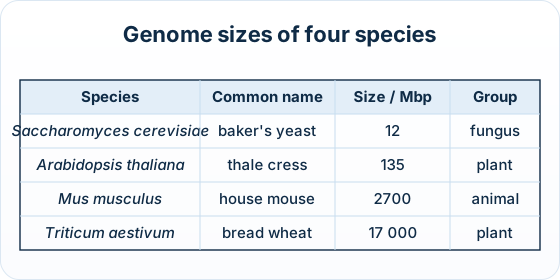
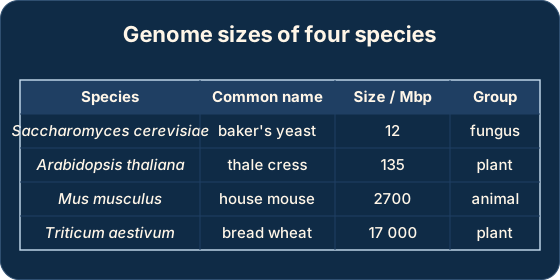
Complexity is not measured: There is no number for complexity, so say how you judged it and that it is subjective.
How it is tested: Paper 1B gives a table of genome sizes and asks you to discuss a link with complexity, using the data.
IB-style questionDiscuss[4 marks]
Discuss the evidence of the relationship between genome size and the complexity of organisms.
Model answer plan
See the answer broken into clear points, with guidance on how each point earns marks.
Quote the numbers: Name the organisms and their sizes from the table, and give a point on each side.