Chromosome numbers at Higher Level: The same statement as SL. HL papers ask how the numbers came to differ, so learn fusion, fission and polyploidy with the human and chimpanzee example.
Practise this as you read
- Suggest how chromosome numbers evolved, for four marks.
- State the human and chimpanzee numbers.
Free preview
This is the free notes preview
You're reading the free notes. Aimnova Pro unlocks the full study experience — and you can try it with your first topic free to keep:
- FlashcardsLock in vocabulary and key terms with spaced repetition.
- Practice questionsAnswer exam-style questions and get instant AI marking.
- Mock exams & past-paper vaultSit full mocks and see exactly how examiners award marks.
- Personalised study planA daily plan built around your exam date and weak areas.
Start Studying Free Full access to Aimnova Pro · cancel anytime
The big idea: Each species has its own number of chromosomes, and in body cells that number is always even.
The points to remember
- Species differ in their chromosome number: there is great diversity.
- Humans have 46 chromosomes; chimpanzees have 48.
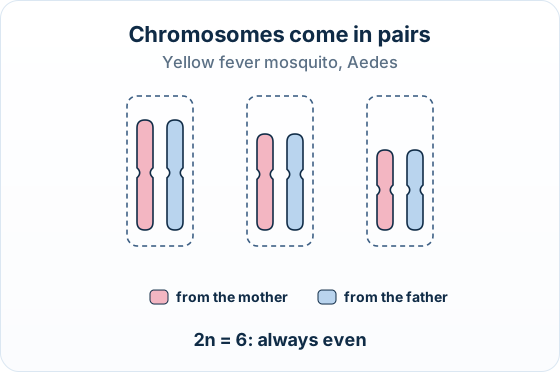
- Body cells are diploid: written 2n.
- Chromosomes come in pairs, so a diploid number is always even.
- Gametes are haploid (one set, n), so they hold half: 23 in a human egg or sperm.
Remember it as: Two of every kind: diploid numbers are even.
Real example: bread wheat: Bread wheat has 42 chromosomes: six sets of 7. It arose when wild grasses crossed and their chromosome sets were doubled, so it holds the sets of three ancestors.
Feeling unprepared for exams?
Get a clear study plan, practice with real questions, and know exactly where you stand before exam day. No more guessing.
Get Exam Ready FreeYour first topic is free to keep • No credit card required
The big idea: Chromosome numbers change over evolution: chromosomes can join, split, or whole sets can double.
The points to remember
- Fusion: two chromosomes join, so the number falls (human chromosome 2 matches chimpanzee 12 and 13).
- Fission: a chromosome splits in two, so the number rises.
- Polyploidy: whole sets double, for example when all chromosomes fail to separate in meiosis, or DNA is copied without the cell dividing.
- A change in chromosome number can lead to new species.
1
Fusion
Two join into one: 48 to 46 in the human line.
2
Fission
One splits into two: the number rises.
3
Polyploidy
Whole sets double: common in plants such as wheat.
Polyploidy, not an extra chromosome: One extra chromosome (a trisomy) is not polyploidy. Polyploidy doubles every chromosome set.
How it is tested: Paper 1B gives a table of chromosome numbers: notice that they are all even. HL Paper 2 can ask how the numbers came to differ.
IB-style questionSuggest[4 marks]
Suggest how the diversity of chromosome numbers in plants and animals could have evolved.
Model answer plan
See the answer broken into clear points, with guidance on how each point earns marks.
The two numbers to know: Human 46, chimpanzee 48. Other numbers will be given to you.