Populations and species at Higher Level: The same statement as SL. At HL it connects to the problems of the species concept and to speciation, so be able to say why the line between populations and species is a judgement.
Practise this as you read
- Explain whether two forms are one population or two, with a reason.
- Outline why speciation is gradual.
Free preview
This is the free notes preview
You're reading the free notes. Aimnova Pro unlocks the full study experience — and you can try it with your first topic free to keep:
- FlashcardsLock in vocabulary and key terms with spaced repetition.
- Practice questionsAnswer exam-style questions and get instant AI marking.
- Mock exams & past-paper vaultSit full mocks and see exactly how examiners award marks.
- Personalised study planA daily plan built around your exam date and weak areas.
Start Studying Free Full access to Aimnova Pro · cancel anytime
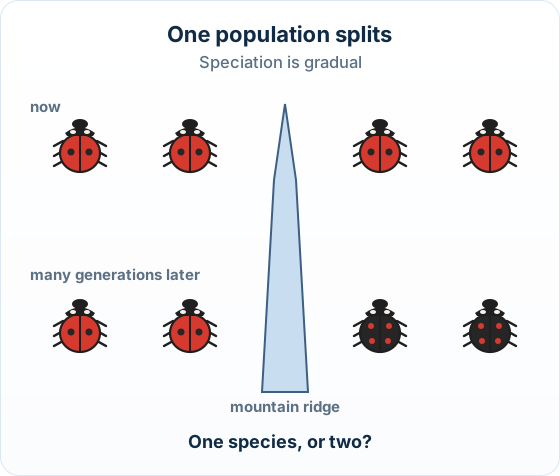
The big idea: Speciation happens gradually, not in one step.
The points to remember
- Speciation splits one species into two or more.
- It starts when populations stop interbreeding, for example when a barrier divides them.
- Each population then changes in its traits, a little every generation.
- Over time they become more and more different, until they can no longer interbreed.
- There is no single moment when one species becomes two.
Remember it as: Split, then drift apart, slowly.
Real example: greenish warblers: Greenish warblers live in a ring of forests around the Tibetan Plateau. Their songs change gradually around the ring, and where the two ends meet in Siberia the birds do not recognise each other's song and do not interbreed.
Know your predicted grade
Take timed mock exams and get detailed feedback on every answer. See exactly where you're losing marks.
Try Mock Exams FreeYour first topic is free to keep • No credit card required
The big idea: Because the change is gradual, calling two populations one species or two can be an arbitrary decision.
The points to remember
- A population is a group of one species living in one area and interbreeding.
- Two populations part-way through speciation may still sometimes interbreed.
- Different biologists can draw the line in different places.
- So the decision whether they are one species or two can be arbitrary.
Signs of one species
- They meet and mate freely
- Their offspring are fertile
- Their traits overlap
Signs of two species
- They never mate, even when together
- Hybrids are rare or sterile
- Their traits no longer overlap
Real example: killer whales: Killer whales that eat fish and those that hunt seals share the same waters but rarely interbreed and differ in their DNA. Whether they are one species or several is still debated.
How it is tested: Paper 1B shows two forms or populations and asks which idea is better supported. Either answer can score, if the reason is about the evidence shown.
IB-style questionExplain[1 mark]
Ladybirds from two sides of a mountain ridge were collected. Those from the west are red with black spots; those from the east are black with red spots.
Explain, with a reason, whether the ladybirds are more likely to be one interbreeding population or two separate populations. [1]
Model answer plan
See the answer broken into clear points, with guidance on how each point earns marks.
Different looks do not prove two species: Colour can vary within one population. Say what the evidence suggests, not that it proves it.