The big idea: A dichotomous key is a tool that identifies an unknown organism by asking a series of either/or questions about its observable features.
How it works
- Each step gives you two choices.
- You pick the one that matches your organism, and it sends you to the next step — or finally names the organism.
- 'Di-chotomous' literally means 'split into two' — every step branches two ways.
How you read a key
- Start at Step 1 — always begin at the top
- Read both choices in the pair before deciding
- Pick the choice that matches the organism in front of you
- Follow the instruction: go to another step, or read off the name
- Keep going until the key gives you an organism's name
Two key terms: Observable feature = something you can see or measure (legs, shell, scales, wings) — not behaviour and not where it lives.
Either/or pair = the two opposite choices offered at each step.
Free preview
This is the free notes preview
You're reading the free notes. Aimnova Pro unlocks the full study experience — and you can try it with your first topic free to keep:
- FlashcardsLock in vocabulary and key terms with spaced repetition.
- Practice questionsAnswer exam-style questions and get instant AI marking.
- Mock exams & past-paper vaultSit full mocks and see exactly how examiners award marks.
- Personalised study planA daily plan built around your exam date and weak areas.
A good dichotomous key uses features that are clearly opposite, so at each step the organism fits one choice and not the other.
Choose features you can observe
- The choices must be about features you can actually observe.
- Good: 'has six legs' versus 'has eight legs'.
- Not: 'lives in a garden' versus 'lives in a pond' — where it lives is not a body feature.
- Dichotomous key
- An identification tool made of paired either/or statements, each leading to another step or to the name of an organism.
- Observable feature
- A characteristic that can be seen or measured directly, such as number of legs, presence of a shell, or type of skin.
- Couplet (step)
- One numbered pair of opposite statements in the key — you choose the one that matches your organism.
- Keys out
- The point at which the key finally identifies (names) the organism.
A GOOD key choice
- 'Has a shell' vs 'has no shell' — opposite and clear
- Based on a feature you can see
- Every organism fits exactly one side
A POOR key choice
- 'Big' vs 'small' — vague, depends on the specimen
- 'Lives in water' — a habitat, not a body feature
- Choices that overlap, so an organism fits both
The golden rule: At every step, follow only the choice that matches your organism, then do exactly what that line tells you — go to the next numbered step or read off the name.
Never skip a step, and never pick a choice just because it sounds likely.
Get feedback like a real examiner
Submit your answers and get instant feedback — what you did well, what's missing, and exactly what to write to score full marks.
The big idea: To build a key, keep splitting a set of organisms into two groups by one visible feature, until each organism stands alone.
The points to remember
- Collect or photograph a few local species: leaves in a park, or animals under stones.
- Pick one visible feature that splits the set into two groups: couplet 1.
- Split each group again by another feature, until every species stands alone.
- Write numbered couplets: each line says what to look for and where to go next, or the name.
- Test the key on new specimens: anyone should reach the same name.
Remember it as: One feature, two groups; repeat.
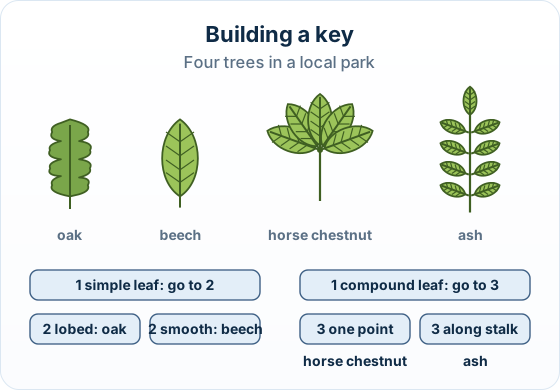
Fieldwork example: a park in autumn: With four trees you need three couplets: one fewer than the number of species. The leaves alone are enough, so the key works in any season the trees are in leaf.
When you write the couplets:
Features you can see, not feelings: 'Lobed edge v smooth edge' works for anyone. 'Pretty v plain' or 'big v small' do not.
How this is tested: On Paper 1A (multiple choice) you are usually given a small dichotomous key and an organism (often shown as a picture or a list of features).
How to win the marks
- You must follow the key and choose the letter or name the organism keys out.
- The marks are won by working through the key step by step — not by guessing from the name.
- Read both choices at each step before you move on.
Use this key for the worked question below. Each numbered step gives two choices; follow the one that matches the animal.
| Step | Choice | Where to go |
|---|---|---|
| 1 | Body has a hard outer skeleton (exoskeleton) and jointed legs | → go to Step 2 |
| 1 | Body is soft, with no jointed legs | → go to Step 3 |
| 2 | Three pairs of legs (six legs) | → Insect |
| 2 | Four pairs of legs (eight legs) | → Spider |
| 3 | Has a coiled shell | → Snail |
| 3 | Has no shell | → Slug |
Exam-style question — follow the key to identify the animal
A small garden animal has a soft body with no jointed legs, and it carries a coiled shell on its back. Use the key above to identify it. [1]
How to work through the key
- Start at Step 1. The animal has a soft body with no jointed legs, so take the second choice → go to Step 3 (not Step 2, which is for hard, jointed-leg bodies).
- At Step 3, check the shell. The animal has a coiled shell, so take the first choice → this keys out as Snail.
- Answer the question: following the key (soft body → Step 3 → has a shell), the animal is identified as a snail.
Final answer
Soft body with no jointed legs → Step 3; has a coiled shell → Snail. The animal is a snail.
The same key drawn as a branching tree. The highlighted route shows the answer: soft body → Step 3 → has a shell → Snail.
Interactive diagram
Explore the labelled diagram, charts and maps for this topic in full study mode.
Check your route: Your path through the key should read: Step 1 (no jointed legs) → Step 3 (has a shell) → Snail. If you ended anywhere else, you took a choice that did not match the animal — go back and re-read both options at each step.
A leaf with seven leaflets spreading from one point is keyed out with this key: 1 simple leaf, go to 2; compound leaf, go to 3. 2 lobed edge, oak; smooth edge, beech. 3 leaflets from one point, horse chestnut; leaflets along a stalk, ash. Which tree is it?
Model answer plan
See the answer broken into clear points, with guidance on how each point earns marks.