The big idea: A DNA barcode works like a shop barcode: it names the species.
The points to remember
- A barcode is a short region of one gene, the same region for every species in a group.
- Its base sequence differs between species but is almost the same within a species.
- Scientists have built reference libraries of barcodes for many thousands of species.
- Read a sample's barcode, match it to the library, and the species is identified.
Remember it as: Read the code, look it up, name the species.
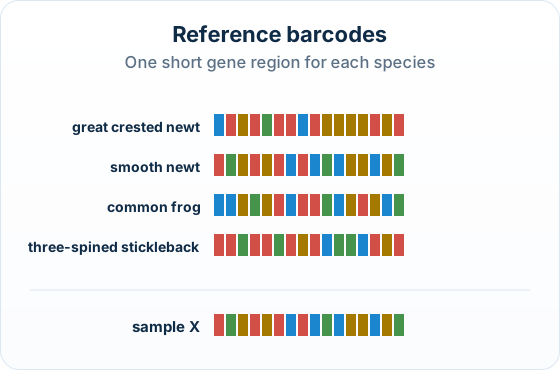
Real example: fish fraud: Barcoding of fish sold in shops and restaurants has often shown that the label was wrong: a cheaper species sold as a dearer one.
Free preview
This is the free notes preview
You're reading the free notes. Aimnova Pro unlocks the full study experience — and you can try it with your first topic free to keep:
- FlashcardsLock in vocabulary and key terms with spaced repetition.
- Practice questionsAnswer exam-style questions and get instant AI marking.
- Mock exams & past-paper vaultSit full mocks and see exactly how examiners award marks.
- Personalised study planA daily plan built around your exam date and weak areas.
Start Studying Free Full access to Aimnova Pro · cancel anytime
The big idea: Organisms shed DNA into their surroundings. Reading the barcodes in a water or soil sample shows which species live there.
The points to remember
- Environmental DNA (eDNA) is DNA shed into water, soil or air from skin, mucus, faeces and cells.
- A sample is taken; DNA is extracted and the barcode region copied by PCR.
- The barcodes are sequenced and matched to the library: a species list.
- Advantages: fast, no need to catch or see animals, finds rare and hidden species.
- Limits: it shows which species are present, not how many or how healthy they are.
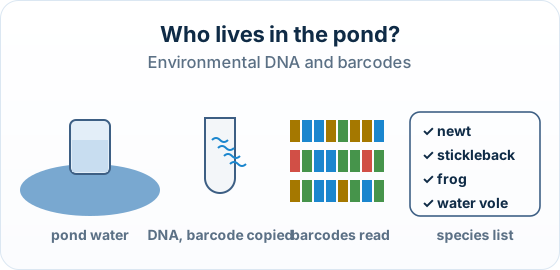
Real example: great crested newts: In England, a pond water sample tested for great crested newt eDNA is accepted in surveys for this protected species, instead of catching newts at night.
Read eDNA questions carefully:
Present, not how many: eDNA tells you which species are there. It does not count the population or show the health of the animals.
Get feedback like a real examiner
Submit your answers and get instant feedback — what you did well, what's missing, and exactly what to write to score full marks.
Try AI Tutor FreeYour first topic is free to keep • No credit card required
How it is tested: Paper 1A asks what eDNA or barcoding can do: identify species in a habitat, including rare ones. Distractors offer counting populations or measuring health.
IB-style questionIdentify[1 mark]
What is an advantage of using environmental DNA to survey the fish in a lake? A gives exact population sizes; B detects rare species that are hard to catch; C shows which fish are diseased; D measures the age of each fish.
Model answer plan
See the answer broken into clear points, with guidance on how each point earns marks.
Barcoding and eDNA go together: One application of DNA barcoding is analysing environmental DNA.