aımnova
DashboardMy LearningCrash CoursesStudy Plan

Aimnova site navigation

Stay in the loop

Get the latest study resources and updates

New features, study tips and exam insights — straight to your inbox.

IB Diploma

  • IB Past Papers
  • IB Study Notes
  • IB Question Bank
  • IB Mock Exams
  • IB Revision

IB Subjects

  • IB Math AA
  • IB Math AI
  • IB Economics
  • IB Business Management
  • IB Physics
  • IB Biology
  • View all IB subjects→

IB Past Papers

  • IB Math AA HL Past Papers
  • IB Math AA SL Past Papers
  • IB Math AI HL Past Papers
  • IB Math AI SL Past Papers
  • IB Economics HL Past Papers
  • IB Economics SL Past Papers
  • IB ESS Past Papers
  • View all past papers→

Study Resources

  • Study Notes
  • Question Bank
  • Mock Exams
  • Crash Courses
  • Flashcards
  • Revision Guide
  • Exam Skills
  • Command Terms
  • Grade Calculator
  • Exam Timetable 2026

Aimnova

  • Features
  • Pricing
  • For Teachers
  • For Schools
  • For Parents
  • About Us
  • Blog
  • Contact
aımnova

IB study, practice and feedback built around the real exam.

TermsPrivacyCookies·© 2026 Aimnova. All rights reserved.c90f7ab

Aimnova is not affiliated with or endorsed by the International Baccalaureate Organization (IB).

NotesBiology HLTopic 1.6Chromosome number as a shared trait within a species
Back to Biology HL Topics
1.6.133 min read

Chromosome number as a shared trait within a species (Biology HL)

IB Biology · Unit 1

IB exam ready

Study like the top scorers do

Access a smart study planner, AI tutor, and exam vault — everything you need to hit your target grade.

Start Free

Contents

  1. 1One species, one chromosome number
  2. 2Different numbers block fertile hybrids
  3. 3Exam-style question (step by step)
The big idea: Chromosome number is a shared trait: all members of a species, and all of an organism's body cells, have the same number.

The points to remember

  • Members of a species share a characteristic chromosome number: humans 46, dogs 78.
  • Every body cell of an organism has that same number: root cells and leaf cells alike.
  • Gametes hold half (one set); fertilization restores the full number.
  • So the number is one more trait shared within a species.
Remember it as: Same species, same count; same body, same count.

So one count from any body cell tells you the count in all the others.

Real example: bluebells: The British bluebell, Hyacinthoides non-scripta, has 16 chromosomes in its root cells, so its leaf and petal cells have 16 too.

Free preview

This is the free notes preview

You're reading the free notes. Aimnova Pro unlocks the full study experience — and you can try it with your first topic free to keep:

  • FlashcardsLock in vocabulary and key terms with spaced repetition.
  • Practice questionsAnswer exam-style questions and get instant AI marking.
  • Mock exams & past-paper vaultSit full mocks and see exactly how examiners award marks.
  • Personalised study planA daily plan built around your exam date and weak areas.
Start Studying Free Full access to Aimnova Pro · cancel anytime
The big idea: Closely related species with different chromosome numbers rarely give fertile offspring.

The points to remember

  • A hybrid gets one set from each parent: horse 32 + donkey 31 = 63 in a mule.
  • In meiosis, chromosomes must line up in matching pairs.
  • With sets that do not match, they cannot all pair, so gametes fail.
  • So the hybrid is sterile, and the parents stay separate species.
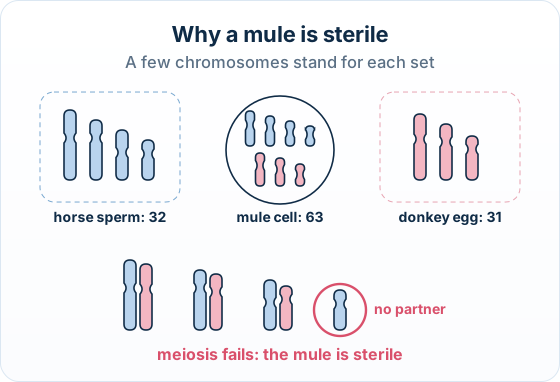
A horse sperm with 32 chromosomes and a donkey egg with 31 join in a mule cell with 63; below, in meiosis three pairs form and one chromosome is circled with no partner; note: meiosis fails, the mule is sterile
Different numbers: chromosomes cannot pair.
Real example: horse and donkey: Horses have 64 chromosomes and donkeys 62. Their mule offspring has 63 and is almost always sterile.

Matching numbers are needed, but they are not always enough:

Same number helps, it does not guarantee: Matching numbers make fertile hybrids possible, not certain: the gene order must match too.

Stop wasting time on topics you know

Our AI identifies your weak areas and focuses your study time where it matters. No more overstudying easy topics.

Try Smart Study FreeYour first topic is free to keep • No credit card required
How it is tested: Paper 2 gives the chromosome number of one cell type and asks for another, or asks why a hybrid is sterile.
IB-style questionState[1 mark]

Cells from the tip of a garlic root have 16 chromosomes. State the number of chromosomes in a garlic leaf cell.

Model answer plan

See the answer broken into clear points, with guidance on how each point earns marks.

Claim your free topic
Do not halve it: Leaf and root cells are both body cells. Halve only for gametes.

Try an IB Exam Question — Free AI Feedback

Test yourself on Chromosome number as a shared trait within a species. Write your answer and get instant AI feedback — just like a real IB examiner.

Horses have 64 chromosomes and plains zebras 44. A horse and a zebra can produce a healthy foal, the zorse.

why the zorse is likely to be sterile.
[2 marks]

Related Biology HL Topics

Continue learning with these related topics from the same unit:

1.1.1Water as the medium for life1.1.2Hydrogen bonds from the polar covalent bonds in water1.1.3Cohesion of water and its consequences for organisms1.1.4Adhesion of water to polar or charged materials
View all Biology HL topics
Improve your exam techniqueCommand terms, paper structure, and mark-scheme tips for Biology HL
Previous1.6.12Difficulties applying the biological species conceptNextDeveloping a dichotomous key for local species1.6.14

6 exam-style questions ready for you

Students who practice on Aimnova improve their scores by 15% on average. Get instant feedback that shows exactly how to improve your answers.

Practice Now — FreeView All Biology HL Topics