The big idea: The breeding test needs organisms that breed sexually. Organisms that reproduce asexually never interbreed, so the test cannot be used.
The points to remember
- The biological species concept asks whether organisms interbreed and give fertile offspring.
- Organisms that reproduce asexually make offspring from one parent, with no partner.
- They never interbreed, so the test has nothing to test.
- Their species are told apart by traits or DNA instead.
Remember it as: No sex, no test.

Real examples: bdelloid rotifers and dandelions: Bdelloid rotifers are tiny freshwater animals; no male has ever been found, and they have reproduced without mating for millions of years. Many dandelions set seed without pollination, so each plant's seeds are copies of it.
Free preview
This is the free notes preview
You're reading the free notes. Aimnova Pro unlocks the full study experience — and you can try it with your first topic free to keep:
- FlashcardsLock in vocabulary and key terms with spaced repetition.
- Practice questionsAnswer exam-style questions and get instant AI marking.
- Mock exams & past-paper vaultSit full mocks and see exactly how examiners award marks.
- Personalised study planA daily plan built around your exam date and weak areas.
Start Studying Free Full access to Aimnova Pro · cancel anytime
The big idea: Bacteria reproduce asexually, and they can also pass genes to bacteria of other species. Both break the breeding test.
The points to remember
- Bacteria reproduce by binary fission: one cell splits into two, no interbreeding.
- Bacteria can pass genes to other species by horizontal gene transfer.
- A common way: a plasmid is copied through a tube, the pilus, from one cell to another.
- So genes mix between species without any breeding, and species boundaries blur.
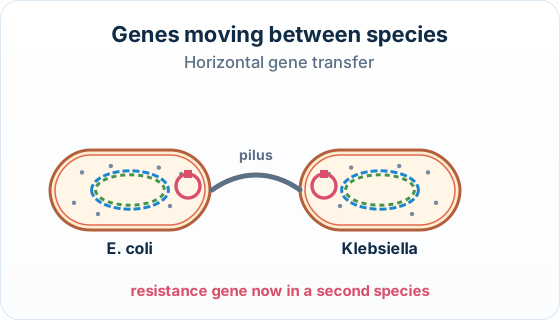
Real example: antibiotic resistance: Genes for resistance to antibiotics, carried on plasmids, have spread from E. coli to other gut bacteria such as Klebsiella. This is one reason resistance spreads so fast in hospitals.
In an answer about bacteria, give the reason, not just the word:
Say why it fails: Write 'bacteria reproduce asexually, so they do not interbreed', or 'genes pass between species by horizontal gene transfer'.
Feeling unprepared for exams?
Get a clear study plan, practice with real questions, and know exactly where you stand before exam day. No more guessing.
Get Exam Ready FreeYour first topic is free to keep • No credit card required
How it is tested: Paper 2 can ask for one difficulty in applying the biological species concept to bacteria, for one mark.
IB-style questionOutline[1 mark]
The human gut contains more than 1000 species of bacteria. Outline a difficulty in applying the biological species concept to bacteria.
Model answer plan
See the answer broken into clear points, with guidance on how each point earns marks.
Two answers, either scores: Asexual reproduction, or genes shared between species by horizontal gene transfer.