The big idea: A virus cannot reproduce on its own — it has no ribosomes, no enzymes for energy and no way to copy itself.
What a virulent virus does instead
Take over
It takes over a living host cell.
Mass-produce
It forces that cell to mass-produce copies of the virus.
Burst
It bursts the cell open to release them.
Take over → copy → burst
The lytic cycle: This ruthless take-over-and-burst route is called the lytic cycle (from lysis = bursting/splitting a cell). The classic example is a bacteriophage — a virus that infects bacteria.
A bacteriophage. The tail fibres anchor to a SPECIFIC receptor (step 1, attachment); the genome packed in the head is injected into the host (step 2, entry).
Interactive diagram
Explore the labelled diagram, charts and maps for this topic in full study mode.
Two words to keep straight: Virulent = a virus that goes straight into the lytic cycle and kills the host quickly.
Lysis = the host cell bursting and dying, releasing the new viruses.
The cycle in five steps (we unpack each next)
- Attachment — the virus locks onto a specific spot on the host
- Entry — the viral genome gets inside the cell
- Replication / synthesis — the host is hijacked to copy the virus's parts
- Assembly — the parts snap together into new viruses
- Lysis / release — the cell bursts, freeing many new viruses
Free preview
This is the free notes preview
You're reading the free notes. Aimnova Pro unlocks the full study experience — and you can try it with your first topic free to keep:
- FlashcardsLock in vocabulary and key terms with spaced repetition.
- Practice questionsAnswer exam-style questions and get instant AI marking.
- Mock exams & past-paper vaultSit full mocks and see exactly how examiners award marks.
- Personalised study planA daily plan built around your exam date and weak areas.
Each step has a clear cause and effect. Follow the logic and you never have to memorise the order — it falls out naturally.
One pass through the lytic cycle
| 1. Attachment | Tail fibres (or surface proteins) bind a specific receptor molecule on the host's outer surface. | The shape of the virus protein must match the host receptor — like a key in a lock. This match is what decides which cells a virus can infect. |
| 2. Entry | The viral genome (DNA or RNA) is injected into the cell; the empty protein coat is left outside. | Only the genetic instructions need to get in — they carry everything needed to commandeer the cell. |
| 3. Replication / synthesis | The host's own enzymes, ribosomes, nucleotides and ATP are redirected to copy the viral genome and translate it into capsid proteins. | The virus brings instructions, not factories. It hijacks the cell's existing machinery instead of building its own. |
| 4. Assembly | Fresh genome copies and capsid proteins self-assemble into many complete new virus particles (virions). | The capsid proteins fit together automatically around a genome copy — no extra machinery required. |
| 5. Lysis / release | The cell bursts (lyses) and dies, releasing a flood of new viruses that infect neighbouring cells. | Often a viral enzyme weakens the cell wall/membrane so it splits open. One infected cell can release hundreds of viruses. |
Why attachment is so specific — and why it matters: A virus can only attach if its surface proteins fit a receptor that the host cell actually has. No matching receptor → no attachment → no infection.
What this explains
- A phage that destroys one species of bacterium may be completely harmless to a different species.
- The cold virus infects your airway cells but not, say, your muscle cells.
Host range: The set of cells a virus can infect is its host range, and it is set right here, at step 1.
- Virulent virus
- A virus that immediately runs the lytic cycle, killing the host cell to reproduce.
- Receptor
- A specific molecule on the host's surface that the virus's proteins bind to during attachment.
- Host range
- The set of cell types or species a particular virus is able to infect — determined by attachment specificity.
- Virion
- A single complete virus particle (genome packed inside its protein capsid), ready to infect a new cell.
- Lysis
- The bursting and death of the host cell that releases the new viruses.
Net effect — the line to remember: The lytic cycle gives rapid amplification of the virus (one cell → many new viruses) and death of the host cell. That double outcome — lots of copies, dead cell — is the whole point of the cycle.
See how examiners mark answers
Answer exam-style questions with model answers. Learn exactly what earns marks and what doesn't.
The big idea: A virus has no metabolism of its own, so the host cell does all the work. Bacteriophage lambda shows the phases of the lytic cycle.
The points to remember
- Attachment: lambda's tail binds a receptor protein on the outer surface of E. coli.
- Entry: lambda injects its DNA into the cell; the empty capsid stays outside.
- Synthesis: the host's enzymes copy the viral DNA and its ribosomes make the viral proteins.
- The host supplies the energy (ATP from respiration) and the raw materials: nucleotides and amino acids.
- Assembly: new heads and tails are built, and a copy of the DNA is packed into each head.
- Lysis: the cell wall is broken, the cell bursts, and about 100 new phages are released.
Remember it as: Attach, inject, copy, assemble, burst: and the host pays for all of it.
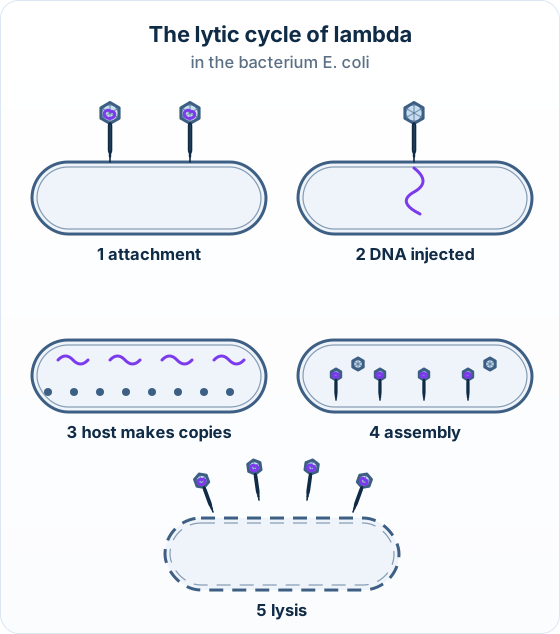
Real example: lambda's way in: Lambda attaches to LamB, a protein in the outer membrane of E. coli that the bacterium uses to take in the sugar maltose. A strain of E. coli without LamB cannot be infected by lambda.
When a question asks what the host does, name the host's own processes:
The host's jobs, not the virus's: Respiration (energy), supplying nucleotides and amino acids, protein synthesis and enzymes are host processes. 'Virus replication' or 'assembly of the virus' are not. And write what attaches to what: 'the phage attaches to the bacterium', not just 'attachment'.
How this is tested: A common HL task is to outline or describe the lytic cycle in order, or to explain why a virus only infects certain hosts.
How to score: Each correct step in the right sequence can earn a mark, so always answer attachment → entry → replication → assembly → lysis, and name the host machinery that gets hijacked.
Exam-style question — outline the lytic cycle of a bacteriophage
A bacteriophage infects a bacterium and follows the lytic cycle. Outline the events of this cycle, in sequence, from the virus reaching the cell to the release of new viruses. [5]
How to score all five marks
- Attachment. The phage binds to a specific receptor on the bacterium's surface using its tail fibres. (The match between phage protein and receptor decides whether infection is even possible.)
- Entry. The phage injects its genome (DNA) into the cell; the empty protein coat stays outside.
- Replication / synthesis. The viral genome hijacks the host's machinery — its enzymes, ribosomes, nucleotides and ATP — to make many copies of the genome and many capsid proteins.
- Assembly. The new genomes and capsid proteins self-assemble into many complete new virus particles (virions).
- Lysis / release. The host cell bursts (lyses) and dies, releasing the new viruses to infect further cells.
Final answer
Attachment to a specific host receptor → injection of the viral genome → hijacking host enzymes/ribosomes/ATP to copy genome + make capsid proteins → self-assembly of new virions → lysis of the host cell, releasing many new viruses.
Check your answer: Five marks need five distinct, ordered points: attach (specific) → enter (genome injected) → replicate (host machinery hijacked) → assemble → lyse (cell dies, viruses released). Skipping the order — or writing 'the virus reproduces' as one lump — loses marks.
Bacteriophage T4 multiplies inside the bacterium E. coli in the lytic cycle. State two processes essential for the virus that are carried out by the host cell.
Model answer plan
See the answer broken into clear points, with guidance on how each point earns marks.