The big idea: Not every phage destroys its host straight away. A temperate phage has a choice of two routes.
Lytic cycle
- Take over the cell.
- Make new phages.
- Burst it open.
Lysogenic cycle
- Slip its DNA into the host chromosome.
- Lie low, making no virus at all.
The prophage: While it lies low it is called a prophage. It does no immediate harm, and it gets copied for free every time the host cell divides — so it spreads quietly through whole generations of bacteria before it ever turns deadly.
A temperate bacteriophage (left). After injecting its DNA it can take the lytic route OR the lysogenic route — in lysogeny the injected DNA integrates into the host chromosome as a prophage instead of immediately making new phages.
Interactive diagram
Explore the labelled diagram, charts and maps for this topic in full study mode.
- Temperate phage
- A bacteriophage that can enter either the lytic cycle (kill the host now) or the lysogenic cycle (integrate and lie dormant).
- Lysogenic cycle
- The pathway in which a phage's DNA integrates into the host chromosome and is replicated along with it, without immediately making new virus or killing the cell.
- Prophage
- Phage DNA that has integrated into the host chromosome and lies dormant there.
- Lytic cycle
- The pathway in which a phage immediately makes many new virions and bursts (lyses) the host cell.
Two routes for the same particle: Lytic = make virus NOW and kill the host.
Lysogenic = hide in the chromosome (as a prophage) and wait.
Only temperate phages can take the lysogenic route. A purely lytic phage has no 'hide' option.
Free preview
This is the free notes preview
You're reading the free notes. Aimnova Pro unlocks the full study experience — and you can try it with your first topic free to keep:
- FlashcardsLock in vocabulary and key terms with spaced repetition.
- Practice questionsAnswer exam-style questions and get instant AI marking.
- Mock exams & past-paper vaultSit full mocks and see exactly how examiners award marks.
- Personalised study planA daily plan built around your exam date and weak areas.
Read the lysogenic cycle as a chain of cause and effect.
The phage injects its DNA, the DNA integrates into the host chromosome, and from then on it simply rides along with the cell — copied for free at every division — until a trigger wakes it up.
The lysogenic cycle, step by step
- A temperate phage attaches to a host bacterium and injects its DNA.
- Instead of taking over the cell, the phage DNA integrates into the host chromosome — it is now called a prophage.
- The prophage stays dormant: it makes no new virus and does no immediate harm.
- Each time the host divides, the prophage is copied passively along with the host chromosome, so it passes into both daughter cells.
- Over many divisions the prophage spreads through the whole population of descendant cells (vertical transmission).
- A trigger — stress, UV light or DNA damage (INDUCTION) — makes the prophage excise (cut itself back out) of the chromosome.
- The freed phage DNA now switches to the lytic cycle: it makes many new phages and lyses (kills) the host.
Why 'passive' replication matters: As a prophage, the phage DNA does not copy itself. It is copied passively — the host's own DNA-replication machinery duplicates the whole chromosome (prophage included) every time the cell divides.
Vertical transmission: So with no effort and no harm, the prophage ends up in every daughter cell. One infected bacterium becomes a whole population of bacteria that all carry the hidden phage. This passing-down through cell division is vertical transmission.
Induction: the switch to lysis: The prophage does not stay hidden forever. Induction is the trigger that switches it from lysogenic to lytic.
How induction plays out
Trigger
Common triggers are stress, UV light or DNA damage — signals that the host cell may be in trouble.
Excise
The prophage excises (cuts itself back out) of the chromosome.
Go lytic
It starts the lytic cycle: it makes many new phages and lyses the host.
Trigger → cut out → burst
Good timing: From the phage's point of view this is good timing — it abandons a failing host en masse and escapes to infect fresh cells.
A clean analogy: Think of the prophage as a stowaway that has hidden inside the host's luggage.
As long as the journey is smooth it stays hidden and gets carried for free (passive replication into every daughter cell).
The moment the journey turns dangerous (stress / UV / DNA damage = induction), the stowaway breaks out and takes over — the lytic ending.
| Lytic cycle | Lysogenic cycle | |
|---|---|---|
| What happens to the phage DNA | It immediately takes over the host's machinery to make new phages | It INTEGRATES into the host chromosome as a PROPHAGE |
| New virus made now? | Yes — many new virions are assembled straight away | No — no new virus particles are made while it is a prophage |
| What happens to the host cell | It is killed (lysed) — it bursts to release the new phages | It survives and keeps living and dividing normally |
| How the phage DNA is copied | Copied many times to build new phages, then the cell dies | Copied PASSIVELY with the host chromosome each time the cell divides |
| Where the copies end up | Released as free phage particles | Inherited by ALL daughter cells (vertical transmission) |
| Speed / timing | Fast — virus produced almost immediately | Latent — can stay dormant for many cell generations |
| Can it switch? | Already lytic — ends in lysis | Yes — INDUCTION (stress, UV, DNA damage) flips it to the lytic cycle |
Know your predicted grade
Take timed mock exams and get detailed feedback on every answer. See exactly where you're losing marks.
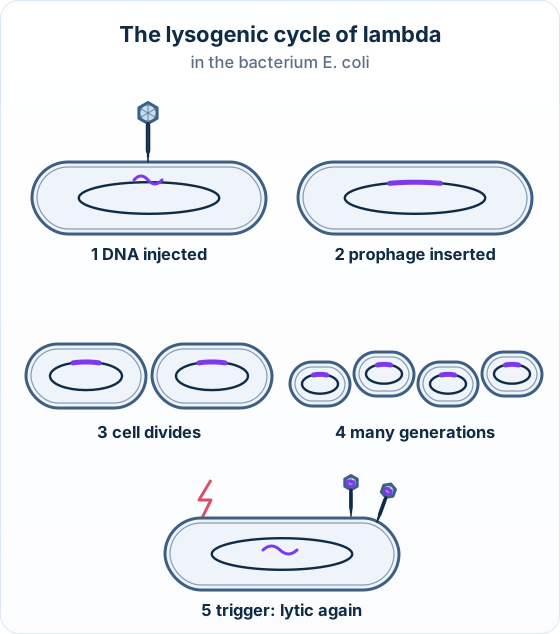
The big idea: In the lysogenic cycle lambda does not destroy its host straight away. Its DNA becomes part of the host chromosome and is passed on every time the cell divides.
The points to remember
- Lambda attaches to E. coli and injects its DNA, just as in the lytic cycle.
- The lambda DNA is inserted into the bacterial chromosome: it is now a prophage.
- Each time the bacterium divides, the prophage is copied with the chromosome, so both daughter cells carry it.
- The prophage stays dormant: no new phages are made and the host is not destroyed.
- A trigger, such as UV light or other damage to the cell, makes the prophage leave the chromosome.
- The phage then enters the lytic cycle: new phages are assembled and the cell bursts.
Remember it as: Lysogenic: hide in the chromosome. Lytic: build and burst.
| Lytic cycle | Lysogenic cycle | |
|---|---|---|
| Attaches and injects DNA | yes | yes |
| Host copies the viral DNA | yes, separately from the host DNA | yes, as part of the host chromosome |
| Viral DNA inserted into host DNA | no | yes: a prophage |
| New phages assembled | straight away | only later, after a trigger |
| Host cell | bursts (lysis) and dies | survives and divides |
Real example: cholera toxin: The gene for cholera toxin is carried by a phage, CTX, that is inserted as a prophage in the chromosome of Vibrio cholerae. Only strains carrying this prophage cause cholera.
Use the exact words when you compare the two cycles:
Say DNA, and say where it goes: Write 'lambda DNA is inserted into the host DNA', not 'genetic material' or 'genome', and not 'the virus is inserted into the cell'. Only the lytic cycle ends with the cell bursting.
How this is tested: A favourite HL task is to compare the lytic and lysogenic cycles of a phage, or to explain how a temperate phage can spread through a bacterial population without making new virus. Score the key contrasts below.
Lytic
- Makes virus now
- Kills the host
Lysogenic
- Integrates as a prophage
- Is copied passively at each host division (so it reaches all daughter cells)
- Does no immediate harm
- Only turns lytic on induction (stress / UV / DNA damage)
Exam-style question — lytic vs lysogenic
A temperate bacteriophage can follow either the lytic or the lysogenic cycle. Compare and contrast these two cycles. [5]
How to score all five marks
- Both start the same. In both cycles the phage attaches to the host and injects its DNA (shared point).
- Lytic — virus now. In the lytic cycle the phage DNA immediately directs the host to make new phages, which are released.
- Lytic — host dies. The host cell is lysed (killed) to release the new virions.
- Lysogenic — integrate as prophage. In the lysogenic cycle the phage DNA integrates into the host chromosome as a prophage instead, making no new virus and doing no immediate harm.
- Lysogenic — passive copying + switch. The prophage is replicated passively each time the host divides (passed to all daughter cells); induction (stress / UV / DNA damage) can later switch it to the lytic cycle. (Award 1 per distinct comparison/contrast, max 5.)
Final answer
Both begin with attachment and injection of phage DNA. Lytic: the DNA at once makes new phages and the host is lysed (killed). Lysogenic: the DNA integrates as a prophage, makes no new virus and does no immediate harm; it is copied passively with the host chromosome into all daughter cells, and only switches to lysis on induction (stress / UV / DNA damage).
Why this scores full marks: It gives a shared point (attachment + injection), the lytic outcome (virus now, host lysed) and the lysogenic outcome (prophage, passive copying, no immediate harm, induction → lysis).
A common way to lose marks is to describe only one cycle — a 'compare and contrast' answer must put the two side by side, ideally with the prophage and induction terms.
| Lytic cycle | Lysogenic cycle | |
|---|---|---|
| What happens to the phage DNA | It immediately takes over the host's machinery to make new phages | It INTEGRATES into the host chromosome as a PROPHAGE |
| New virus made now? | Yes — many new virions are assembled straight away | No — no new virus particles are made while it is a prophage |
| What happens to the host cell | It is killed (lysed) — it bursts to release the new phages | It survives and keeps living and dividing normally |
| How the phage DNA is copied | Copied many times to build new phages, then the cell dies | Copied PASSIVELY with the host chromosome each time the cell divides |
| Where the copies end up | Released as free phage particles | Inherited by ALL daughter cells (vertical transmission) |
| Speed / timing | Fast — virus produced almost immediately | Latent — can stay dormant for many cell generations |
| Can it switch? | Already lytic — ends in lysis | Yes — INDUCTION (stress, UV, DNA damage) flips it to the lytic cycle |
Bacteriophage lambda can follow two routes after it infects E. coli. Compare and contrast the lytic and lysogenic cycles of lambda.
Model answer plan
See the answer broken into clear points, with guidance on how each point earns marks.