The big idea: Viruses differ hugely in shape and structure. Three examples show the range: bacteriophage lambda, coronaviruses and HIV.
The points to remember
- Shape and size vary: lambda has a head and a tail; coronaviruses and HIV are roughly spherical.
- The genetic material is DNA or RNA: DNA in lambda, RNA in coronaviruses and HIV.
- It is single- or double-stranded: lambda's DNA is double-stranded; coronavirus and HIV RNA is single-stranded.
- Some viruses are enveloped in membrane taken from the host cell (coronaviruses, HIV); others are not (lambda).
- Some carry an enzyme: HIV carries reverse transcriptase; most viruses carry none.
- The number of nucleic acid molecules varies: HIV has two copies of its RNA; a coronavirus has one long strand.
Remember it as: Lambda: naked DNA on a tail. Coronavirus and HIV: RNA wrapped in a host membrane.
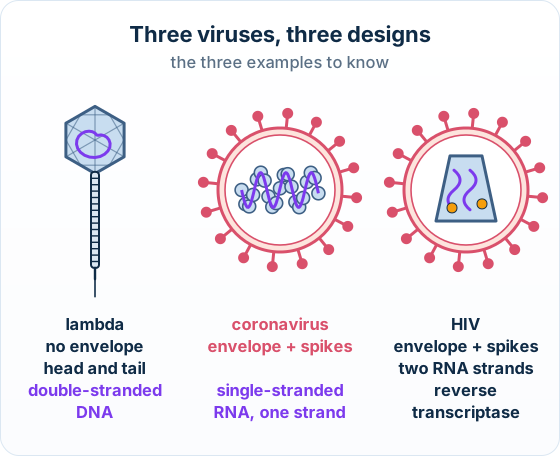
| Virus | Shape | Envelope | Nucleic acid | Extra |
|---|---|---|---|---|
| Bacteriophage lambda | head and tail | none | double-stranded DNA, linear | infects E. coli |
| Coronavirus | spherical, spikes | yes, from the host | single-stranded RNA, one molecule | very long RNA |
| HIV | spherical, cone-shaped capsid | yes, from the host | single-stranded RNA, two copies | reverse transcriptase |
Real example: SARS-CoV-2: The coronavirus that caused COVID-19 carries one strand of RNA about 30,000 bases long, one of the longest RNA genomes of any virus. Its envelope comes from the membrane of the cell it left.
Be exact about where an envelope comes from:
No plasma membrane of its own: An envelope is a piece of the host cell's plasma membrane, taken as the virus leaves. Never write that a virus has its own plasma membrane.
Free preview
This is the free notes preview
You're reading the free notes. Aimnova Pro unlocks the full study experience — and you can try it with your first topic free to keep:
- FlashcardsLock in vocabulary and key terms with spaced repetition.
- Practice questionsAnswer exam-style questions and get instant AI marking.
- Mock exams & past-paper vaultSit full mocks and see exactly how examiners award marks.
- Personalised study planA daily plan built around your exam date and weak areas.
The big idea: Most viruses you have met store their genes as DNA, or use their RNA fairly directly. A retrovirus does something stranger.
What a retrovirus is
- A retrovirus is an enveloped RNA virus that carries its own enzyme: reverse transcriptase.
- This enzyme lets the virus run the central rule of biology backwards — it builds DNA from an RNA template (RNA → DNA).
- That is the reverse of normal transcription, which is why it is called a retrovirus.
The famous example: The most famous example is HIV, the virus that causes AIDS.
A retrovirus such as HIV is an ENVELOPED virus: a protein capsid holds its RNA genome (plus reverse transcriptase) inside a lipid envelope studded with glycoprotein spikes that lock onto the host cell. (Compare the enveloped virus on the right.)
Interactive diagram
Explore the labelled diagram, charts and maps for this topic in full study mode.
- Retrovirus
- An enveloped virus whose genetic material is RNA and which carries the enzyme reverse transcriptase.
- Reverse transcriptase
- An enzyme that makes a DNA copy from an RNA template — the reverse of normal transcription.
- HIV
- Human Immunodeficiency Virus — a retrovirus that infects and destroys helper T-lymphocytes (CD4 cells).
- AIDS
- Acquired Immune Deficiency Syndrome — the condition that develops when HIV has destroyed enough helper T-cells that the immune system can no longer protect the body.
- Provirus
- The viral DNA once it has been inserted into the host cell's own DNA.
Why 'reverse'?: Normal transcription: DNA → RNA.
Reverse transcription: RNA → DNA.
The prefix retro- means 'backwards' — the virus copies information in the opposite direction to the usual flow.
See how examiners mark answers
Answer exam-style questions with model answers. Learn exactly what earns marks and what doesn't.
Read the next steps as a chain of cause and effect. Each step only happens because the one before it did.
The key trick is that the virus does not stay separate — it gets its genes written into the host's own DNA, so the cell unknowingly makes virus for it.
How a retrovirus takes over a cell
- HIV's surface spikes bind to CD4 on a helper T-lymphocyte, and the virus enters, releasing its RNA and reverse transcriptase.
- Reverse transcriptase copies the viral RNA into DNA (RNA → DNA) — the reverse of normal transcription.
- This viral DNA is inserted into the host cell's own DNA. It is now a provirus.
- The host cell's own machinery transcribes the provirus, making new viral RNA and proteins.
- These assemble into new virus particles, which are released (often destroying the T-cell) and go on to infect more helper T-lymphocytes.
| Step | What happens |
|---|---|
| 1. Attach & enter | Spikes on HIV's envelope bind to CD4 on a helper T-lymphocyte; the virus enters and releases its RNA and reverse transcriptase. |
| 2. Reverse transcribe | Reverse transcriptase copies the viral RNA into a DNA version (RNA → DNA). |
| 3. Integrate | This viral DNA is inserted into the host cell's own DNA — now called a PROVIRUS. |
| 4. Transcribe & build | The host machinery transcribes the provirus to make new viral RNA and proteins, which assemble into new viruses. |
| 5. Release & spread | New virus particles leave (often destroying the T-cell) and infect more helper T-lymphocytes. |
The reversal is the whole point: Your cells run information one way: DNA → RNA → protein.
Reverse transcriptase lets the virus run the first step backwards: RNA → DNA. Only by making a DNA copy can the virus slip into the host genome as a provirus — and once it is there, the cell treats those viral genes as its own.
| Normal transcription (in your cells) | Reverse transcription (retrovirus) | |
|---|---|---|
| Enzyme | RNA polymerase | Reverse transcriptase (carried inside the virus) |
| Template (read from) | DNA | Viral RNA |
| Product (made) | RNA (mRNA) | DNA |
| Direction of information | DNA → RNA | RNA → DNA (the REVERSE — hence 'retro') |
| Where it happens | Always, in every living cell | Only after a retrovirus infects a cell |
Why HIV is so damaging: HIV targets helper T-lymphocytes (CD4 cells) — the cells that coordinate the whole immune response.
Over years, HIV gradually destroys these cells. With too few of them, the immune system can no longer fight off infections — this immune deficiency is AIDS. People then become ill from infections a healthy immune system would normally control.
HIV is an enveloped RNA virus — the spikes on the envelope bind to CD4 on helper T-lymphocytes, the doorway it uses to get in.
Interactive diagram
Explore the labelled diagram, charts and maps for this topic in full study mode.
HIV questions: A question on HIV as a retrovirus has its marks in three places.
Where the marks sit
- The role of reverse transcriptase (RNA → DNA, the reverse of transcription)
- The integration step (viral DNA joins the host genome as a provirus, then is transcribed to make new virus)
- The consequence of no proofreading (high mutation rate → drug resistance / immune escape / hard to vaccinate)
A classic full-mark answer: It names HIV, says it infects helper T-lymphocytes (CD4 cells), and links their destruction to AIDS.
Exam-style question — the role of reverse transcriptase
HIV is a retrovirus. Explain the role of reverse transcriptase in the replication of HIV, and explain one consequence of the enzyme lacking a proofreading function. [5]
How to score all five marks
- The enzyme's job. Reverse transcriptase makes a DNA copy from the viral RNA (RNA → DNA) — this is the reverse of normal transcription.
- Why a DNA copy is needed. Only as DNA can the viral genes be inserted into the host cell's own DNA, forming a provirus.
- Making new virus. The host cell then transcribes the provirus, producing new viral RNA and proteins that assemble into new HIV particles.
- No proofreading → high mutation rate. Because the enzyme does not correct its copying errors, HIV gains a very high mutation rate and evolves rapidly.
- One consequence (pick one). This rapid change leads to resistance to a single drug (so combination antiretrovirals are used) OR immune escape, which is why an effective vaccine has been so hard to make. (Award 1 mark per distinct point, up to 5.)
Final answer
Reverse transcriptase copies HIV's RNA into DNA (RNA → DNA, the reverse of transcription); this DNA integrates into the host genome as a provirus that is transcribed to make new virus. Because the enzyme lacks proofreading, HIV mutates very fast, leading to drug resistance and immune escape (so it is hard to vaccinate against).
Why this scores full marks: It pins down the direction (RNA → DNA = reverse of transcription), the integration step (provirus → transcribed to make new virus), and ties the missing proofreading to a real consequence (resistance or immune escape).
A common way to lose marks: Writing 'it copies the RNA' without saying into DNA, or forgetting that the DNA must join the host genome.
| Feature | Retrovirus (e.g. HIV) | A typical DNA virus |
|---|---|---|
| Genetic material | RNA | DNA |
| Special enzyme carried | Reverse transcriptase | None of this kind needed |
| First step inside the cell | Copy its RNA into DNA | Use its DNA directly |
| Joins the host's own DNA? | Yes — inserts as a provirus | Usually no |
| Mutation / change | Very fast (no proofreading) | Slower (DNA copying is checked) |
Describe, using named examples, how viruses differ in their structure.
Model answer plan
See the answer broken into clear points, with guidance on how each point earns marks.