The big idea: A virus is not a living cell — it is a tiny non-cellular (acellular) infectious particle.
No cell machinery
- It has no cytoplasm, no organelles, no ribosomes and no metabolism of its own.
- Outside a host it just sits there, completely inert.
Only two parts: At its simplest a virus is only two things: a piece of genetic material (the genome) wrapped in a protein coat (the capsid).
Two contrasting viruses: a bacteriophage (polyhedral protein capsid 'head' + tail) and an enveloped virus (capsid wrapped in a lipid envelope studded with glycoprotein spikes). Both are just a nucleic acid core inside a protein coat — non-cellular.
Interactive diagram
Explore the labelled diagram, charts and maps for this topic in full study mode.
- Virus
- A non-cellular infectious particle: a nucleic acid genome enclosed in a protein capsid (sometimes with a lipid envelope). It can only replicate inside a host cell.
- Non-cellular (acellular)
- Not made of cells; lacking cytoplasm, organelles, ribosomes and metabolism.
- Genome
- A virus's genetic material — either DNA or RNA, single- or double-stranded — carrying the genes to make new virus particles.
- Capsid
- The protein coat surrounding the genome, built from many repeating protein sub-units called capsomeres.
Why we don't simply call viruses 'alive': Living things respire, grow and reproduce by themselves. A virus does none of these on its own — it has no machinery to do so.
It only ever copies itself by hijacking a host cell's ribosomes and enzymes. So a virus sits on the border between living and non-living.
Free preview
This is the free notes preview
You're reading the free notes. Aimnova Pro unlocks the full study experience — and you can try it with your first topic free to keep:
- FlashcardsLock in vocabulary and key terms with spaced repetition.
- Practice questionsAnswer exam-style questions and get instant AI marking.
- Mock exams & past-paper vaultSit full mocks and see exactly how examiners award marks.
- Personalised study planA daily plan built around your exam date and weak areas.
Read each part as structure → function: every feature of a virus exists to get its genome into a host cell and protect it on the way.
Start with the two parts every virus has, then the extras some viruses add.
| Part | What it is | What it does |
|---|---|---|
| Genome (nucleic acid core) | DNA or RNA — single- or double-stranded | Carries the genes that instruct the host cell to build new virus particles |
| Capsid | A protein coat built from repeating sub-units called capsomeres | Protects the genome and helps the virus attach to and enter a host cell |
| Envelope (only in some viruses) | A lipid membrane stolen from the host cell as the virus leaves | Surrounds the capsid; helps the virus fuse with and hide from the next host |
| Glycoprotein spikes (envelope only) | Protein 'keys' sticking out of the envelope | Bind to specific receptors on the host cell so the virus can attach and enter |
Capsid → entry; envelope + spikes → targeting: The capsid does two jobs: it shields the fragile genome and gives the virus a shape that can dock onto a host cell.
Envelope and spikes
- Some viruses (e.g. influenza, HIV, coronaviruses) also wrap themselves in a lipid envelope taken from the host's own membrane as they bud out.
- Sticking out of that envelope are glycoprotein spikes.
- A spike works like a key that fits a specific lock — it binds a particular receptor on the host cell.
- This is why a given virus can usually only infect certain cells or species.
Despite very different shapes, sizes and genomes, both share the same minimal plan — genome + capsid (± envelope).
Interactive diagram
Explore the labelled diagram, charts and maps for this topic in full study mode.
Three ways viruses differ enormously
- Size — from tiny ones around 20 nm across up to giant viruses bigger than some bacteria.
- Capsid shape — helical (a spiral rod), polyhedral / icosahedral (a many-sided 'ball'), or complex (like a bacteriophage with a polyhedral head and a tail).
- Genome type — DNA or RNA, and single-stranded (ss) or double-stranded (ds). This single feature is the main reason viruses are sorted into so many different groups.
A worked structure → function example: Take an enveloped influenza virus. Its RNA genome holds the genes. The capsid protects that RNA. The lipid envelope (host-derived) hides it from the immune system, and the glycoprotein spikes lock onto receptors on cells lining your airway — so the virus attaches there and not, say, in your liver.
When the spikes change: Change the spikes (as flu does each year) and the key changes shape — which is why last year's immunity may no longer fit.
One rule that applies to ALL viruses: However big, however shaped, whatever genome — every virus is an obligate intracellular parasite.
It cannot replicate on its own. It must get inside a living host cell and use the host's ribosomes, enzymes and raw materials to build copies of itself. 'Obligate' means it has no choice — there is no free-living option.
Stop wasting time on topics you know
Our AI identifies your weak areas and focuses your study time where it matters. No more overstudying easy topics.
The big idea: Viruses are very varied, but they share only a few features. Learn the five on this list: every one can earn a mark.
The points to remember
- Small, fixed size: most viruses are 20 to 300 nm across, and every particle of one virus is the same size.
- Nucleic acid as genetic material: DNA or RNA, never both. Not every virus has DNA.
- A capsid made of protein encloses the nucleic acid.
- No cytoplasm: there is nothing inside but the nucleic acid (and in some, a few proteins).
- Few or no enzymes: a virus cannot make ATP or proteins, so it must use a host cell's.
Remember it as: Small, a nucleic acid, a protein coat, and nothing else.
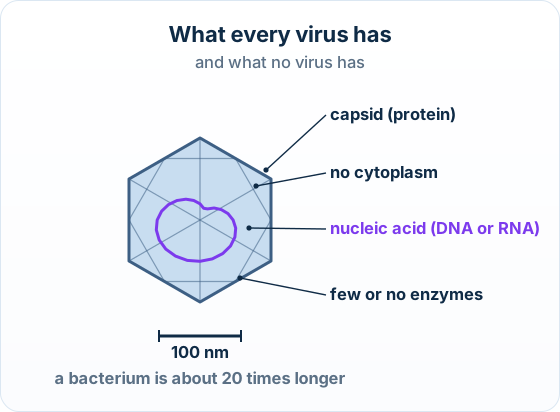
Real example: norovirus: Norovirus, which causes stomach upsets, is about 30 nm across: a protein capsid around one strand of RNA. It has no cytoplasm and carries no enzymes of its own.
Name the feature exactly when you write it down:
Say which molecule: 'Genetic material' alone does not earn the mark: write 'nucleic acid', 'DNA or RNA'. And never write that all viruses contain DNA: many contain RNA instead.
How this is tested: HL questions on viruses usually ask you to do one of three things.
The usual tasks
- Describe the basic structure of a virus
- Compare a virus with a cell
- Outline the diversity of viruses (shape and genome type)
A common reasoning twist: Explain why a particular structure (e.g. spikes) matters, or why viruses are not classed as fully living. Always anchor your answer to the same parts: genome + capsid (± envelope + spikes) and the phrase obligate intracellular parasite.
Exam-style question — structure and diversity of viruses
Outline the basic structure of a virus, and explain two ways in which viruses show diversity. [4]
How to score all four marks
- State the universal plan. Every virus has a genome — a nucleic acid (DNA or RNA) — enclosed in a protein capsid made of capsomere sub-units. (Mark 1)
- Add the optional parts. Some viruses also have a lipid envelope (from the host membrane) carrying glycoprotein spikes used to attach to host cells. (Mark 2)
- Diversity 1 — capsid shape. Capsids vary: helical, polyhedral/icosahedral, or complex (e.g. a bacteriophage with head + tail). (Mark 3)
- Diversity 2 — genome type. The genome can be DNA or RNA and single- or double-stranded — the main basis for grouping viruses. (Mark 4)
Final answer
A virus is a nucleic acid genome (DNA or RNA) inside a protein capsid, sometimes with a lipid envelope and glycoprotein spikes. Viruses differ in capsid shape (helical / icosahedral / complex) and in genome type (DNA vs RNA, single- vs double-stranded).
Why this scores full marks: It names the two universal parts (genome + capsid), adds the optional envelope/spikes, and gives two genuinely different axes of diversity — shape and genome — rather than two examples of the same thing.
A frequent way to lose a mark: Calling a virus a 'cell', or saying its genome is 'DNA' only — remember a viral genome can be DNA or RNA.
| Feature | A living cell | A virus |
|---|---|---|
| Cytoplasm / organelles | Yes | No |
| Ribosomes | Yes — makes its own proteins | No — must borrow the host's |
| Own metabolism (respiration etc.) | Yes | No |
| Can reproduce on its own | Yes | No — only inside a host cell |
| Genetic material | Always DNA | DNA OR RNA |
Measles virus multiplies inside cells of the human airway. Describe one reason that viruses such as measles are not considered to be living.
Model answer plan
See the answer broken into clear points, with guidance on how each point earns marks.