aımnova
DashboardMy LearningCrash CoursesStudy Plan

Aimnova site navigation

Stay in the loop

Get the latest study resources and updates

New features, study tips and exam insights — straight to your inbox.

IB Diploma

  • IB Past Papers
  • IB Study Notes
  • IB Question Bank
  • IB Mock Exams
  • IB Revision

IB Subjects

  • IB Math AA
  • IB Math AI
  • IB Economics
  • IB Business Management
  • IB Physics
  • IB Biology
  • View all IB subjects→

IB Past Papers

  • IB Math AA HL Past Papers
  • IB Math AA SL Past Papers
  • IB Math AI HL Past Papers
  • IB Math AI SL Past Papers
  • IB Economics HL Past Papers
  • IB Economics SL Past Papers
  • IB ESS Past Papers
  • View all past papers→

Study Resources

  • Study Notes
  • Question Bank
  • Mock Exams
  • Crash Courses
  • Flashcards
  • Revision Guide
  • Exam Skills
  • Command Terms
  • Grade Calculator
  • Exam Timetable 2026

Aimnova

  • Features
  • Pricing
  • For Teachers
  • For Schools
  • For Parents
  • About Us
  • Blog
  • Contact
aımnova

IB study, practice and feedback built around the real exam.

TermsPrivacyCookies·© 2026 Aimnova. All rights reserved.c90f7ab

Aimnova is not affiliated with or endorsed by the International Baccalaureate Organization (IB).

NotesBiology HLTopic 1.4Evolution of multicellularity
Back to Biology HL Topics
1.4.143 min read

Evolution of multicellularity (Biology HL)

IB Biology · Unit 1

AI-powered feedback

Stop guessing — know where you lost marks

Get instant, examiner-style feedback on every answer. See exactly how to improve and what the markscheme expects.

Try It Free

Contents

  1. 1Multicellularity evolved many times
  2. 2Why be multicellular
  3. 3Exam-style question (step by step)
The big idea: Being made of many cells is not a one-off invention. It evolved again and again, in separate groups.

The points to remember

  • Multicellularity has evolved repeatedly: separately in different groups of eukaryotes.
  • All plants and all animals are multicellular.
  • Many fungi (mushrooms, moulds) and many eukaryotic algae (seaweeds) are too; yeasts are single cells.
  • Each group started from single-celled ancestors.
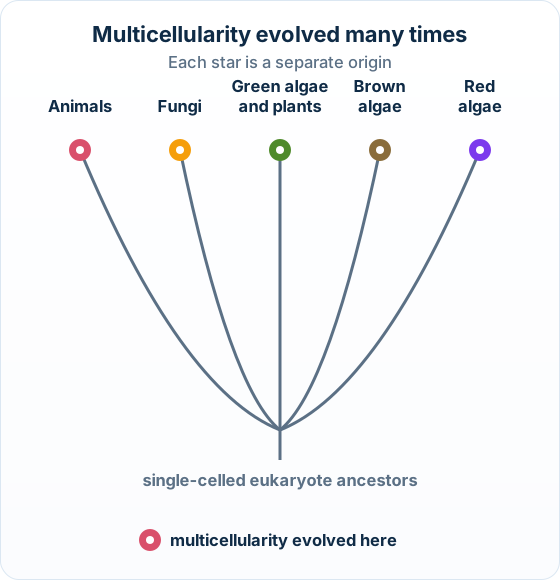
A tree from single-celled eukaryote ancestors to animals, fungi, green algae and plants, brown algae and red algae, with a separate origin of multicellularity marked on each branch
Each star is a separate origin of multicellularity.
Remember it as: Not once, but many times.

It has even been watched happening:

Real example: snowflake yeast: In 2012 scientists grew single-celled yeast and kept only the cells that sank fastest. Within weeks, the yeast formed clusters of cells that stayed stuck together: 'snowflake yeast'.

Free preview

This is the free notes preview

You're reading the free notes. Aimnova Pro unlocks the full study experience — and you can try it with your first topic free to keep:

  • FlashcardsLock in vocabulary and key terms with spaced repetition.
  • Practice questionsAnswer exam-style questions and get instant AI marking.
  • Mock exams & past-paper vaultSit full mocks and see exactly how examiners award marks.
  • Personalised study planA daily plan built around your exam date and weak areas.
Start Studying Free Full access to Aimnova Pro · cancel anytime
The big idea: Many cells working together can build a bigger body, and the cells can share out the jobs.

The points to remember

  • Larger body size: a body of many cells can grow far bigger than one cell can.
  • Cell specialization: different cells take on different jobs, such as support, feeding or reproduction.
  • Specialized cells do their one job more efficiently than one cell doing everything.

Single-celled alga

  • One cell does every job
  • Microscopic in size

Multicellular seaweed

  • Some cells anchor it, others photosynthesize
  • Can grow to many metres long
Real example: Volvox: Volvox is a green alga made of hundreds of cells in a hollow ball. Most cells swim and photosynthesize; a few specialized cells inside make new colonies.

Watch the wording:

Not mutualism: Cells of one multicellular organism are one species working together. Mutualism is between two different species.

Practice with exam-style questions

Answer exam-style questions and get AI feedback that shows you exactly what examiners want to see in a full-marks response.

Try Practice FreeYour first topic is free to keep • No credit card required
How it is tested: Paper 1A shows a single-celled organism and the group it forms, and asks which statements about multicellularity are correct.
IB-style questionOutline[2 marks]

Giant kelp is a multicellular brown alga that grows over 30 metres long. Outline two advantages of multicellularity that kelp shows.

Model answer plan

See the answer broken into clear points, with guidance on how each point earns marks.

Claim your free topic
The two advantages: The two advantages to name are a larger body size and cell specialization.

Try an IB Exam Question — Free AI Feedback

Test yourself on Evolution of multicellularity. Write your answer and get instant AI feedback — just like a real IB examiner.

Giant kelp is a multicellular brown alga, while diatoms are single-celled algae.

two advantages of multicellularity shown by kelp.
[2 marks]

Related Biology HL Topics

Continue learning with these related topics from the same unit:

1.1.1Water as the medium for life1.1.2Hydrogen bonds from the polar covalent bonds in water1.1.3Cohesion of water and its consequences for organisms1.1.4Adhesion of water to polar or charged materials
View all Biology HL topics
Improve your exam techniqueCommand terms, paper structure, and mark-scheme tips for Biology HL
Previous1.4.13Cell differentiation as the process for developing specialized tissuesNextStructural features common to viruses1.5.1

4 exam-style questions ready for you

Students who practice on Aimnova improve their scores by 15% on average. Get instant feedback that shows exactly how to improve your answers.

Practice Now — FreeView All Biology HL Topics