aımnova
DashboardMy LearningCrash CoursesStudy Plan

Aimnova site navigation

Stay in the loop

Get the latest study resources and updates

New features, study tips and exam insights — straight to your inbox.

IB Diploma

  • IB Past Papers
  • IB Study Notes
  • IB Question Bank
  • IB Mock Exams
  • IB Revision

IB Subjects

  • IB Math AA
  • IB Math AI
  • IB Economics
  • IB Business Management
  • IB Physics
  • IB Biology
  • View all IB subjects→

IB Past Papers

  • IB Math AA HL Past Papers
  • IB Math AA SL Past Papers
  • IB Math AI HL Past Papers
  • IB Math AI SL Past Papers
  • IB Economics HL Past Papers
  • IB Economics SL Past Papers
  • IB ESS Past Papers
  • View all past papers→

Study Resources

  • Study Notes
  • Question Bank
  • Mock Exams
  • Crash Courses
  • Flashcards
  • Revision Guide
  • Exam Skills
  • Command Terms
  • Grade Calculator
  • Exam Timetable 2026

Aimnova

  • Features
  • Pricing
  • For Teachers
  • For Schools
  • For Parents
  • About Us
  • Blog
  • Contact
aımnova

IB study, practice and feedback built around the real exam.

TermsPrivacyCookies·© 2026 Aimnova. All rights reserved.c90f7ab

Aimnova is not affiliated with or endorsed by the International Baccalaureate Organization (IB).

NotesBiology HLTopic 1.4Atypical cell structure in eukaryotes
Back to Biology HL Topics
1.4.94 min read

Atypical cell structure in eukaryotes (Biology HL)

IB Biology · Unit 1

Your first topic is free to keep

Know exactly what to write for full marks

Practice with exam questions and get AI feedback that shows you the perfect answer — what examiners want to see.

Start Free

Contents

  1. 1Atypical cells at Higher Level
  2. 2One nucleus is typical
  3. 3Why these cells are built this way
  4. 4Exam-style question (step by step)
Atypical cells at Higher Level: The same statement as SL. HL papers pair phloem sieve tubes with red blood cells: both have no nucleus. Know all four examples by their number of nuclei.

Practise this as you read

  • Identify what two atypical cells share.
  • Outline why each one is atypical.

Free preview

This is the free notes preview

You're reading the free notes. Aimnova Pro unlocks the full study experience — and you can try it with your first topic free to keep:

  • FlashcardsLock in vocabulary and key terms with spaced repetition.
  • Practice questionsAnswer exam-style questions and get instant AI marking.
  • Mock exams & past-paper vaultSit full mocks and see exactly how examiners award marks.
  • Personalised study planA daily plan built around your exam date and weak areas.
Start Studying Free Full access to Aimnova Pro · cancel anytime
The big idea: A typical eukaryotic cell has one nucleus. Atypical cells have none, or many.

The atypical cells

  • Red blood cells are anucleate — they lose their nucleus as they mature, leaving more room to carry oxygen.
  • Skeletal muscle fibres and fungal hyphae are multinucleate — one long cell contains many nuclei sharing the same cytoplasm.
  • Phloem sieve tube elements have no nucleus either; a companion cell beside each one keeps its nucleus.
Atypical cells — the exceptions: Most cells have one nucleus. A few do not, and the IB calls these atypical. The shared 'atypical' feature is simply that the number of nuclei is not one.
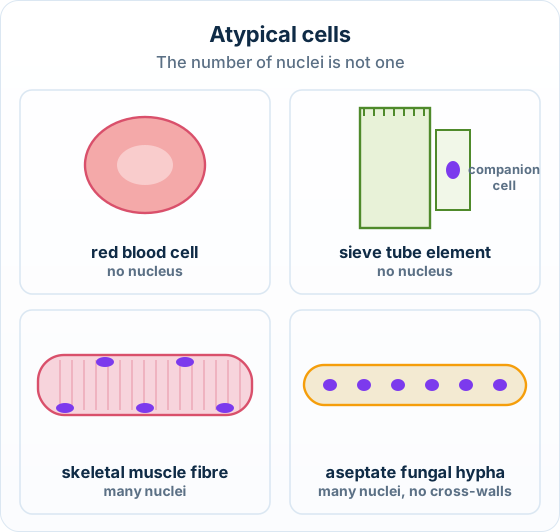
Four panels: a red blood cell with no nucleus, a sieve tube element with no nucleus beside a companion cell with one, a long muscle fibre with many nuclei, a hypha with many nuclei and no cross-walls
Count the nuclei: none, none, many, many.
Real examples: bread mould and a maple tree: Bread mould (Rhizopus) grows as hyphae with no cross-walls, so hundreds of nuclei share one tube of cytoplasm. In a sugar maple, sap flows through sieve tubes that have no nuclei.

Atypical cells are still eukaryotic: they have membrane-bound organelles, or come from cells that did.

Memorize terms 3x faster

Smart flashcards show you cards right before you forget them. Perfect for definitions and key concepts.

Try Flashcards FreeYour first topic is free to keep • No credit card required
The big idea: Each atypical cell's number of nuclei suits its job.

The points to remember

  • A red blood cell loses its nucleus, leaving more room for haemoglobin.
  • A sieve tube element has no nucleus, so it is an open tube for sap; its companion cell does the work.
  • A skeletal muscle fibre forms when many cells fuse, so it has many nuclei.
  • An aseptate hypha has no cross-walls, so many nuclei share one cytoplasm.
Remember it as: None for room or flow; many for length.
1

Red blood cell

No nucleus: more room for haemoglobin to carry oxygen.

2

Sieve tube element

No nucleus: an open tube, so sap flows easily; the companion cell keeps it alive.

3

Skeletal muscle fibre

Many nuclei: cells fuse into one long fibre that contracts as one.

4

Aseptate hypha

Many nuclei: no cross-walls, so nuclei and cytoplasm move freely along the hypha.

Atypical is not prokaryotic: A red blood cell has no nucleus, but it is not a prokaryote: it is a eukaryotic cell that lost its nucleus.
How it is tested: Paper 1A shows two kinds of cell and asks what makes them both atypical: count the nuclei. Paper 2 can ask what is unusual about a fungus: no cross-walls, many nuclei.
IB-style questionOutline[2 marks]

Skeletal muscle fibres and red blood cells are both described as atypical. Outline why each is atypical.

Model answer plan

See the answer broken into clear points, with guidance on how each point earns marks.

Claim your free topic
The shared feature: Two multinucleate cells share 'several nuclei'; two anucleate cells share 'no nucleus'. They still have cytoplasm and membranes.

Try an IB Exam Question — Free AI Feedback

Test yourself on Atypical cell structure in eukaryotes. Write your answer and get instant AI feedback — just like a real IB examiner.

A mature mammalian red blood cell loses a structure as it develops, which makes it an atypical cell.

which structure is lost and how this helps the cell.
[2 marks]

Related Biology HL Topics

Continue learning with these related topics from the same unit:

1.1.1Water as the medium for life1.1.2Hydrogen bonds from the polar covalent bonds in water1.1.3Cohesion of water and its consequences for organisms1.1.4Adhesion of water to polar or charged materials
View all Biology HL topics
Improve your exam techniqueCommand terms, paper structure, and mark-scheme tips for Biology HL
Previous1.4.8Differences in eukaryotic cell structure between animals, fungi and plantsNextCell types and cell structures viewed in light and electron micrographs1.4.10

11 exam-style questions ready for you

Students who practice on Aimnova improve their scores by 15% on average. Get instant feedback that shows exactly how to improve your answers.

Practice Now — FreeView All Biology HL Topics