Animal, fungal and plant cells at Higher Level: The same statement as SL. HL papers ask you to compare animal and fungal organelles, and plant and fungal cells, in paired statements, and to decide from a micrograph whether a cell is from a plant or an animal.
Practise this as you read
- Distinguish in pairs: both cells in each sentence.
- Identify the cell type with a reason you can see.
Free preview
This is the free notes preview
You're reading the free notes. Aimnova Pro unlocks the full study experience — and you can try it with your first topic free to keep:
- FlashcardsLock in vocabulary and key terms with spaced repetition.
- Practice questionsAnswer exam-style questions and get instant AI marking.
- Mock exams & past-paper vaultSit full mocks and see exactly how examiners award marks.
- Personalised study planA daily plan built around your exam date and weak areas.
The big idea: Animal, plant and fungal cells are all eukaryotic — they all have a nucleus and membrane-bound organelles. But they are not identical.
A few key structures tell them apart
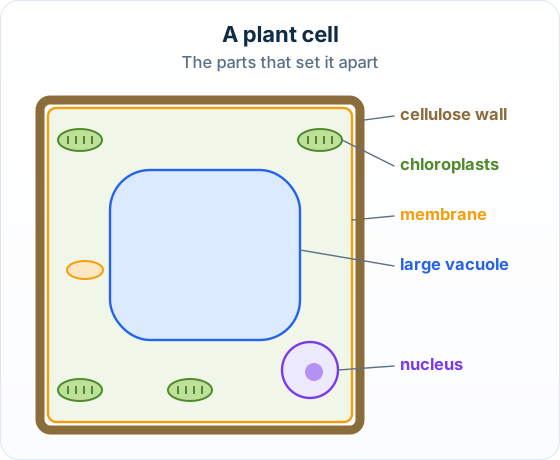
- Plant cells have a cellulose cell wall, a large central vacuole and chloroplasts.
- Fungal cells have a cell wall too, but it is made of chitin, and they have no chloroplasts.
- Animal cells have no cell wall at all — just a flexible cell membrane.
All three are eukaryotic, but you tell them apart by a few structures: the animal cell has no wall (irregular shape), the plant cell has a cellulose wall, a large central vacuole and chloroplasts, and the fungal cell has a chitin wall but no chloroplasts.
Interactive diagram
Explore the labelled diagram, charts and maps for this topic in full study mode.
| Feature | Animal cell | Plant cell | Fungal cell |
|---|---|---|---|
| Cell wall | none | yes — made of cellulose | yes — made of chitin |
| Outer boundary if no wall | cell membrane only | — | — |
| Large permanent vacuole | no | yes (one large central one) | vacuoles, often large |
| Chloroplasts | no | yes | no |
| Usual shape | rounded / irregular | fixed, regular (often box-like) | often long thread-like hyphae |
Eukaryotic vs the cell type: Do not mix up two different comparisons.
Prokaryote vs eukaryote = do you have a nucleus? (covered in the previous lesson)
Animal vs plant vs fungal = which type of eukaryotic cell is it? — that is what this section is about.
Learn what examiners really want
See exactly what to write to score full marks. Our AI shows you model answers and the key phrases examiners look for.
Start by defining the structures that do the telling-apart, because the exam questions turn on these exact words.
- Cell wall
- A rigid layer OUTSIDE the cell membrane that gives the cell a fixed shape and support. Plant and fungal cells have one; animal cells do not.
- Cellulose
- The carbohydrate that makes up the PLANT cell wall.
- Chitin
- The carbohydrate that makes up the FUNGAL cell wall (the same material as in insect exoskeletons).
- Vacuole
- A fluid-filled sac. Plant cells have one LARGE permanent central vacuole that keeps the cell firm; animal cells have only small temporary ones.
- Chloroplast
- The organelle where photosynthesis happens. Found ONLY in plant cells (and some protists) — never in animal or fungal cells.
Plant cell — built for support & photosynthesis
- Cellulose cell wall → fixed, regular shape
- Large central vacuole → keeps the cell firm
- Chloroplasts → can make its own food
Fungal cell — wall, but no photosynthesis
- Chitin cell wall (not cellulose)
- Vacuoles, which can be large, but no chloroplasts
- No chloroplasts → cannot photosynthesise
Animal cells are the odd one out: with no cell wall, only the flexible cell membrane holds them in. That is why an animal cell looks rounded or irregular, while a walled plant cell keeps a regular, fixed shape.
The big idea: Beyond the wall, four more structures tell the three kinds of cell apart: vacuoles, plastids, centrioles, and cilia or flagella.
The points to remember
- Vacuoles: a plant cell has one large permanent vacuole of sap that keeps it firm.
- Animal cells have only small, temporary vacuoles; fungal vacuoles can be large.
- Plastids are found only in plant cells: chloroplasts photosynthesize, and amyloplasts store starch.
- Centrioles are found in animal cells, not in plant cells (or most fungi).
- Cilia and flagella are found on many animal cells; flowering plants and most fungi have none.
- Store of carbohydrate: starch in plants, glycogen in animals and fungi.
Remember it as: Plants: wall, vacuole, plastids. Animals: centrioles, cilia, flagella.
| Structure | Animal cell | Plant cell | Fungal cell |
|---|---|---|---|
| Cell wall | none | cellulose | chitin |
| Vacuole | small, temporary | large, permanent | can be large |
| Plastids | none | chloroplasts, amyloplasts | none |
| Centrioles | present | absent | absent (most) |
| Cilia, flagella | on many cells | absent (flowering plants) | absent (most) |
| Carbohydrate store | glycogen | starch | glycogen |
Real example: a potato: Potato tuber cells are packed with amyloplasts, plastids full of starch grains. Iodine solution turns them blue-black.
When you distinguish, name the structure for both cells in the same sentence.
Wall material counts: A fungal wall is chitin, never cellulose; naming the wrong material, or adding a wrong extra, loses the mark.
Never wonder what to study next
Get a personalized daily plan based on your exam date, progress, and weak areas. We'll tell you exactly what to review each day.
How this is tested: Expect a quick identify question and a short Explain or State question.
Where it comes up
- Paper 1A: identify a structure found in animal cells.
- Paper 2 / Paper 3: explain why an animal cell looks irregular but a plant cell keeps a regular shape.
- Paper 2 / Paper 3: name the material of a fungal cell wall (chitin).
Exam-style question — irregular animal cell vs regular plant cell
Under the microscope, cheek (animal) cells look squashed and irregular, while leaf (plant) cells keep a neat, regular shape.
Explain this difference in terms of cell structure. [2]
How to score both marks
- Identify the structural difference. The plant cell has a rigid cell wall (made of cellulose) on the outside; the animal cell has only a flexible cell membrane and no cell wall.
- Link structure to shape. The cell wall holds the plant cell in a fixed, regular shape and resists being squashed; with no wall, the animal cell's membrane lets it be pushed out of shape, so it looks irregular.
- Answer the command term (Explain). Because the plant cell has a rigid cellulose cell wall and the animal cell does not, the plant cell keeps a regular shape while the animal cell is easily deformed into an irregular one.
Final answer
The plant cell has a rigid cellulose cell wall that holds it in a fixed regular shape; the animal cell has no cell wall — only a flexible membrane — so it is easily squashed into an irregular shape.
What earns the marks: Mark 1: name the structural difference (plant has a cell wall, animal does not).
Mark 2: link it to shape (rigid wall → fixed/regular shape; membrane only → deformable/irregular). Stating the difference without the consequence scores only one mark.
A student compares a cell from a spinach leaf with a cell from a human cheek. Distinguish between the structures of these two cells.
Model answer plan
See the answer broken into clear points, with guidance on how each point earns marks.