Processes of life in unicellular organisms at Higher Level: The same statement as SL: eight functions of life, all carried out by one cell. Match each structure or behaviour you see to the function it shows, and keep homeostasis and excretion apart.
Practise this as you read
- Identify functions of life from images.
- Explain why one cell must excrete.
Free preview
This is the free notes preview
You're reading the free notes. Aimnova Pro unlocks the full study experience — and you can try it with your first topic free to keep:
- FlashcardsLock in vocabulary and key terms with spaced repetition.
- Practice questionsAnswer exam-style questions and get instant AI marking.
- Mock exams & past-paper vaultSit full mocks and see exactly how examiners award marks.
- Personalised study planA daily plan built around your exam date and weak areas.
The big idea: A unicellular organism is made of just one cell — yet that single cell must carry out every function of life on its own.
What that means
- There is no division of labour into tissues or organs: the one cell feeds, moves, reacts, grows, removes waste and reproduces all by itself.
- Examples include Paramecium and Amoeba (animal-like protists), Chlamydomonas (a green alga) and bacteria.
The functions of life
- Nutrition — obtaining nutrients and energy
- Metabolism — the chemical reactions inside the cell
- Growth — getting larger / making more cell material
- Response — reacting to a stimulus in the surroundings
- Excretion — getting rid of the waste products of metabolism
- Homeostasis — keeping internal conditions stable
- Reproduction — producing offspring
- Movement — moving itself or its parts, such as by beating cilia
An easy way to remember: To recall the eight functions, group them by what the cell is doing. Any grouping works, as long as you can name all eight functions.
Three groups of functions
- Staying alive day to day: nutrition (feeding), metabolism (its reactions), excretion (removing waste) and homeostasis (staying balanced).
- Dealing with the outside world: response (reacting to its surroundings) and movement (swimming with cilia or a flagellum).
- Getting bigger and making more: growth and reproduction.
Practice with exam-style questions
Answer exam-style questions and get AI feedback that shows you exactly what examiners want to see in a full-marks response.
To answer exam questions you must be able to match a feature you can see in a single-celled organism to the function of life it demonstrates.
First, lock down what the key terms mean.
- Unicellular organism
- A living organism whose whole body is a single cell.
- Function of life
- A life process that every living organism must carry out to stay alive (e.g. nutrition, response, reproduction).
- Contractile vacuole
- A structure in many freshwater single-celled organisms that collects excess water and pumps it back out of the cell.
- Binary fission
- Reproduction in which one cell divides into two identical cells.
Now connect each function to a clue you might observe under a microscope or in a description. This table is the tool you use in the exam:
| Function of life | What it means | Clue in a single cell |
|---|---|---|
| Nutrition | Getting the nutrients/energy it needs | Engulfing food, a food vacuole, or chloroplasts to photosynthesise |
| Metabolism | Chemical reactions inside the cell | Enzymes working / energy being released or used |
| Growth | Getting larger or making more cell material | Cell increases in size over time |
| Response | Reacting to a stimulus | Moving toward food or away from light/touch |
| Excretion | Removing waste products of metabolism | Releasing CO₂ made by respiration |
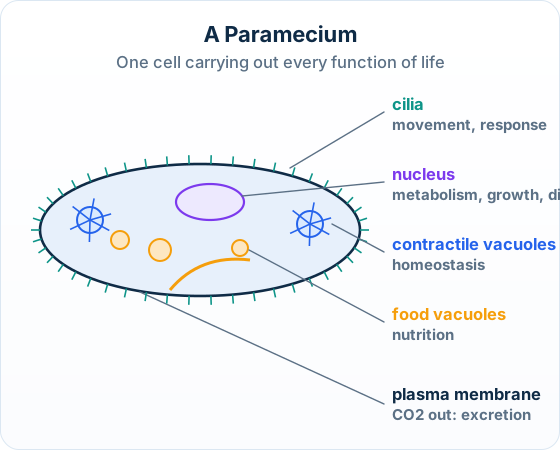
| Homeostasis | Keeping internal conditions stable | A contractile vacuole pumping out excess water |
| Reproduction | Producing offspring | Dividing into two cells (binary fission) |
| Movement | Moving itself or its parts | Beating cilia or a flagellum to swim |
A single-celled organism carrying out all functions of life.
Interactive diagram
Explore the labelled diagram, charts and maps for this topic in full study mode.
Homeostasis vs excretion — keep them separate: A contractile vacuole is the classic source of confusion.
Pumping out excess water keeps the cell's internal water balance stable, so this is homeostasis.
Excretion is removing the waste products of metabolism, such as CO₂ — water entering by osmosis is not a metabolic waste, so the contractile vacuole is best matched to homeostasis, not excretion.
How this is tested: Unicellular organisms are tested on Paper 1A (multiple choice) and in short Paper 2 questions.
Paper 1A
- You are often shown images or a description of a unicellular pond organism
- You are asked to identify which functions of life it is demonstrating
Paper 2
- A short question can ask you to describe how a single cell carries out a named function
- Or to state that one cell performs all the functions of life
The core skill: The skill is always the same: read off an observable clue and name the matching function.
Exam-style question — a Paramecium under the microscope
A student watches a single Paramecium (a unicellular pond organism). They observe it (i) sweeping food particles into a food vacuole, and (ii) steadily emptying a contractile vacuole. State the function of life shown by each observation. [2]
How to score both marks
- Read clue (i). Sweeping food into a food vacuole is taking in nutrients — this is nutrition.
- Read clue (ii). Emptying a contractile vacuole removes excess water and keeps the internal water balance stable — this is homeostasis (osmoregulation).
- Answer the command term. (i) Nutrition; (ii) Homeostasis. Two correct functions = 2 marks.
Final answer
(i) Nutrition (taking in food via the food vacuole); (ii) Homeostasis (the contractile vacuole pumps out excess water to keep internal conditions stable).
Why this scores: Each mark comes from matching one observed clue to one function. Naming excretion for the contractile vacuole would lose the mark — that water is not a metabolic waste, so it is homeostasis.
Chlamydomonas is a single-celled alga that carries out all the functions of life. Explain why this cell needs to carry out excretion.
Model answer plan
See the answer broken into clear points, with guidance on how each point earns marks.