Eukaryote cell structure at Higher Level: The same statement as SL. HL papers ask for membrane-bound organelles shared by plant and animal cells, and use the nucleus and its double membrane again when they ask about the origin of eukaryotic cells.
Practise this as you read
- State membrane-bound organelles.
- Identify a cell as eukaryotic from what you can see.
Free preview
This is the free notes preview
You're reading the free notes. Aimnova Pro unlocks the full study experience — and you can try it with your first topic free to keep:
- FlashcardsLock in vocabulary and key terms with spaced repetition.
- Practice questionsAnswer exam-style questions and get instant AI marking.
- Mock exams & past-paper vaultSit full mocks and see exactly how examiners award marks.
- Personalised study planA daily plan built around your exam date and weak areas.
The big idea: A eukaryotic cell is divided into compartments: membranes wall off spaces inside it, each with its own job.
The points to remember
- A plasma membrane encloses the cytoplasm, which is divided into compartments by membranes.
- Each membrane-bound organelle is a compartment with its own job: the nucleus, mitochondria, ER, Golgi apparatus, vesicles and vacuoles.
- The cytoplasm has 80S ribosomes, free or attached to the rough ER.
- A cytoskeleton of microtubules and microfilaments keeps the cell's shape and moves organelles around.
Remember it as: Eukaryote: a cell with rooms, each behind its own membrane.
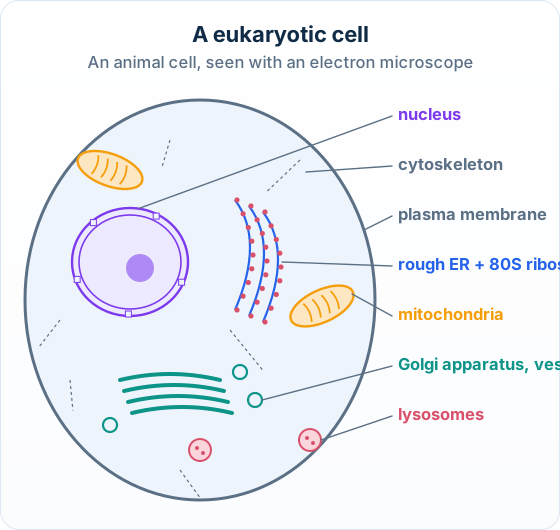
Real example: a yeast cell: Baker's yeast is a single-celled fungus, but its cell is eukaryotic: it has a nucleus, mitochondria, ER, a Golgi apparatus and a large vacuole.
Animal, plant and fungal cells, and single-celled protists, are all eukaryotic.
Get feedback like a real examiner
Submit your answers and get instant feedback — what you did well, what's missing, and exactly what to write to score full marks.
The big idea: The nucleus holds the chromosomes behind a double membrane with pores.
The points to remember
- The nucleus is surrounded by a double membrane, the nuclear envelope.
- The envelope has nuclear pores: gaps that let substances such as mRNA in and out.
- Inside are the chromosomes: long, linear DNA molecules bound to histone proteins.
- A dense nucleolus inside the nucleus is where ribosomes are made.
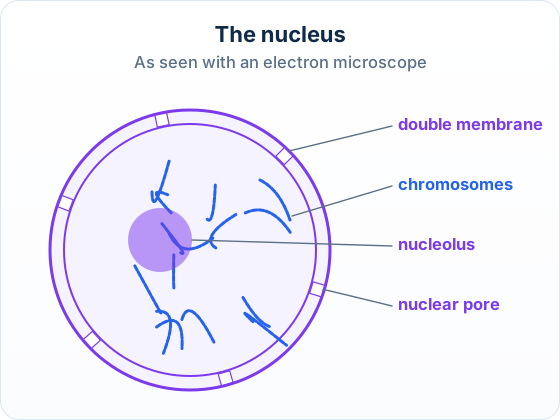
Chromosomes, not loose DNA: Eukaryotic DNA is linear and bound to histones. Naked, circular DNA is the prokaryote's.
The big idea: Outside the nucleus, the cytoplasm holds many membrane-bound organelles, each doing one job.
Mitochondria
Aerobic respiration: release energy as ATP.
Rough ER
Membranes with ribosomes: make proteins for export.
Smooth ER
Membranes without ribosomes: make lipids.
Golgi apparatus
Modify proteins and pack them into vesicles.
Vesicles
Small sacs that carry substances around the cell.
Lysosomes
Vesicles of digestive enzymes that break down worn-out parts.
Vacuoles
Larger sacs that store water and other substances.
Remember it as: Make it on the rough ER, pack it in the Golgi, ship it in a vesicle.
A pancreas cell that makes digestive enzymes is packed with rough ER and Golgi apparatus, because it exports so much protein.
Membrane-bound or not: Ribosomes and the cytoskeleton have no membrane of their own. The nucleus and mitochondria have two.
Learn what examiners really want
See exactly what to write to score full marks. Our AI shows you model answers and the key phrases examiners look for.
How it is tested: Paper 2 asks for membrane-bound organelles found in eukaryotic cells [2]; Paper 1B and Paper 2 ask whether a cell is eukaryotic, with a reason seen in the image [1].
Cells from a pea leaf and from a human pancreas are both eukaryotic. State two membrane-bound organelles found in both of these cells.
Model answer plan
See the answer broken into clear points, with guidance on how each point earns marks.
Eukaryotic, with a reason: Name a feature you can see: a nucleus, or membrane-bound organelles. A feature you cannot see in the image, such as 80S ribosomes, does not count.