aımnova
DashboardMy LearningCrash CoursesStudy Plan

Aimnova site navigation

Stay in the loop

Get the latest study resources and updates

New features, study tips and exam insights — straight to your inbox.

IB Diploma

  • IB Past Papers
  • IB Study Notes
  • IB Question Bank
  • IB Mock Exams
  • IB Revision

IB Subjects

  • IB Math AA
  • IB Math AI
  • IB Economics
  • IB Business Management
  • IB Physics
  • IB Biology
  • View all IB subjects→

IB Past Papers

  • IB Math AA HL Past Papers
  • IB Math AA SL Past Papers
  • IB Math AI HL Past Papers
  • IB Math AI SL Past Papers
  • IB Economics HL Past Papers
  • IB Economics SL Past Papers
  • IB ESS Past Papers
  • View all past papers→

Study Resources

  • Study Notes
  • Question Bank
  • Mock Exams
  • Crash Courses
  • Flashcards
  • Revision Guide
  • Exam Skills
  • Command Terms
  • Grade Calculator
  • Exam Timetable 2026

Aimnova

  • Features
  • Pricing
  • For Teachers
  • For Schools
  • For Parents
  • About Us
  • Blog
  • Contact
aımnova

IB study, practice and feedback built around the real exam.

TermsPrivacyCookies·© 2026 Aimnova. All rights reserved.c90f7ab

Aimnova is not affiliated with or endorsed by the International Baccalaureate Organization (IB).

NotesBiology HLTopic 1.4Cell differentiation as the process for developing specialized tissues
Back to Biology HL Topics
1.4.133 min read

Cell differentiation as the process for developing specialized tissues (Biology HL)

IB Biology · Unit 1

IB exam ready

Study like the top scorers do

Access a smart study planner, AI tutor, and exam vault — everything you need to hit your target grade.

Start Free

Contents

  1. 1Same genes, different cells
  2. 2Signals from the environment
  3. 3Exam-style question (step by step)
The big idea: Every cell in your body has the same genes. Cells differ because each one uses a different set of them.

The points to remember

  • Differentiation: an unspecialized cell becomes a specialized cell, with a structure suited to one job.
  • All the cells of an organism have the same genome: the same genes.
  • Each kind of cell expresses a different set of genes: some are switched on, others off.
  • Different genes expressed means different proteins made, so the cells develop differently.
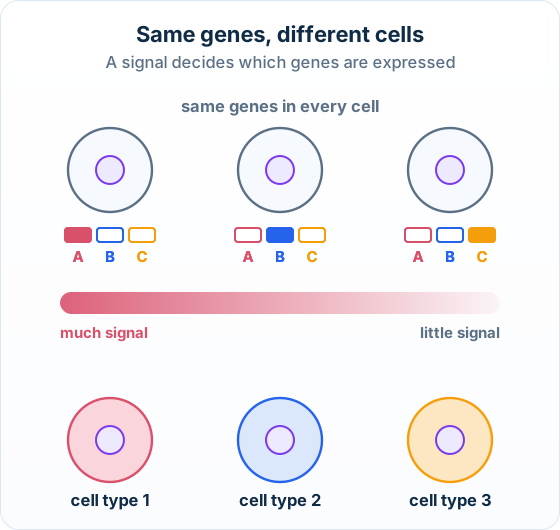
Three identical embryo cells with genes A, B and C; a signal gradient across them; a different gene switched on in each; three different specialized cells
Same genes, different genes switched on.
Remember it as: Same genes, different genes switched on.

You can see it in your own blood:

Real example: haemoglobin: Every cell in your body carries the genes for haemoglobin, but only the cells that become red blood cells switch them on. A skin cell has the genes and never uses them.

Free preview

This is the free notes preview

You're reading the free notes. Aimnova Pro unlocks the full study experience — and you can try it with your first topic free to keep:

  • FlashcardsLock in vocabulary and key terms with spaced repetition.
  • Practice questionsAnswer exam-style questions and get instant AI marking.
  • Mock exams & past-paper vaultSit full mocks and see exactly how examiners award marks.
  • Personalised study planA daily plan built around your exam date and weak areas.
Start Studying Free Full access to Aimnova Pro · cancel anytime
The big idea: Which genes a cell switches on is often triggered by a change in its environment.

The points to remember

  • A cell's environment includes signal chemicals from other cells, its position, and outside conditions.
  • In an embryo, a signal chemical spreads out to form a gradient: cells at different places get different amounts.
  • The amount of signal decides which genes are expressed, so cells in different places become different tissues.

The trigger

  • A signal chemical, or light, reaches the cell
  • The amount differs from place to place

The response

  • Some genes are switched on, others off
  • The cell makes new proteins and specializes
Real example: a seedling in the dark: A bean seedling grown in the dark stays pale. Once light reaches it, the leaf cells switch on the genes for chloroplasts and turn green: the environment triggered the change.

Keep the two ideas apart:

The genes do not change: Differentiation does not add or remove genes. The DNA stays the same; only which genes are used changes.

Never wonder what to study next

Get a personalized daily plan based on your exam date, progress, and weak areas. We'll tell you exactly what to review each day.

Try Free Study PlanYour first topic is free to keep • No credit card required
How it is tested: Paper 1A names a cause, such as gradients of signalling chemicals, and asks what results: differentiation.
IB-style questionOutline[2 marks]

Muscle cells and nerve cells develop from identical cells in a human embryo. Outline the basis of this cell differentiation.

Model answer plan

See the answer broken into clear points, with guidance on how each point earns marks.

Claim your free topic
Use the word: Write 'gene expression', not just 'genes': the genes are the same, their expression differs.

Try an IB Exam Question — Free AI Feedback

Test yourself on Cell differentiation as the process for developing specialized tissues. Write your answer and get instant AI feedback — just like a real IB examiner.

Muscle cells and nerve cells in a human embryo develop from identical unspecialized cells.

the basis of this cell differentiation.
[2 marks]

Related Biology HL Topics

Continue learning with these related topics from the same unit:

1.1.1Water as the medium for life1.1.2Hydrogen bonds from the polar covalent bonds in water1.1.3Cohesion of water and its consequences for organisms1.1.4Adhesion of water to polar or charged materials
View all Biology HL topics
Improve your exam techniqueCommand terms, paper structure, and mark-scheme tips for Biology HL
Previous1.4.12Origin of eukaryotic cells by endosymbiosisNextEvolution of multicellularity1.4.14

4 practice questions on Cell differentiation as the process for developing specialized tissues

Students who practiced this topic on Aimnova scored 82% on average. Try free practice questions and get instant AI feedback.

Try 3 Free QuestionsView All Biology HL Topics