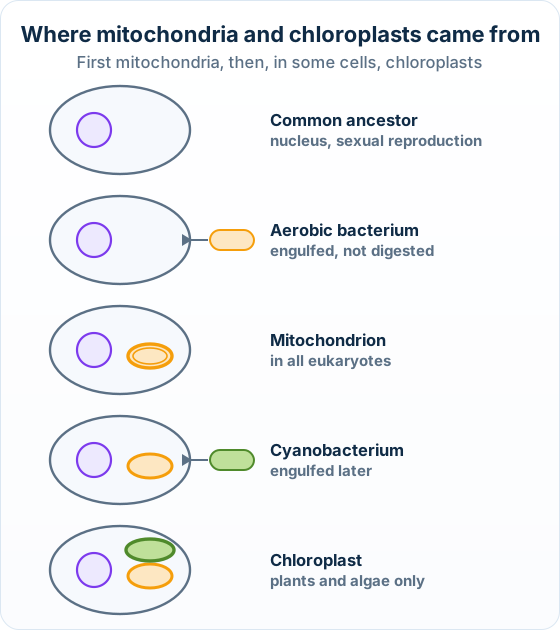
The big idea: All eukaryotes come from one ancestor with a nucleus. Mitochondria came from an engulfed bacterium; chloroplasts came later, in some eukaryotes only.
After LUCA, life branched into the prokaryotes (bacteria and archaea). The next great leap was the eukaryotic cell — and the standout feature of eukaryotes is their membrane-bound organelles, especially mitochondria (and, in plants and algae, chloroplasts).
Where did those organelles come from? The endosymbiotic theory answers this with a cause-and-effect chain.
Endosymbiosis — how a mitochondrion was born
- A larger host cell engulfed a smaller free-living aerobic bacterium by endocytosis — but did not digest it.
- The bacterium survived inside the host as an endosymbiont (one organism living inside another, to mutual benefit).
- The bacterium did aerobic respiration for the host (lots of ATP); the host gave it a safe home and nutrients.
- Over many generations the endosymbiont became permanent — it became the mitochondrion.
- The same story with a photosynthetic cyanobacterium gave rise to the chloroplast in plants and algae.
The endosymbiotic origin of mitochondria: a host cell engulfs a free-living aerobic bacterium by endocytosis; the bacterium survives inside as an endosymbiont and, over generations, becomes a mitochondrion.
Interactive diagram
Explore the labelled diagram, charts and maps for this topic in full study mode.
The points to remember
- All eukaryotes evolved from one common unicellular ancestor that had a nucleus and reproduced sexually.
- Mitochondria came first, by endosymbiosis, so they are found in almost every eukaryote.
- Chloroplasts came later, in some eukaryotes only: the ancestors of plants and algae.
Remember it as: Mitochondria in all, chloroplasts in some.
It is still happening:
Real example: Paulinella: The amoeba Paulinella took in a cyanobacterium only about 100 million years ago. The green body inside it still looks like that bacterium: a snapshot of how chloroplasts began.
Free preview
This is the free notes preview
You're reading the free notes. Aimnova Pro unlocks the full study experience — and you can try it with your first topic free to keep:
- FlashcardsLock in vocabulary and key terms with spaced repetition.
- Practice questionsAnswer exam-style questions and get instant AI marking.
- Mock exams & past-paper vaultSit full mocks and see exactly how examiners award marks.
- Personalised study planA daily plan built around your exam date and weak areas.
The big idea: Mitochondria and chloroplasts still carry the features of the bacteria they came from.
The points to remember
- 70S ribosomes, like bacteria; the rest of the eukaryotic cell has 80S.
- Naked, circular DNA of their own: no histones, like a bacterial chromosome.
- They replicate on their own, by binary fission, not when the cell divides.
- A double membrane: the bacterium's own, plus the host membrane from endocytosis.
The fingerprints that prove it: If mitochondria really were once free-living bacteria, they should still carry leftover bacterial features. They do — four of them.
Four bacterial fingerprints
Own circular DNA
Like a bacterial chromosome, unlike the host's linear DNA.
70S ribosomes
Prokaryote-type: the bacterial size, not the 80S ribosomes of the rest of the cell.
Double membrane
The inner one is the bacterium's original membrane; the outer one is the host membrane that wrapped around it.
Binary fission
They divide by splitting in two independently of the cell, exactly as bacteria reproduce.
Circular DNA, 70S, two membranes, fission
Why we still see the bacterial origin today: the engulfed bacterium kept its OWN circular DNA, its OWN 70S (prokaryote-type) ribosomes and a DOUBLE membrane, and it still divides by binary fission — the fingerprints of a former free-living cell.
Interactive diagram
Explore the labelled diagram, charts and maps for this topic in full study mode.
| Feature of mitochondria & chloroplasts | Why it is evidence for an engulfed bacterium |
|---|---|
| Their own small, CIRCULAR DNA | Bacteria have a single circular chromosome; eukaryotic nuclei have linear DNA. The organelle keeping circular DNA points to a bacterial origin. |
| 70S (prokaryote-type) ribosomes | These are the bacterial size of ribosome — the rest of the eukaryotic cell uses larger 80S ribosomes. The organelle still runs the bacterial machinery. |
| A DOUBLE membrane | The inner membrane is the bacterium's original membrane; the outer one came from the host's membrane wrapping around it as it was engulfed. |
| Divides by BINARY FISSION | The organelle splits in two independently of the host cell dividing — exactly how free-living bacteria reproduce. |
Say it exactly: Write 'its own DNA' or 'circular DNA', not 'genetic material'. Binary fission needs 'on its own': cells divide too.
Study smarter, not longer
Most students waste 40% of study time on topics they already know. Our AI tracks your progress and optimizes every minute.
The big idea: A theory is strong when it explains many observations and its predictions keep coming true. Endosymbiosis does both.
The points to remember
- It explains observations: the organelles' DNA, 70S ribosomes, double membranes and fission.
- It made predictions that were tested: organelle DNA should match bacterial DNA, and it does.
- One idea accounting for many observations is what makes a theory strong.
Observations it explains
- Own circular DNA
- 70S ribosomes
- Double membrane
- Division by binary fission
Predictions it passed
- Mitochondrial DNA is closest to that of a group of aerobic bacteria
- Chloroplast DNA is closest to cyanobacteria
- Drugs that block bacterial 70S ribosomes also block protein-making in mitochondria
Real example: an antibiotic: The antibiotic chloramphenicol blocks bacterial 70S ribosomes. It also stops mitochondria making proteins, just as the theory predicts.
Endosymbiosis questions: Score the marks by listing distinct features (own circular DNA, 70S ribosomes, double membrane, binary fission) and saying why each is bacterial. Don't just say 'mitochondria came from bacteria' — give the evidence.
Mitochondria are thought to have evolved from free-living bacteria that were engulfed by an ancestral host cell. Outline the evidence that supports this endosymbiotic origin.
Model answer plan
See the answer broken into clear points, with guidance on how each point earns marks.
Why this scores full marks: It gives four distinct, separately-creditable features and, for each, says why it is bacterial (circular not linear DNA; 70S not 80S; inner-membrane origin; binary fission).
A common way to lose marks is to repeat one idea ('it has bacterial DNA' twice) or to state the conclusion without the evidence — you need four different fingerprints.
An electron micrograph of a cell from a pea leaf has the organelles labelled Y, which are chloroplasts. Explain how the organelles labelled Y provide evidence for the theory of endosymbiosis.
Model answer plan
See the answer broken into clear points, with guidance on how each point earns marks.