The big idea: Every living thing is built from organic (carbon-based) molecules: amino acids, nucleotides and sugars. But where did the very first ones come from?
The answer at the heart of this topic
- Before the first cell existed, there were no living things to make these molecules.
- Organic molecules can form abiotically, that is without life, from simple inorganic starting materials, given a source of energy.
- This is step 1 in the origin of cells: make the monomers (the small building blocks) first.
- Abiotic
- Happening without living organisms — produced by physical and chemical processes alone.
- Inorganic precursor
- A simple, non-living starting molecule (e.g. methane, ammonia, water) from which organic molecules can be built.
- Organic molecule
- A carbon-based molecule of the kind found in living things, such as an amino acid, nucleotide or sugar.
- Monomer
- A small molecule that is a building block — many monomers join to make a polymer (e.g. amino acids are the monomers of proteins).
- Prebiotic synthesis
- The formation of organic molecules on the early Earth before any life existed.
Why this matters: If the building blocks could only be made by living cells, life could never have started — you'd need a cell to make the molecules to make the first cell.
Prebiotic synthesis breaks that circle: the monomers came first, made by ordinary chemistry on the early Earth.
Free preview
This is the free notes preview
You're reading the free notes. Aimnova Pro unlocks the full study experience — and you can try it with your first topic free to keep:
- FlashcardsLock in vocabulary and key terms with spaced repetition.
- Practice questionsAnswer exam-style questions and get instant AI marking.
- Mock exams & past-paper vaultSit full mocks and see exactly how examiners award marks.
- Personalised study planA daily plan built around your exam date and weak areas.
Scientists propose three main sources for the first organic monomers. They are not rivals — molecules may have come from more than one of them.
Read each as cause and effect: simple inorganic molecules + a source of energy → organic monomers.
1. The early atmosphere — the Miller-Urey experiment
- In 1953, Stanley Miller and Harold Urey tested whether organic molecules could form in early-Earth conditions.
- They sealed a reducing mixture of gases — methane (CH₄), ammonia (NH₃), hydrogen (H₂) and water vapour (H₂O) — in a flask, mimicking the early atmosphere.
- They passed electric sparks through the gases to imitate lightning (the energy source).
- After days, the water collected a brown 'soup' that contained amino acids and other small organic molecules.
- Conclusion: monomers can form abiotically — no life is needed, just inorganic gases and energy.
Why a REDUCING atmosphere matters: A reducing atmosphere is rich in hydrogen and has no free oxygen.
Oxygen breaks organic molecules apart, so it would have stopped them building up. The early Earth's lack of oxygen is what let the new molecules survive and accumulate.
2. Deep-sea hydrothermal vents
- On the ocean floor, sea water seeps into hot, magma-heated rock and gushes back out at hydrothermal vents.
- This water is hot and rich in reduced (hydrogen-rich) chemicals — a steady supply of energy and raw materials.
- Mineral surfaces at the vents act as catalysts, holding molecules close together so they react more easily.
- Simple organic molecules can form there — and the vents shelter them from the harsh surface and UV light.
3. Delivery from space (extraterrestrial)
- Some organic molecules may have formed in space and been delivered to Earth by meteorites, comets and dust.
- The Murchison meteorite (fell in Australia, 1969) was found to contain amino acids — organic monomers made off Earth.
- This shows the early Earth could have been 'seeded' with building blocks from outside.
| Proposed source | Where / what | Energy used | What it can make |
|---|---|---|---|
| Early atmosphere (Miller-Urey) | A reducing mix of gases (methane, ammonia, hydrogen, water vapour) above the early oceans | Lightning / UV light (simulated by an electric spark) | Amino acids and other small organic monomers |
| Deep-sea hydrothermal vents | Hot, mineral-rich water where sea water meets magma-heated rock on the ocean floor | Heat + chemical (reduced) compounds; mineral surfaces act as catalysts | Simple organic molecules formed and concentrated on mineral surfaces |
| Extraterrestrial delivery | Organic molecules carried to Earth on meteorites, comets and dust | Formed in space; delivered by impact | Amino acids and other organics already made (e.g. found in the Murchison meteorite) |
The shared message: All three routes make the same point: the monomers of life can arise abiotically.
The early atmosphere, the vents and space all show that ordinary chemistry — given energy and the right inorganic starting materials — can build the small organic molecules that life is made from.
Monomers must come BEFORE polymers: Making the monomers is only step 1.
Polymers — proteins, nucleic acids — are chains of monomers, so the building blocks must exist first before they can be joined up.
That is why prebiotic synthesis of monomers is the starting point for every theory of the origin of cells.
| Stage | What forms | Example molecules |
|---|---|---|
| 1. Monomers (this micro) | Small building-block molecules form abiotically | Amino acids, nucleotides, simple sugars |
| 2. Polymers (next steps) | Monomers join into chains | Polypeptides, RNA / nucleic acids, polysaccharides |
| 3. Towards cells | Polymers self-assemble and become enclosed | Self-replicating molecules inside membranes |
Know your predicted grade
Take timed mock exams and get detailed feedback on every answer. See exactly where you're losing marks.
The big idea: Miller and Urey showed that carbon compounds can form from inorganic ones under early-Earth conditions. To evaluate it, give what it showed and what it could not show.
The points to remember
- Gases: water vapour, hydrogen, methane and ammonia, with no oxygen, to model the early atmosphere.
- Energy: electric sparks to model lightning; the water was heated and condensed to model the ocean and rain.
- Result: after a week the water held amino acids and other carbon compounds.
- Strength: the first test of the hypothesis; organic molecules formed from inorganic ones, with no life.
- Limits: the early atmosphere may have had more carbon dioxide and nitrogen and less methane and ammonia.
- It made monomers only: no polymers, no self-replicating molecules, no cells.
Remember it as: Ocean, atmosphere, lightning, rain: amino acids, but not a cell.
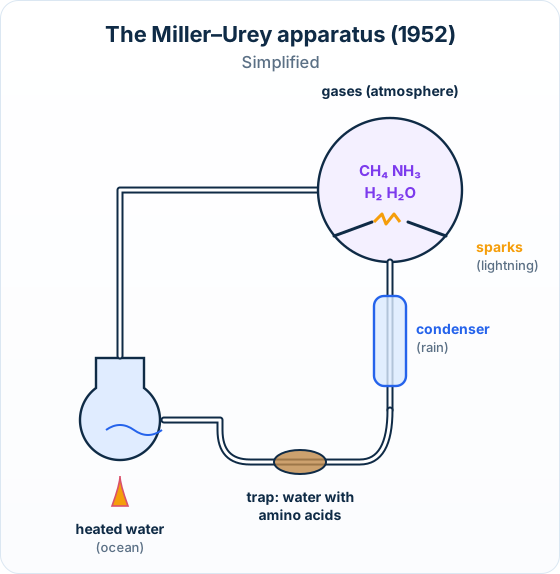
What it shows
- Amino acids form from inorganic gases plus energy
- No living thing is needed
- A hypothesis about the origin of life can be tested
What it cannot show
- That these were the real early gases
- How monomers joined into polymers
- How the first cell formed
Real example: Miller's old samples: In 2008 scientists re-tested sealed vials from Miller's 1950s experiments with modern equipment. One set, made with steam like a volcanic eruption, held more than 20 different amino acids.
One trap to avoid when you write about it:
It did not make life: The experiment made carbon compounds such as amino acids. It did not make cells, DNA or living things.
How this is tested: On an HL paper you may be asked to outline the Miller-Urey experiment, or to state/explain how organic molecules could form before life existed.
Score points for
- The reducing gas mixture used.
- The energy source: a spark imitating lightning.
- The product: amino acids / organic monomers.
- The conclusion: monomers can form abiotically.
Another source: You may also be asked to name another proposed source: hydrothermal vents or extraterrestrial delivery (meteorites).
IB-style question — the Miller-Urey experiment
Outline how the Miller-Urey experiment provided evidence for the prebiotic synthesis of organic molecules. [4]
How to score all four marks
- The set-up. A sealed flask held a reducing mixture of gases — methane, ammonia, hydrogen and water vapour — to model the early Earth's atmosphere.
- The energy. Electric sparks were passed through the gases to imitate lightning on the early Earth.
- The product. After several days, amino acids (and other small organic molecules) were found in the water — built from the inorganic gases.
- The conclusion. This showed that organic monomers can form abiotically — without any living organisms — so the building blocks of life could have arisen on the early Earth. (Award 1 mark per distinct point, up to 4.)
Final answer
A reducing mixture of methane, ammonia, hydrogen and water vapour was sparked with electricity (mimicking lightning). After several days amino acids and other organic molecules formed, showing that organic monomers can form abiotically, without life.
Why this scores full marks: It names the reducing gases, the energy source (spark/lightning), the product (amino acids) and draws the conclusion (abiotic synthesis is possible).
A common way to lose a mark is to say the experiment 'created life' — it did not. It only made the building blocks (monomers), not a cell.
The guide asks you to evaluate the experiment. A long-answer version:
Evaluate the Miller–Urey experiment as evidence for the origin of carbon compounds on the early Earth.
Model answer plan
See the answer broken into clear points, with guidance on how each point earns marks.