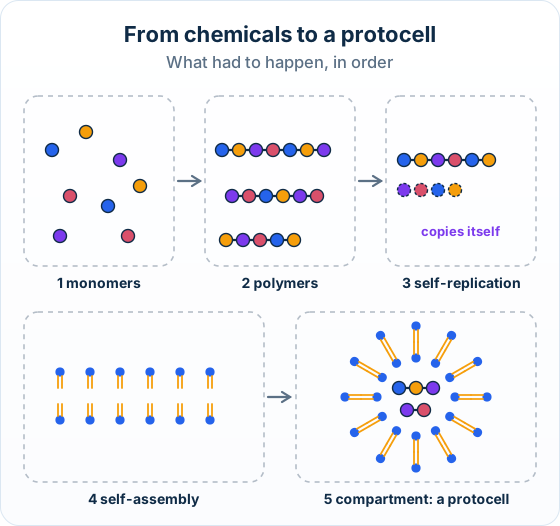
The big idea: Today a cell only comes from another cell. The first cell had to arise from chemistry, and four things had to happen for that.
The points to remember
- Cells are very complex, and today they arise only by division of pre-existing cells (biogenesis).
- The first cell had no cell to come from, so it arose from non-living chemistry (abiogenesis).
- Catalysis: something had to speed up reactions before there were enzymes.
- Self-replication: a molecule had to copy itself, so information could be passed on.
- Self-assembly: molecules such as lipids had to come together on their own into structures.
- Compartmentalization: a membrane had to enclose the chemistry, keeping the inside different from the outside.
Remember it as: Speed it up, copy it, build it, wrap it.
Real example: Pasteur's flasks: In 1859 Louis Pasteur boiled broth in flasks with long, bent swan necks. No microbes grew until he broke the neck. Life came only from existing life.
Free preview
This is the free notes preview
You're reading the free notes. Aimnova Pro unlocks the full study experience — and you can try it with your first topic free to keep:
- FlashcardsLock in vocabulary and key terms with spaced repetition.
- Practice questionsAnswer exam-style questions and get instant AI marking.
- Mock exams & past-paper vaultSit full mocks and see exactly how examiners award marks.
- Personalised study planA daily plan built around your exam date and weak areas.
Start Studying Free Full access to Aimnova Pro · cancel anytime
The big idea: A hypothesis must be testable. The origin of the first cells is hard to test, because we cannot rebuild the early Earth and the first protocells left no fossils.
The points to remember
- A scientific claim, hypothesis or theory must be testable: there must be a way to check it against evidence.
- The exact conditions on the pre-biotic Earth cannot be replicated in a laboratory.
- The first protocells did not fossilize: soft droplets leave no trace in rock.
- So scientists test each step separately: making carbon compounds, vesicles forming, RNA that copies itself.
What scientists can test
- Can carbon compounds form from simple gases?
- Do fatty acids form vesicles in water?
- Can RNA copy itself and catalyse reactions?
What they cannot
- The exact mix of gases, heat and light 4 billion years ago
- A fossil of the first protocell
- Which route was actually taken
Real example: the oldest fossils: The oldest widely accepted fossils, from the Pilbara region of Western Australia, are about 3.5 billion years old. They are already cells. Nothing older shows how the first cell formed.
Get feedback like a real examiner
Submit your answers and get instant feedback — what you did well, what's missing, and exactly what to write to score full marks.
Try AI Tutor FreeYour first topic is free to keep • No credit card required
How it could be asked: No paper has asked this yet. Likely shapes: a Paper 2 Outline of what the first cells needed, or of why the hypotheses are hard to test.
IB-style questionOutline[4 marks]
Outline the requirements for the spontaneous origin of the first cells.
Model answer plan
See the answer broken into clear points, with guidance on how each point earns marks.