The big idea: Before there were any cells, the early ocean held a thin soup of simple carbon molecules, including phospholipids and fatty acids.
Put phospholipids in water
- Something remarkable happens on their own, with no enzymes and no instructions.
- They line up into a bilayer.
- The bilayer closes up into a tiny vesicle: a droplet wrapped in a membrane.
A protocell: Such a membrane-bound droplet is called a protocell. It is the first time a patch of chemistry gets its own inside, separate from the surroundings.
- Protocell
- A simple membrane-bound droplet that forms by itself in water; a key step between non-living chemistry and the first true cells (but not yet alive).
- Phospholipid
- A lipid with a water-loving (hydrophilic) phosphate head and two water-hating (hydrophobic) fatty-acid tails — the molecule that builds membranes.
- Vesicle
- A small fluid-filled sac enclosed by a membrane.
- Bilayer
- A double layer of phospholipids, tails facing in and heads facing the water on each side — the basic membrane structure.
- Self-assembly
- When molecules organise themselves into a structure spontaneously, without being put together by enzymes.
- Compartmentalisation
- Using a membrane to separate an internal space, with its own contents and chemistry, from the surroundings.
'Spontaneous' = no help needed: Spontaneous here does not mean 'instant'. It means the molecules arrange themselves without enzymes, energy input or a template.
The phospholipid's own shape — a head that loves water and tails that hate it — is all that is needed.
Free preview
This is the free notes preview
You're reading the free notes. Aimnova Pro unlocks the full study experience — and you can try it with your first topic free to keep:
- FlashcardsLock in vocabulary and key terms with spaced repetition.
- Practice questionsAnswer exam-style questions and get instant AI marking.
- Mock exams & past-paper vaultSit full mocks and see exactly how examiners award marks.
- Personalised study planA daily plan built around your exam date and weak areas.
Two ideas do all the work here. First, why a membrane forms by itself. Second, why having a membrane is such a big advantage — big enough to be naturally selected.
Why a bilayer forms on its own (the hydrophobic effect)
- Each phospholipid has a hydrophilic head (loves water) and two hydrophobic tails (hate water).
- In water, the tails are pushed together to hide from the water — this is the hydrophobic effect.
- The molecules line up into a bilayer: heads facing the water on both sides, tails tucked inside, away from water.
- A flat sheet has exposed edges, so the bilayer curls up and seals into a closed vesicle — the lowest-energy, most stable shape.
- All of this happens spontaneously — driven by the molecules' shape, with no enzymes and no genetic instructions.
Fatty acids do it too: It is not only modern phospholipids. Simple fatty acids — which can form from non-living chemistry on the early Earth — also self-assemble into membrane vesicles in water.
That matters because it means the raw materials for the very first membranes were already available before any life existed. These simple fatty acid vesicles are thought to be the likeliest first membranes.
Now the second idea: once a droplet has a membrane, it gains an inside — and an inside changes everything. The membrane separates an internal chemistry from the surroundings.
What a compartment gives you
- It concentrates reactants — molecules are trapped close together, so they collide and react more often.
- It retains products — useful molecules built inside stay inside instead of drifting away.
- It lets the inside differ from the outside — a separate internal environment can be maintained.
- It protects self-replicating molecules — early replicators are sheltered and kept with their helpers, not washed apart.
| Free in the 'soup' (no membrane) | Inside a protocell (membrane) | |
|---|---|---|
| Where the molecules are | Spread thinly through a huge volume of water | Trapped together in one tiny droplet |
| Concentration of reactants | Very low — collisions are rare | High — molecules are packed close, so they collide often |
| Reaction rate | Slow (few useful reactions) | Faster (more frequent, productive collisions) |
| What happens to products | Drift away and are lost / diluted | Retained inside, so they can be used or build up |
| Internal vs external chemistry | The same everywhere — no separate inside | The inside can differ from the surroundings |
| Protection of replicators | Exposed; can be broken down or washed apart | Sheltered by the membrane, kept with their helpers |
Why this was naturally selected: Picture lots of droplets. A droplet that traps the right molecules runs its internal reactions faster, makes more of its useful products, and keeps its replicators safe.
So it grows and divides into more droplets better and more often than a leaky or membrane-less mixture. Its 'recipe' becomes more common over time.
Selection before life: That is natural selection acting before true life: compartmentalisation was favoured because it raised reaction rates and protected the replicators.
A protocell is NOT alive: A protocell has a membrane and an inside — but it still lacks reliable heredity. It cannot copy its contents accurately generation after generation.
So it is a crucial stepping stone between organic chemistry and true cells, but it is not yet a living cell.
Feeling unprepared for exams?
Get a clear study plan, practice with real questions, and know exactly where you stand before exam day. No more guessing.
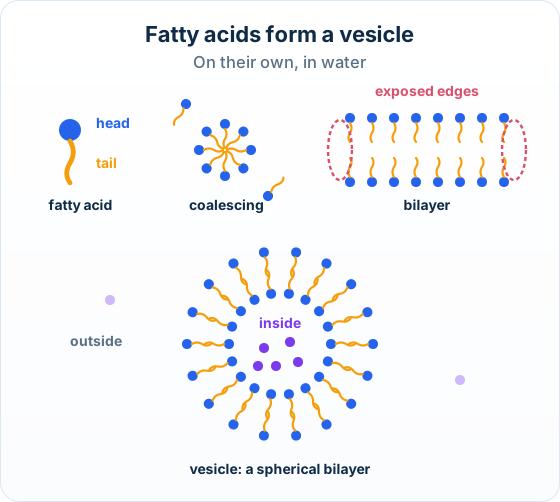
The big idea: Fatty acids in water come together on their own into a hollow sphere with a double wall: a vesicle. Its inside can then become different from the outside.
The points to remember
- A fatty acid has a hydrophilic head (attracted to water) and a hydrophobic tail (not attracted to water).
- In water, fatty acids coalesce: they come together, with their tails hidden from the water.
- They form a bilayer: heads facing the water on both sides, tails inside.
- A flat bilayer has edges where tails touch water, so it closes into a sphere: a vesicle.
- This happens spontaneously, with no enzymes, and fatty acids can form without life.
- The vesicle is a compartment: its inside chemistry can become different from the outside.
Remember it as: Heads out, tails in, edges closed: a vesicle.
Real example: vesicles on clay: In 2003 Jack Szostak's team showed that a common clay, montmorillonite, speeds up the formation of fatty acid vesicles. RNA stuck to the clay ended up inside the vesicles.
Keep the words exact when you describe it:
Tails in, not heads: The hydrophobic tails face each other inside the bilayer; the hydrophilic heads face the water, inside and outside the vesicle.
How this is tested: This HL-only idea is usually an Outline / Explain question worth a few marks. The examiner wants two halves.
(1) How the membrane forms
- Phospholipids/fatty acids self-assemble into a bilayer vesicle in water (the hydrophobic effect).
- It happens spontaneously, with no enzymes.
(2) Why that matters
- Compartmentalisation concentrates reactants, retains products, separates an internal chemistry, and protects replicators.
- So it raises reaction rates and was naturally selected.
A reliable extra mark: State that the protocell is a step towards cells but not yet alive (it lacks reliable heredity).
IB-style question — protocells and compartmentalisation
Explain how protocells could have formed spontaneously, and outline the advantage that compartmentalisation gave to early self-replicating molecules. [6]
How to score all six marks
- Self-assembly. Phospholipids (or simple fatty acids) spontaneously assemble into a bilayer in water, with no enzymes needed.
- Why — the hydrophobic effect. The hydrophobic tails are pushed away from water and tuck together, while the hydrophilic heads face the water; the bilayer seals into a closed vesicle (a protocell).
- Compartmentalisation defined. The membrane creates an inside separated from the surroundings, with its own internal chemistry.
- Concentrates / retains. It concentrates reactants (so reactions are faster) and retains the products inside instead of letting them diffuse away.
- Protects + selected. It shelters the self-replicating molecules, keeping them together; droplets that did this best out-reproduced others, so compartmentalisation was naturally selected.
- Not yet alive. A protocell is a step between organic chemistry and true cells but is not yet living, because it lacks reliable heredity. (Award 1 mark per distinct point, up to 6.)
Final answer
Phospholipids/fatty acids self-assemble into a bilayer vesicle in water because the hydrophobic tails hide from water (the hydrophobic effect), with no enzymes — forming a protocell. Its membrane compartmentalises an inside: it concentrates reactants (faster reactions), retains products, gives a separate internal chemistry, and protects the self-replicating molecules. Droplets that did this best reproduced more, so compartmentalisation was naturally selected. A protocell is a step towards cells but is not yet alive, as it lacks reliable heredity.
Why this scores full marks: It answers both halves: the how (self-assembly + the hydrophobic effect → bilayer vesicle) and the why (compartmentalisation concentrates reactants, retains products, protects replicators → naturally selected).
A common way to lose marks: Describing the membrane forming but never saying what the compartment is good for, or claiming a protocell is alive. Add the 'not yet alive: no reliable heredity' line to lock in the last mark.
| Feature | Protocell | A true living cell |
|---|---|---|
| Membrane / compartment | Yes — a self-assembled phospholipid bilayer vesicle | Yes — a controlled membrane |
| Different inside chemistry | Yes — a separate internal environment | Yes |
| Concentrates reactants | Yes | Yes |
| Reliable heredity (faithful copying) | No — copying is crude and error-prone | Yes — DNA replicated accurately |
| Controlled metabolism (enzymes) | Not really — chemistry is uncontrolled | Yes — enzyme-controlled |
| Counts as 'alive'? | NO — a stepping stone only | Yes |