Components of a nucleotide at Higher Level: The same statement as SL. At HL you also need the direction of a strand (its 5′ and 3′ ends), and that is read from the same carbon numbers you learn here, so learn the drawing with its 1′ and 5′ joins.
Practise this as you read
- Draw an RNA nucleotide and a DNA nucleotide from memory, each labelled.
- Name the sugar every time: deoxyribose or ribose.
Free preview
This is the free notes preview
You're reading the free notes. Aimnova Pro unlocks the full study experience — and you can try it with your first topic free to keep:
- FlashcardsLock in vocabulary and key terms with spaced repetition.
- Practice questionsAnswer exam-style questions and get instant AI marking.
- Mock exams & past-paper vaultSit full mocks and see exactly how examiners award marks.
- Personalised study planA daily plan built around your exam date and weak areas.
The big idea: DNA and RNA are long chains called nucleic acids.
Picture a string of beads: each bead is one nucleotide — the monomer (single building block) they are built from.
Each nucleotide is a bit of backbone (phosphate + sugar) plus one coloured base. Join many together: the backbones make one long 'string' and the bases stick out along it — that whole chain is a nucleic acid (DNA or RNA).
Interactive diagram
Explore the labelled diagram, charts and maps for this topic in full study mode.
| Part of a nucleotide | What it is | Job |
|---|---|---|
| Phosphate group | A small group containing phosphorus | Links nucleotides together into a strand |
| Pentose sugar | A 5-carbon sugar (deoxyribose or ribose) | Forms the backbone with the phosphate |
| Nitrogenous base | One of A, T/U, C or G | Carries the genetic information |
A single DNA nucleotide: a phosphate joined to a pentose sugar (deoxyribose), which is joined to a nitrogenous base. The sugar sits in the middle.
Interactive diagram
Explore the labelled diagram, charts and maps for this topic in full study mode.
Picture one nucleotide: Think of three pieces joined in a row:
phosphate — sugar — base
The phosphate and sugar make the backbone; the base sticks out to the side and is the part that codes information.
Learn what examiners really want
See exactly what to write to score full marks. Our AI shows you model answers and the key phrases examiners look for.
The big idea: In the exam a nucleotide is drawn with three shapes: a circle, a pentagon and a rectangle. Where they join, and what you call them, earns the marks.
The points to remember
- Three shapes: a circle for the phosphate, a pentagon for the pentose sugar, a rectangle for the base.
- The base joins the sugar at carbon 1′, the corner on the right of the ring.
- The phosphate joins the sugar at carbon 5′, the carbon just outside the ring on the left.
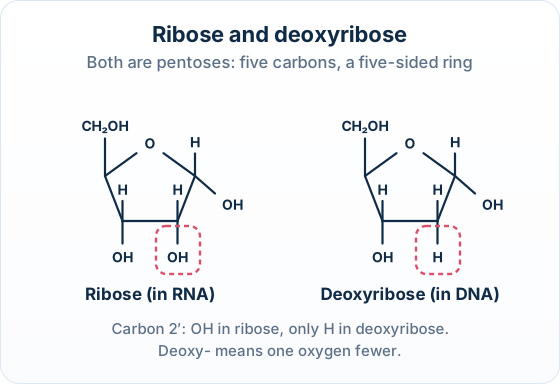
- Name the sugar: deoxyribose in DNA, ribose in RNA.
- Any base fits, except thymine in RNA and uracil in DNA.
Remember it as: Phosphate on 5′, base on 1′: the sugar sits in the middle.
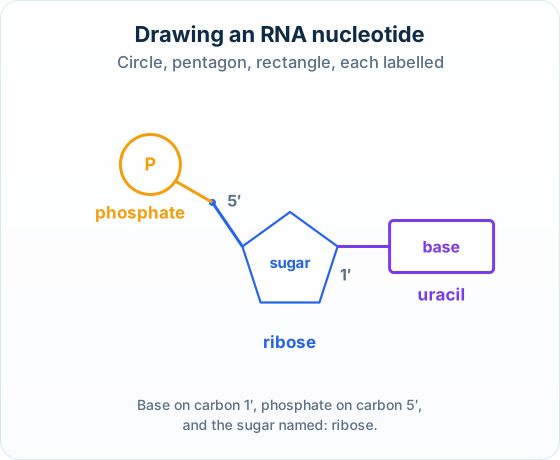
Two labels that lose the mark: 'Pentose' on its own is not enough: write deoxyribose or ribose.
A base of thymine in an RNA nucleotide, or uracil in a DNA nucleotide, is wrong.
To tell the two sugars apart, look at carbon 2′, the lower right corner of the ring:
Real example: a crop short of phosphorus: Maize grown in soil short of phosphorus stays small and its leaves turn purple. Without phosphorus, its cells cannot make enough phosphate groups for DNA, RNA, ATP and phospholipids, the molecules of cell membranes.
How this is tested: This topic is tested on Paper 2 and on Paper 1A, in three kinds of question.
Three question types
- On Paper 2 a 3-mark Draw question can ask you to draw and label a single DNA or RNA nucleotide — show the phosphate, sugar and base joined together.
- Distinguish / contrast questions ask for the structural differences between DNA and RNA (sugar, one base, strands).
- On Paper 1A you may have to identify which sugars and bases belong to DNA, RNA or both.
IB-style question — draw and label a DNA nucleotide
Draw and label a diagram of a single DNA nucleotide. [3]
How to score all three marks
- Draw the three parts joined in a row. Show a phosphate group, joined to a pentose sugar (deoxyribose), joined to a nitrogenous base. A simple labelled chain of three shapes is enough — circle = phosphate, pentagon = sugar, rectangle = base.
- Label each part clearly. Write phosphate, (deoxyribose) sugar, and base next to the correct shape.
- Show how they join. The phosphate attaches to the sugar, and the base attaches to the sugar — so the sugar sits in the middle, linked to both. (Mark 1: three parts present. Mark 2: parts correctly labelled. Mark 3: phosphate–sugar–base joined the correct way, with the sugar central.)
Final answer
A labelled chain showing phosphate — deoxyribose sugar — nitrogenous base, with the sugar in the centre joined to both the phosphate and the base.
The DNA nucleotide your diagram should match: phosphate — sugar (deoxyribose) — base, all labelled, with the sugar central.
Interactive diagram
Explore the labelled diagram, charts and maps for this topic in full study mode.
The diagram you should draw: Three labelled shapes joined like this:
phosphate — sugar (deoxyribose) — base
Check yours shows the sugar in the middle, joined on one side to the phosphate and on the other side to the base, with all three labelled. For an RNA nucleotide the only changes are: sugar = ribose, and the base can be uracil.
| Part of a nucleotide | What it is | Job |
|---|---|---|
| Phosphate group | A small group containing phosphorus | Links nucleotides together into a strand |
| Pentose sugar | A 5-carbon sugar (deoxyribose or ribose) | Forms the backbone with the phosphate |
| Nitrogenous base | One of A, T/U, C or G | Carries the genetic information |