DNA as the genetic material at Higher Level: The same statement as SL: DNA in every living organism, RNA in some viruses. At HL you also study the experiment that showed DNA, not protein, is the genetic material (Hershey and Chase), so be clear now on what 'genetic material' means.
Practise this as you read
- Name the molecule exactly: DNA, never 'nucleic acid'.
- Explain why an RNA virus is not an exception: viruses are not living.
Free preview
This is the free notes preview
You're reading the free notes. Aimnova Pro unlocks the full study experience — and you can try it with your first topic free to keep:
- FlashcardsLock in vocabulary and key terms with spaced repetition.
- Practice questionsAnswer exam-style questions and get instant AI marking.
- Mock exams & past-paper vaultSit full mocks and see exactly how examiners award marks.
- Personalised study planA daily plan built around your exam date and weak areas.
The big idea: Every organism carries its own instructions, its genetic material. In every living organism, that molecule is DNA.
The points to remember
- Genetic material: the molecule that stores the instructions for building and running an organism.
- It is copied when cells divide and passed on to the next generation.
- In all living organisms the genetic material is DNA (deoxyribonucleic acid).
- Bacteria, plants, fungi and animals all use this same molecule.
Remember it as: Every living thing, one molecule: DNA.
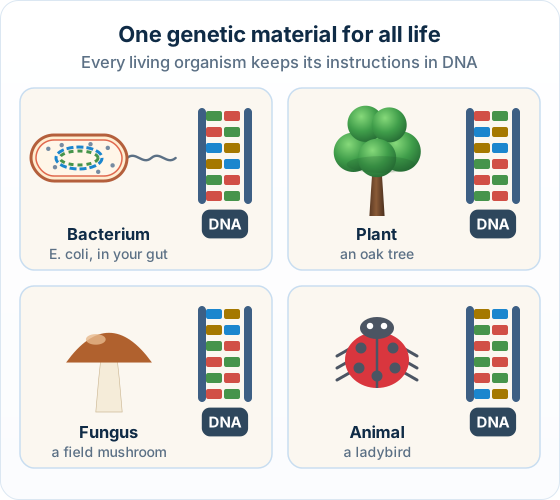
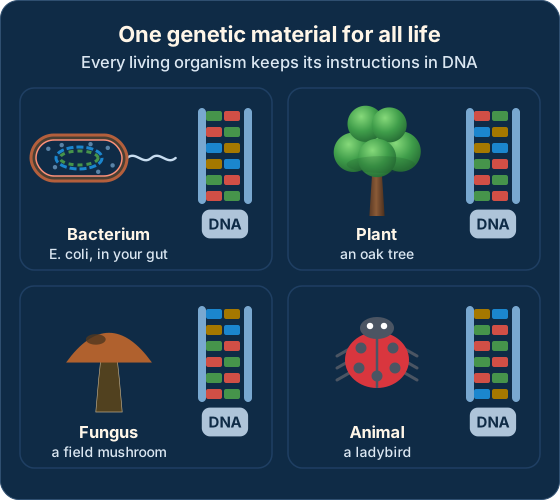
Real example: DNA from million-year-old mammoths: In 2021 scientists read DNA from woolly mammoth teeth kept frozen in the Siberian ground for more than a million years. Extinct or alive, ancient or modern, every organism ever tested stores its instructions in DNA.
When a question asks you to name the genetic material, one word earns the mark:
Name the molecule exactly: Write DNA (or deoxyribonucleic acid). 'Nucleic acid' on its own is too vague, and 'RNA' is wrong for a living organism.
Know your predicted grade
Take timed mock exams and get detailed feedback on every answer. See exactly where you're losing marks.
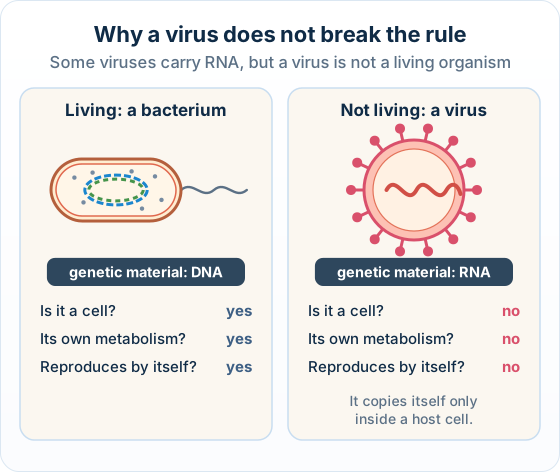
The big idea: Every virus carries genetic material, and in some viruses it is RNA, not DNA.
That does not break the rule, because viruses are not considered living.
The points to remember
- Every virus carries genetic material: DNA in some viruses, RNA in others.
- RNA viruses include the influenza virus and SARS-CoV-2, the virus that causes COVID-19.
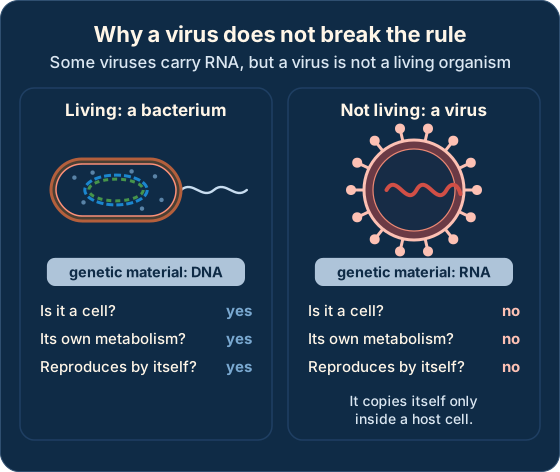
- Viruses are not considered living: they are not made of cells and have no metabolism of their own.
- A virus is copied only inside a living host cell, using that cell's machinery.
- So the rule stands: every living organism uses DNA.
Remember it as: RNA in a virus is no exception: a virus is not alive.
The first virus ever discovered is an RNA virus. Here it is under an electron microscope:
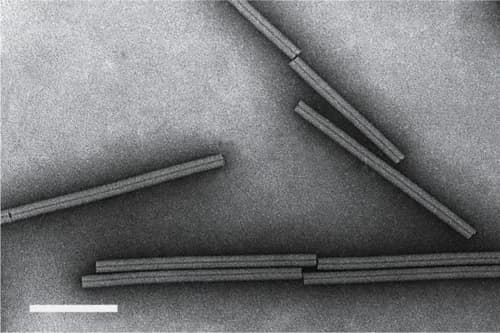
Real example: tobacco mosaic virus: In the 1890s, tobacco mosaic virus was the first virus to be discovered: something smaller than any bacterium was spreading a disease between tobacco plants. Its genetic material is one strand of RNA, inside a rod-shaped coat of protein. It can only be copied inside the cells of a living plant.
How it is asked: Two shapes so far: a Paper 1A item that tests the rule and the virus exception together, and a one-mark Paper 2 State. Here is each, worked through.
Which features are common to every virus? I. not living. II. carries genetic material. III. carries DNA. A. I and II only. B. I and III only. C. II and III only. D. I, II and III.
Model answer plan
See the answer broken into clear points, with guidance on how each point earns marks.
The Paper 2 version is one mark for one exact word:
A new lettuce plant can grow from a single leaf placed in moist soil. State the molecule that lettuce plants use as their genetic material.
Model answer plan
See the answer broken into clear points, with guidance on how each point earns marks.
If the question is about a virus: Read whether it asks about a living organism or a virus. A news report says that HIV, the virus that causes AIDS, carries RNA, and asks whether some living things do not need DNA. The reply is always the same: viruses are not living, so they are not exceptions to the rule.