aımnova
DashboardMy LearningCrash CoursesStudy Plan

Aimnova site navigation

Stay in the loop

Get the latest study resources and updates

New features, study tips and exam insights — straight to your inbox.

IB Diploma

  • IB Past Papers
  • IB Study Notes
  • IB Question Bank
  • IB Mock Exams
  • IB Revision

IB Subjects

  • IB Math AA
  • IB Math AI
  • IB Economics
  • IB Business Management
  • IB Physics
  • IB Biology
  • View all IB subjects→

IB Past Papers

  • IB Math AA HL Past Papers
  • IB Math AA SL Past Papers
  • IB Math AI HL Past Papers
  • IB Math AI SL Past Papers
  • IB Economics HL Past Papers
  • IB Economics SL Past Papers
  • IB ESS Past Papers
  • View all past papers→

Study Resources

  • Study Notes
  • Question Bank
  • Mock Exams
  • Crash Courses
  • Flashcards
  • Revision Guide
  • Exam Skills
  • Command Terms
  • Grade Calculator
  • Exam Timetable 2026

Aimnova

  • Features
  • Pricing
  • For Teachers
  • For Schools
  • For Parents
  • About Us
  • Blog
  • Contact
aımnova

IB study, practice and feedback built around the real exam.

TermsPrivacyCookies·© 2026 Aimnova. All rights reserved.10c8990

Aimnova is not affiliated with or endorsed by the International Baccalaureate Organization (IB).

NotesBiology HLTopic 1.2Evidence from the Hershey–Chase experiment for DNA as the genetic material
Back to Biology HL Topics
1.2.144 min read

Evidence from the Hershey–Chase experiment for DNA as the genetic material (Biology HL)

IB Biology · Unit 1

Exam preparation

Practice the questions examiners actually ask

Our question bank mirrors real IB exam papers. Practice under timed conditions and track your progress across topics.

Start Practicing

Contents

  1. 1The Hershey–Chase experiment
  2. 2Reading the results
  3. 3Exam-style question (step by step)
The big idea: A virus injects its genetic material into a bacterium. Hershey and Chase labelled the virus's protein and its DNA with different radioactive atoms, then looked to see which one went in.

The points to remember

  • In the 1940s many scientists thought protein was the genetic material. Hershey and Chase tested protein or DNA.
  • They used a bacteriophage (a virus of bacteria): just a protein coat with DNA inside.
  • Protein contains sulfur but DNA does not; DNA contains phosphorus but protein has almost none.
  • So they labelled the protein with radioactive sulfur-35 (³⁵S), and in a second batch the DNA with phosphorus-32 (³²P).
  • After infection, a blender knocked the empty phage coats off the bacteria.
  • A centrifuge spun the bacteria into a pellet; the light coats stayed in the liquid (the supernatant).
Remember it as: Sulfur for protein, phosphorus for DNA.
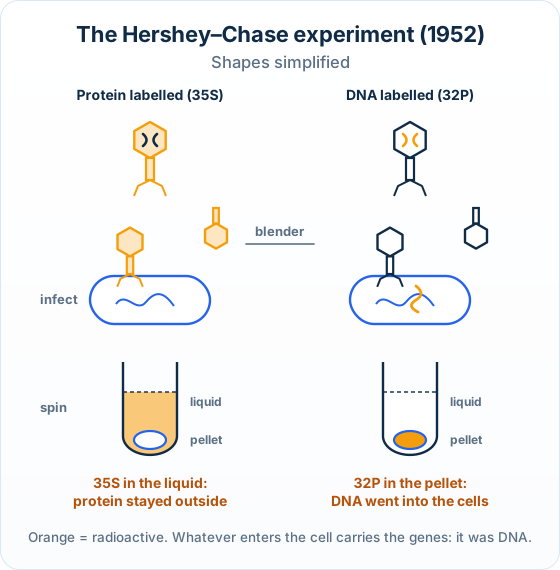
Two batches of phages, one with a radioactive protein coat and one with radioactive DNA, infect bacteria; a blender removes the coats; a centrifuge leaves the coats in the liquid and the bacteria in the pellet; the sulfur label ends in the liquid and the phosphorus label in the pellet
Follow each label: the protein stays outside, the DNA goes in.

Free preview

This is the free notes preview

You're reading the free notes. Aimnova Pro unlocks the full study experience — and you can try it with your first topic free to keep:

  • FlashcardsLock in vocabulary and key terms with spaced repetition.
  • Practice questionsAnswer exam-style questions and get instant AI marking.
  • Mock exams & past-paper vaultSit full mocks and see exactly how examiners award marks.
  • Personalised study planA daily plan built around your exam date and weak areas.
Start Studying Free Full access to Aimnova Pro · cancel anytime
The big idea: The protein label stayed outside the cells and the DNA label went in, so DNA carries the genes.

The points to remember

  • ³⁵S stayed mostly in the supernatant: the protein coats stayed outside the bacteria.
  • ³²P was mostly in the pellet: the DNA went inside the bacteria.
  • The new phages made inside the bacteria contained some of the ³²P, and almost none of the ³⁵S.
  • Whatever enters the cell must carry the instructions for new phages, so DNA is the genetic material.
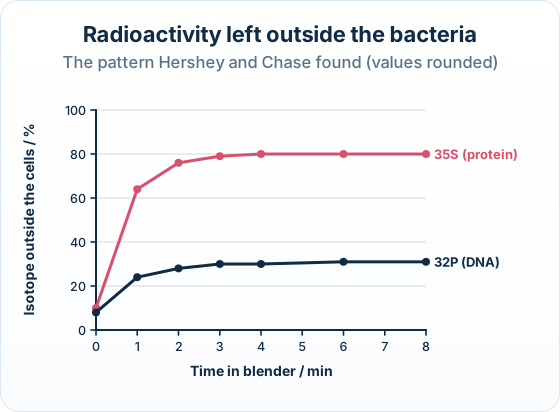
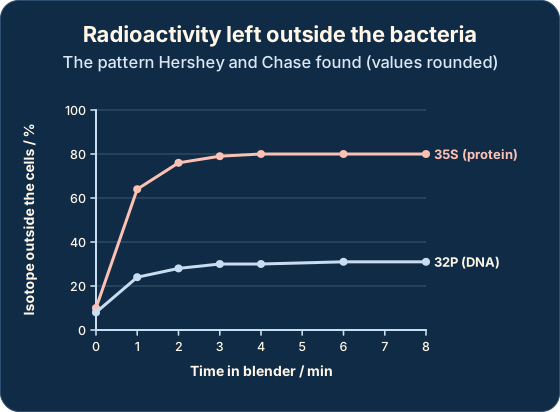
Line graph of the percentage of each isotope left outside the bacteria against time in the blender: sulfur-35 rises to about 80 per cent, phosphorus-32 levels off at about 30 per centLine graph of the percentage of each isotope left outside the bacteria against time in the blender: sulfur-35 rises to about 80 per cent, phosphorus-32 levels off at about 30 per cent
After a few minutes of blending, about 80% of the ³⁵S is outside the cells but only about 30% of the ³²P.
Nature of science: a new tool, a new experiment: After the Second World War, radioactive isotopes made in nuclear reactors became available to biologists. Being able to label sulfur and phosphorus separately is what made this experiment possible.

Memorize terms 3x faster

Smart flashcards show you cards right before you forget them. Perfect for definitions and key concepts.

Try Flashcards FreeYour first topic is free to keep • No credit card required
How it is asked: Paper 1A: the conclusion from a pellet and supernatant table. Paper 1B: a graph or table of results, then explain how it shows DNA is the genetic material.
IB-style questionExplain[3 marks]

The graph shows the percentage of ³⁵S and ³²P left outside bacteria after blending. Explain how these data provide evidence that DNA is the genetic material.

Model answer plan

See the answer broken into clear points, with guidance on how each point earns marks.

Claim your free topic

Try an IB Exam Question — Free AI Feedback

Test yourself on Evidence from the Hershey–Chase experiment for DNA as the genetic material. Write your answer and get instant AI feedback — just like a real IB examiner.

The Hershey–Chase experiment was carried out in 1952, a few years after radioactive isotopes became widely available to biologists.

why radioactive isotopes made this experiment possible.
[2 marks]

Related Biology HL Topics

Continue learning with these related topics from the same unit:

1.1.1Water as the medium for life1.1.2Hydrogen bonds from the polar covalent bonds in water1.1.3Cohesion of water and its consequences for organisms1.1.4Adhesion of water to polar or charged materials
View all Biology HL topics
Improve your exam techniqueCommand terms, paper structure, and mark-scheme tips for Biology HL
Previous1.2.13Structure of a nucleosomeNextChargaff's data on the amounts of purine and pyrimidine bases1.2.15

7 practice questions on Evidence from the Hershey–Chase experiment for DNA as the genetic material

Students who practiced this topic on Aimnova scored 82% on average. Try free practice questions and get instant AI feedback.

Try 3 Free QuestionsView All Biology HL Topics