aımnova
DashboardMy LearningPaper MasteryStudy Plan

Aimnova site navigation

Stay in the loop

Get the latest study resources and updates

New features, study tips and exam insights — straight to your inbox.

IB Diploma

  • IB Past Papers
  • IB Study Notes
  • IB Question Bank
  • IB Mock Exams
  • IB Revision

IB Subjects

  • IB Math AA
  • IB Math AI
  • IB Economics
  • IB Business Management
  • IB Physics
  • IB Biology
  • View all IB subjects→

IB Past Papers

  • IB Math AA HL Past Papers
  • IB Math AA SL Past Papers
  • IB Math AI HL Past Papers
  • IB Math AI SL Past Papers
  • IB Economics HL Past Papers
  • IB Economics SL Past Papers
  • IB ESS Past Papers
  • View all past papers→

Study Resources

  • Study Notes
  • Question Bank
  • Mock Exams
  • Flashcards
  • Revision Guide
  • Exam Skills
  • Command Terms
  • Grade Calculator
  • Exam Timetable 2026

Aimnova

  • Features
  • Pricing
  • For Teachers
  • For Schools
  • For Parents
  • About Us
  • Blog
  • Contact
aımnova

IB study, practice and feedback built around the real exam.

TermsPrivacyCookies·© 2026 Aimnova. All rights reserved.bf08e16

Aimnova is not affiliated with or endorsed by the International Baccalaureate Organization (IB).

NotesBiology HLTopic 1.1The search for extraterrestrial life and the presence of water
Back to Biology HL Topics
1.1.86 min read

The search for extraterrestrial life and the presence of water (Biology HL)

IB Biology · Unit 1

Your first topic is free to keep

Know exactly what to write for full marks

Practice with exam questions and get AI feedback that shows you the perfect answer — what examiners want to see.

Start Free

Contents

  1. 1Looking for life means looking for water
  2. 2The Goldilocks zone
  3. 3Exam-style question (step by step)
The big idea: Every search for extraterrestrial life begins with one question: is there liquid water? Life as we know it cannot run without it.

The points to remember

  • Water is the medium for life: the reactions of life happen in water, and the first cells formed in water.
  • So the search for extraterrestrial life is a search for liquid water, present now or in the past.
  • Three places to look: Mars (dry rivers and lakes), icy moons with oceans under the ice, and planets around other stars.
Remember it as: Follow the water: no liquid water, no search.
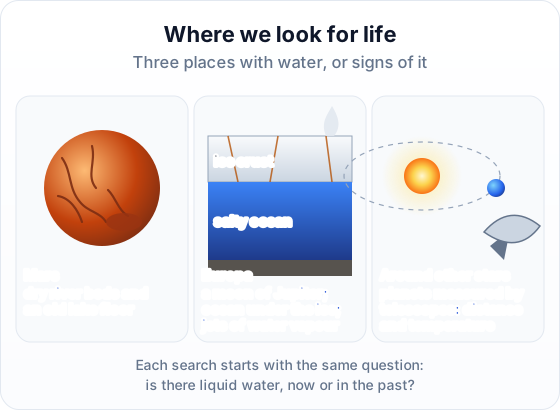
Three panels: Mars with dark branching river channels and a lake floor; a cross-section of Europa with an ice crust over a blue ocean and a jet of vapour; a star with a planet on a dashed orbit and a telescope dishThree panels: Mars with dark branching river channels and a lake floor; a cross-section of Europa with an ice crust over a blue ocean and a jet of vapour; a star with a planet on a dashed orbit and a telescope dish
Three places we look for life. In every one, the first question is whether there is, or was, liquid water.

Real example: between 2008 and 2015 the Cassini spacecraft flew through jets of water vapour shooting out of Enceladus, a small icy moon of Saturn. It found salt and carbon-based molecules in the jets, which come from an ocean of liquid water under the ice. That ocean is why Enceladus is now a target in the search for life.

On Mars, the Curiosity rover drilled into mudstone in Gale crater in 2013 and showed that a lake of fresh water once filled it. Past water means life could once have lived there.

Free preview

This is the free notes preview

You're reading the free notes. Aimnova Pro unlocks the full study experience — and you can try it with your first topic free to keep:

  • FlashcardsLock in vocabulary and key terms with spaced repetition.
  • Practice questionsAnswer exam-style questions and get instant AI marking.
  • Mock exams & past-paper vaultSit full mocks and see exactly how examiners award marks.
  • Personalised study planA daily plan built around your exam date and weak areas.
Start Studying Free Full access to Aimnova Pro · cancel anytime
The big idea: A planet can only keep liquid water if it is the right distance from its star. That band is the Goldilocks zone.

The points to remember

  • Water is liquid only between 0 °C and 100 °C (at a pressure like Earth's). Hotter, it boils away; colder, it freezes.
  • The Goldilocks zone is the band of distances from a star where a planet's temperature lets water stay liquid.
  • Too close to the star, water boils away (Venus). Too far, it is ice (the outer planets). Earth sits in the zone.
  • In a table of planets, pick the one whose temperature range allows liquid water, with air and gravity a living thing could stand.
Remember it as: Goldilocks: not too hot, not too cold, just right for liquid water.
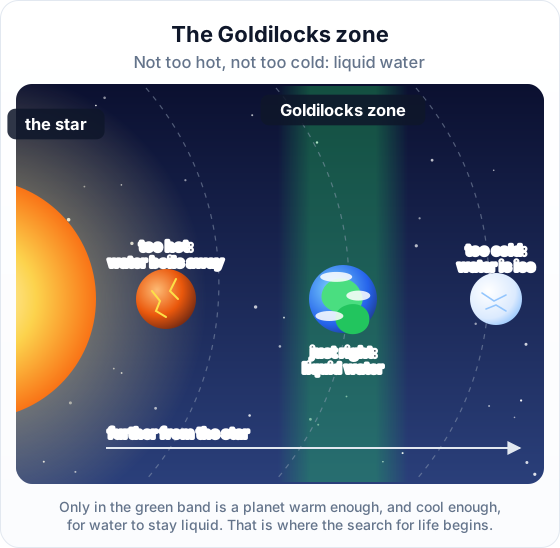
A star at the left and three planets at increasing distance: a hot cracked planet labelled too hot, an Earth-like planet inside a green band labelled Goldilocks zone, and an icy planet labelled too coldA star at the left and three planets at increasing distance: a hot cracked planet labelled too hot, an Earth-like planet inside a green band labelled Goldilocks zone, and an icy planet labelled too cold
Not too hot, not too cold. Only in the green band can a planet keep liquid water at its surface.

Real example: TRAPPIST-1 is a small, cool star 40 light years away with seven Earth-sized planets found in 2017. The inner ones are too hot and the outer ones too cold, but three sit in the Goldilocks zone. TRAPPIST-1e, an exoplanet that receives about two thirds of the starlight Earth gets, could have liquid water if it has an atmosphere.
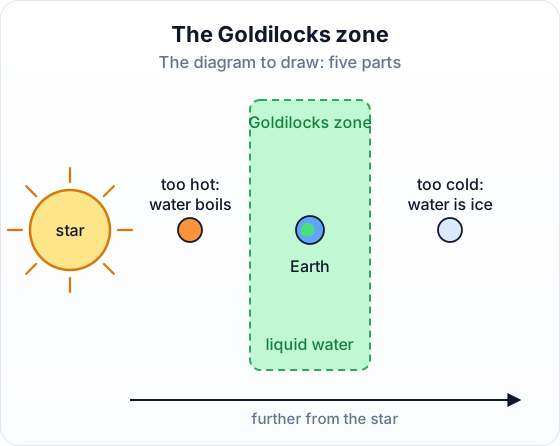
Handwritten diagram built in five steps: a star, a hot planet, a shaded Goldilocks band, a cold planet, and Earth inside the band
The Goldilocks zone, drawn one part at a time.

The exam gives you a table and asks which planet falls within the Goldilocks zone. Read the temperature column first:
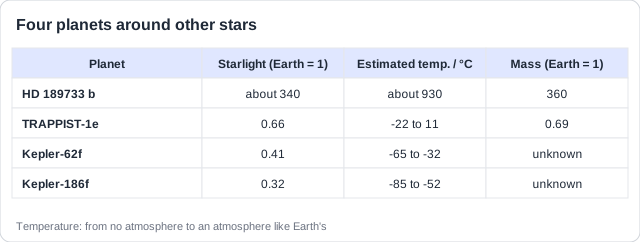
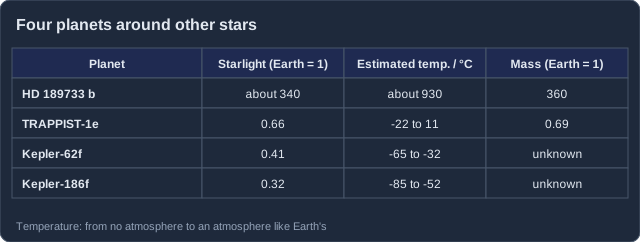
Table of four planets around other stars with starlight received, estimated temperature and mass: HD 189733 b about 930 °C, TRAPPIST-1e -22 to 11 °C, Kepler-62f -65 to -32 °C, Kepler-186f -85 to -52 °CTable of four planets around other stars with starlight received, estimated temperature and mass: HD 189733 b about 930 °C, TRAPPIST-1e -22 to 11 °C, Kepler-62f -65 to -32 °C, Kepler-186f -85 to -52 °C
An exam-style table. TRAPPIST-1e is the only planet whose temperature range reaches above 0 °C, so it could hold liquid water.
Reading the table: Temperature decides it: the planet must be able to sit between 0 °C and 100 °C. An atmosphere marked unknown does not rule a planet out. A planet at 750 °C or -100 °C is out whatever else the table says; so is one with poisonous gases or a gravity many times Earth's.

Stop wasting time on topics you know

Our AI identifies your weak areas and focuses your study time where it matters. No more overstudying easy topics.

Try Smart Study FreeYour first topic is free to keep • No credit card required
How this is tested: A one-mark multiple-choice item shows a table of planets and asks which one lies in the Goldilocks zone. A short written part can ask you to explain why a particular planet or moon is a target in the search for life.
IB-style questionExplain[3 marks]

TRAPPIST-1e orbits a small, cool star 40 light years from Earth. It receives about two thirds of the starlight that Earth receives, and estimates of its temperature range from -22 °C with no atmosphere to 11 °C with an atmosphere like Earth's. Explain why TRAPPIST-1e is a target in the search for extraterrestrial life.

Model answer plan

See the mark-by-mark plan — for / against / judgement, with marking guidance — in study mode.

Claim your free topic

Try an IB Exam Question — Free AI Feedback

Test yourself on The search for extraterrestrial life and the presence of water. Write your answer and get instant AI feedback — just like a real IB examiner.

Astronomers describe Earth as lying in the Sun's Goldilocks zone.

what is meant by the Goldilocks zone.
[1 mark]

Related Biology HL Topics

Continue learning with these related topics from the same unit:

1.1.1Water as the medium for life1.1.2Hydrogen bonds from the polar covalent bonds in water1.1.3Cohesion of water and its consequences for organisms1.1.4Adhesion of water to polar or charged materials
View all Biology HL topics
Improve your exam techniqueCommand terms, paper structure, and mark-scheme tips for Biology HL
Previous1.1.7Extraplanetary origin of water on Earth and its retentionNextNucleotides & DNA vs RNA1.2.1

6 practice questions on The search for extraterrestrial life and the presence of water

Students who practiced this topic on Aimnova scored 82% on average. Try free practice questions and get instant AI feedback.

Try 3 Free QuestionsView All Biology HL Topics