Urban & rural life, HL-ready: The entorno urbano y rural vocabulary comparing city and country life is the same at SL and HL. You are in the right place.
What HL adds later
- This comparison stretches into a longer 450–600-word essay.
- It meets slightly denser texts.
- Build a vivid vocabulary for contrasting urban and rural living now. The extra HL length is more room to compare in detail.
What 'el entorno urbano y rural' covers: Urban and rural life (el entorno urbano y rural) is part of the theme Sharing the planet. You need vocabulary to describe towns and the countryside, neighbourhoods and public spaces, the advantages and problems of each — and to give your opinion about them. Learn the words below as a deck, then use them in the reading and writing sections.
- la ciudad
- city
- el pueblo
- village / small town
- el campo
- the countryside
- el barrio
- neighbourhood
- el vecino / la vecina
- neighbour
- el ayuntamiento
- the town council / town hall
- el espacio verde
- green space
- el transporte público
- public transport
- el atasco
- traffic jam
- la contaminación
- pollution
- la tranquilidad
- peace and quiet
- abandonado/a
- abandoned / neglected
- recuperar / rehabilitar
- to revive / to do up (a space)
| Useful expression (Spanish) | English |
|---|---|
| Vivo en un barrio tranquilo a las afueras. | I live in a quiet neighbourhood on the outskirts. |
| En la ciudad hay mucha contaminación y atascos. | In the city there's a lot of pollution and traffic jams. |
| En el pueblo se vive con más tranquilidad. | Life in the village is more peaceful. |
| Faltan espacios verdes en el centro. | There aren't enough green spaces in the centre. |
| Los vecinos quieren recuperar la plaza. | The neighbours want to revive the square. |
Why this matters: This vocabulary turns up in every skill — a reading text about a neighbourhood, a listening interview about city life, a Paper 1 blog about improving a public space, or your oral. Reusing the right topic words is how you score Criterion A (Language).
Free preview
Reading it is one thing — hearing it is another
You're reading the free notes. Aimnova Pro unlocks the full study experience — and you can try it with your first topic free to keep:
- Audio on every wordTap any vocabulary word or example to hear it read aloud in natural Spanish.
- FlashcardsLock in vocabulary and key terms with spaced repetition.
- Practice questionsAnswer exam-style questions and get instant AI marking.
- Mock exams & past-paper vaultSit full mocks and see exactly how examiners award marks.
- Personalised study planA daily plan built around your exam date and weak areas.
Have something to say: Examiners reward developed ideas, not just vocabulary. Take a position and back it up.
Common debates on urban and rural life
- Living in the city vs the countryside
- Pollution and traffic vs peace and quiet
- How residents can improve their own neighbourhood
Opinion phrases (use these to introduce a view)
- En mi opinión… / Desde mi punto de vista… — In my opinion… / From my point of view…
- Me parece que… / Creo que… — It seems to me that… / I think that…
- Lo más importante es… — The most important thing is…
- Por un lado… por otro lado… — On the one hand… on the other hand…
- Estoy (totalmente) de acuerdo con… — I (completely) agree with…
Vivir en la ciudad (drawbacks)
- Hay mucha contaminación y demasiados atascos.
- El ritmo es estresante y todo es más caro.
- A menudo faltan espacios verdes donde descansar.
Vivir en el campo (benefits)
- Se respira aire limpio y hay más tranquilidad.
- La gente se conoce y la comunidad es más unida.
- Hay más espacio y contacto con la naturaleza.
City streets
- parques abandonados, falta de aparcamiento
- un día sin coches privados en el barrio
- las supermanzanas de Barcelona, un paso de cebra original
Villages emptying and filling
- un pueblo que pierde habitantes
- mudarse de la ciudad a un pueblo
- el teletrabajo y el turismo rural repueblan aldeas
Living together
- el ruido del tráfico y de los bares por la noche
- derribar edificios antiguos de un barrio
- un centro histórico sin vecinos
Big questions behind this topic (IB guide, theme Sharing the planet)
- ¿Qué retos y beneficios traen los cambios en las ciudades y en el campo?
- ¿Para quién son las calles: para los coches o para las personas?
- ¿Cómo se puede devolver la vida a un pueblo?
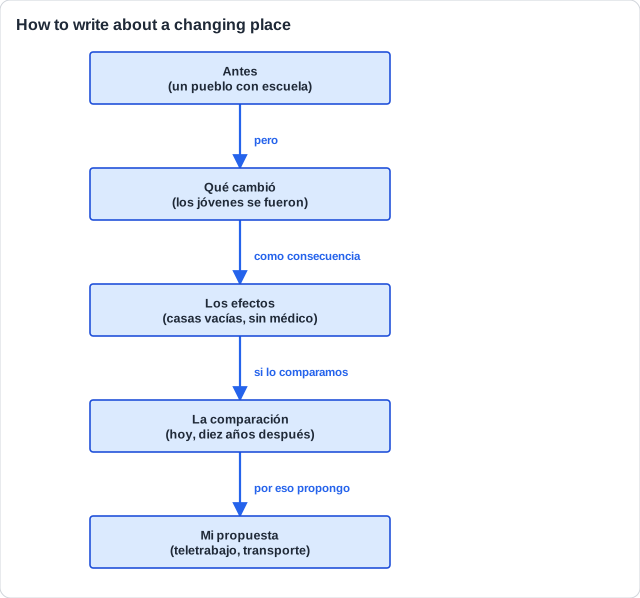
Link your ideas: Connectors lift your answer from a list into an argument: además (besides), sin embargo (however), por lo tanto (therefore), aunque (although). Use at least two or three in any written answer.
Stop wasting time on topics you know
Our AI identifies your weak areas and focuses your study time where it matters. No more overstudying easy topics.
Read like Paper 2: Here is a short blog — the kind of text Paper 2 (Reading) gives you.
How to work through it
- Read it once just for the general idea; don't worry about every word.
- Tap the audio button to hear it.
- Tap Ver traducción if you get stuck.
- Then we'll do one exam question together.
De la ciudad al pueblo (1/3): Hace un año mis padres decidieron dejar Madrid y nos mudamos a un pueblo de Asturias de apenas trescientos habitantes. Yo estaba furiosa: allí no había cine, el autobús pasaba dos veces al día y la conexión a internet era muy lenta.
De la ciudad al pueblo (2/3)
Los primeros meses me aburría muchísimo y echaba de menos a mis amigos. Sin embargo, poco a poco empecé a ver las ventajas: respiro aire limpio, voy en bici al instituto del pueblo de al lado y todos los vecinos se saludan por la calle.
De la ciudad al pueblo (3/3)
Mis padres teletrabajan y ya no pasan dos horas al día en el tráfico. Todavía echo de menos algunas cosas de la ciudad, pero ahora entiendo por qué cada vez más familias eligen vivir en el campo.
- mudarse
- to move (house)
- el/la habitante
- inhabitant
- la conexión a internet
- internet connection
- teletrabajar
- to work from home
- echar de menos
- to miss (someone/something)
IB-style task — una pregunta de Paper 2
Una pregunta, paso a paso
- The question — Según el texto, ¿qué ventajas descubrió la persona en el pueblo?
- Find it in the text. Look for las ventajas: respiro aire limpio, voy en bici al instituto del pueblo de al lado y todos los vecinos se saludan por la calle.
- The answer — Respira aire limpio, va en bici al instituto y los vecinos se saludan por la calle.
Reading technique: For a según el texto (according to the text) question, find the exact line that proves your answer — don't rely on memory or general knowledge.
La tarea — your task: La revista de tu colegio prepara un número sobre la vida en la ciudad. Escribe una entrevista con una vecina que consiguió transformar una plaza de tu barrio: preséntala, hazle preguntas y cierra la entrevista.
Escribe entre 450 y 600 palabras.
Interview structure — 3 steps
Introduction
Set the scene and present the person. Hablamos con Lucía Romero, la vecina que…
Questions and answers
Three questions in usted, each answer after a dash. —¿Cómo era la plaza antes? —Estaba llena de coches…
Closing
Thank her and add a last piece of news. Muchas gracias, Lucía. La plaza celebra…
Intro → Q & A → Thanks + info
Modelo: los 3 pasos en ~100 palabras
La entrevista, paso a paso
- Hace un año, la plaza del Sol era un aparcamiento. Hoy tiene árboles, bancos y una zona de juegos. Hablamos con Lucía Romero, la vecina que lo hizo posible.
- —¿Cómo era la plaza antes? —Estaba llena de coches; no había sombra y nadie se sentaba allí. —¿Qué hicieron los vecinos? —Recogimos firmas y pedimos ayuda al ayuntamiento. —¿Qué consejo daría a otros barrios? —Que no se queden en las quejas: el cambio depende de nosotros.
- Muchas gracias, Lucía. La plaza celebra su primer aniversario el próximo sábado.
Por qué funciona — why it works: A strong interview does this for each of the three Paper 1 criteria:
A — Language /12
- Imperfect to describe the past: era, estaba, no había
- Preterite for actions: recogimos, pedimos
- Usted questions and subjunctive advice: ¿daría…?, que no se queden
B — Message /12
- Task fully done: introduces her, asks questions AND closes
- Answers show the before, the action and the advice
C — Conceptual /6
- Interview conventions: an introduction that sets the scene
- Question–answer layout with dashes, usted throughout
- A closing thanks plus useful information
Ready to ace Urban & rural?
You've seen the preview. Here's what you'll unlock:
Bite-Sized Study Notes
Full syllabus broken into chunks that stick
Exam Practice
See exactly how to score full marks
AI Feedback
Know exactly what examiners want
Smart Study Plan
Know exactly what to study next