Health & well-being at HL pace: Breathe out: the salud y bienestar vocabulary and the diet, sport and mental-health arguments here match the SL course word for word.
Same as SL
- Salud y bienestar vocabulary
- Diet, sport and mental-health arguments
- Nothing extra has been bolted on
What HL adds later
- Your longer written essay
- The literary-extract oral
- Treat this health language as a toolkit you keep reusing, so the heavier HL tasks rest on solid foundations rather than last-minute panic
What 'la salud y el bienestar' covers: Health and well-being (la salud y el bienestar) is part of the theme Identities. You need vocabulary to talk about diet, sleep, exercise, stress and physical and mental health — and to give your opinion about them. Learn the words below as a deck, then use them in the reading and writing sections.
- la salud
- health
- el bienestar
- well-being
- la alimentación / la dieta
- diet / eating habits
- una dieta equilibrada
- a balanced diet
- hacer ejercicio
- to exercise
- el sueño / dormir bien
- sleep / to sleep well
- estar en forma
- to be fit
- la salud mental
- mental health
- el estrés / estar estresado/a
- stress / to be stressed
- la comida rápida / la bollería
- fast food / pastries
- cuidarse
- to look after yourself
- los hábitos saludables
- healthy habits
- al aire libre
- in the open air / outdoors
| Useful expression (Spanish) | English |
|---|---|
| Intento llevar una dieta equilibrada. | I try to eat a balanced diet. |
| Hago ejercicio para mantenerme en forma. | I exercise to keep fit. |
| Dormir bien es fundamental para la salud. | Sleeping well is essential for your health. |
| Cuido mi salud mental tanto como la física. | I look after my mental health as much as my physical health. |
| Como demasiada comida rápida. | I eat too much fast food. |
Why this matters: This vocabulary turns up in every skill — a reading text on diet or sleep, a listening interview about routines, a Paper 1 article on health, or your oral. Reusing the right topic words is how you score Criterion A (Language).
Free preview
Reading it is one thing — hearing it is another
You're reading the free notes. Aimnova Pro unlocks the full study experience — and you can try it with your first topic free to keep:
- Audio on every wordTap any vocabulary word or example to hear it read aloud in natural Spanish.
- FlashcardsLock in vocabulary and key terms with spaced repetition.
- Practice questionsAnswer exam-style questions and get instant AI marking.
- Mock exams & past-paper vaultSit full mocks and see exactly how examiners award marks.
- Personalised study planA daily plan built around your exam date and weak areas.
Have something to say: Examiners reward developed ideas, not just vocabulary. Take a position and back it up.
Common debates about health
- Fast food and diet
- The importance of sleep
- Exercise and the outdoors
- Looking after your mental health, not only the body
Opinion phrases (use these to introduce a view)
- En mi opinión… / Desde mi punto de vista… — In my opinion… / From my point of view…
- Me parece que… / Creo que… — It seems to me that… / I think that…
- Lo más importante es… — The most important thing is…
- Por un lado… por otro lado… — On the one hand… on the other hand…
- Estoy (totalmente) de acuerdo con… — I (completely) agree with…
Malos hábitos (drawbacks)
- Mucha gente come comida rápida y duerme poco.
- El estrés perjudica la salud mental.
- Una vida sedentaria nos quita energía.
Hábitos saludables (benefits)
- Una dieta equilibrada nos da más energía.
- Dormir bien mejora la concentración y el humor.
- Hacer ejercicio al aire libre reduce el estrés.
Body
- dormir poco antes de los exámenes
- alimentos que ayudan a concentrarse
- empezar un deporte al aire libre o en un club
Mind
- el estrés y la Semana de la Salud Mental
- la meditación y las rutinas de un deportista
- dejar de fumar día a día
Choices and rules
- cerrar las cadenas de comida rápida
- la dieta vegana, el huerto escolar
- las mascotas y la salud
Big questions behind this topic (IB guide, theme Identities)
- ¿Qué ideas e imágenes asociamos con una vida sana?
- ¿Quién es responsable de nuestra salud: cada persona o las autoridades?
- ¿La salud mental importa tanto como la física?
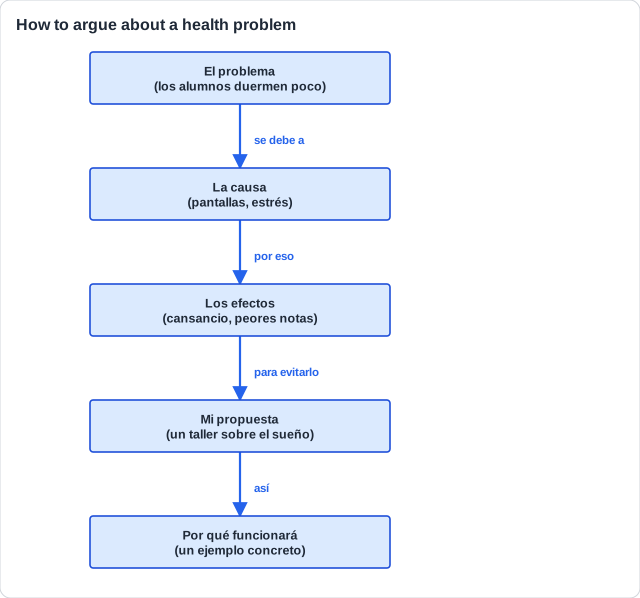
Link your ideas: Connectors lift your answer from a list into an argument: además (besides), sin embargo (however), por lo tanto (therefore), aunque (although). Use at least two or three in any written answer.
Practice with exam-style questions
Answer exam-style questions and get AI feedback that shows you exactly what examiners want to see in a full-marks response.
Read like Paper 2: Here is a short blog — the kind of text Paper 2 (Reading) gives you. Then we'll do one exam question together.
How to read it
Read once for the gist
Read it once just for the general idea; don't worry about every word.
Listen
Tap the audio button to hear it.
Stuck?
Tap Ver traducción if you get stuck.
Gist → listen → translation if stuck
Pequeños hábitos, más energía: Desde que empecé el bachillerato, dormía muy poco: estudiaba hasta muy tarde y al día siguiente estaba agotada y no me concentraba en clase.
Entonces mi médica me explicó que el sueño es tan importante como la comida o el ejercicio. Ahora intento acostarme antes de las once y desayuno fruta y avena en lugar de bollería.
Pequeños hábitos, más energía (continuación)
También salgo a caminar media hora al aire libre cada tarde. No he cambiado mi vida de golpe, pero con estos pequeños hábitos me siento con más energía y de mejor humor.
- agotado/a
- exhausted
- concentrarse
- to concentrate
- la avena
- oats / porridge
- de golpe
- all at once / suddenly
- estar de buen/mal humor
- to be in a good/bad mood
IB-style task — una pregunta de Paper 2
Una pregunta, paso a paso
- The question — Según el texto, ¿qué desayuna ahora la persona?
- Find it in the text. Look for desayuno: Ahora intento acostarme antes de las once y desayuno fruta y avena en lugar de bollería.
- The answer — Desayuna fruta y avena (en lugar de bollería).
Reading technique: For a según el texto (according to the text) question, find the exact line that proves your answer — don't rely on memory or general knowledge.
La tarea — your task: Tu colegio organiza una semana de la salud. Escribe un correo electrónico formal a la directora del instituto: describe los hábitos de salud de los estudiantes y propón cambios para cuidar el cuerpo y la mente.
Escribe entre 450 y 600 palabras.
Formal email structure — 6 steps
Subject line
Say in a few words what the email is about. Asunto: Propuestas para la semana de la salud
Formal greeting
Use the person's title, then a colon. Estimada señora directora:
Body: the situation
Say who you are and describe the problem, in usted. Le escribo como delegada de mi clase…
Your request
Ask for concrete changes politely. Le pido que el colegio ofrezca…, sería útil…
Polite close
Thank the reader and close formally. Le agradezco su atención. Atentamente,
Signature
Your full name and your role. Lucía Pérez, delegada de clase
Subject → Greeting → Situation → Request → Close → Signature
Modelo: los 6 pasos en ~100 palabras
El correo, paso a paso
- Asunto: Propuestas para la semana de la salud
- Estimada señora directora:
- Le escribo como delegada de mi clase para hablarle de la salud de los estudiantes. Muchos dormimos poco, comemos comida rápida en el recreo y casi no hacemos ejercicio. Por eso, a menudo estamos cansados y estresados.
- Por ello, le pido que durante la semana de la salud el colegio ofrezca fruta gratis en el recreo y organice clases de yoga por la mañana. Además, sería útil una charla sobre el sueño.
- Le agradezco de antemano su atención y quedo a la espera de su respuesta. Atentamente,
- Lucía Pérez, delegada de 2.º de Bachillerato
Por qué funciona — why it works: A strong formal email does this for each of the three Paper 1 criteria:
A — Language /12
- Present to describe habits: dormimos, comemos
- Subjunctive after a request: le pido que… ofrezca
- Conditional for politeness: sería útil
- Connectors: por eso, por ello, además
B — Message /12
- Task fully done: describes habits AND proposes changes
- Two concrete proposals, each with a reason
C — Conceptual /6
- Email conventions: Asunto:, Estimada…:, Atentamente, signature
- Usted all the way through: le escribo, su atención
- Polite, clear request to someone in charge
Ready to ace Health & well-being?
You've seen the preview. Here's what you'll unlock:
Bite-Sized Study Notes
Full syllabus broken into chunks that stick
Exam Practice
See exactly how to score full marks
AI Feedback
Know exactly what examiners want
Smart Study Plan
Know exactly what to study next