Lifestyles vocab — built for HL too: Relax: the daily-routine words and work-life-balance opinion phrases on this estilos de vida page are exactly the set SL learns, so you have landed in the right place.
Same as SL
- Daily-routine words
- Work-life-balance opinion phrases
- The same estilos de vida set SL learns
What HL adds later
- You stretch this vocabulary across a 450–600-word Paper 1 task
- You lean on it when you discuss your two literary works
- Master the phrases now and the HL load feels far lighter
What 'estilos de vida' covers: Lifestyles (estilos de vida) is part of the theme Identities. You need vocabulary to describe daily routines, habits, the pace of life and well-being — and to give your opinion about them. Learn the words below as a deck, then use them in the reading and writing sections.
- el estilo de vida
- lifestyle
- la rutina (diaria)
- (daily) routine
- el ritmo de vida
- the pace of life
- madrugar
- to get up early
- trasnochar
- to stay up late
- el ocio / el tiempo libre
- leisure / free time
- el bienestar
- well-being
- llevar una vida sana
- to live a healthy life
- el equilibrio entre la vida y el trabajo
- work-life balance
- la vida sedentaria
- a sedentary life
- desconectar (de las pantallas)
- to switch off (from screens)
- estar estresado/a — el estrés
- to be stressed — stress
- cuidar la alimentación
- to watch what you eat
| Useful expression (Spanish) | English |
|---|---|
| Llevo una vida muy ajetreada. | I lead a very hectic life. |
| Intento mantener el equilibrio. | I try to keep a balance. |
| Me gusta desconectar los fines de semana. | I like to switch off at weekends. |
| Paso demasiado tiempo frente a la pantalla. | I spend too much time in front of the screen. |
| Hago ejercicio para reducir el estrés. | I exercise to reduce stress. |
Why this matters: This vocabulary turns up in every skill — a reading text on health, a listening interview about routines, a Paper 1 blog, or your oral. Reusing the right topic words is how you score Criterion A (Language).
Free preview
Reading it is one thing — hearing it is another
You're reading the free notes. Aimnova Pro unlocks the full study experience — and you can try it with your first topic free to keep:
- Audio on every wordTap any vocabulary word or example to hear it read aloud in natural Spanish.
- FlashcardsLock in vocabulary and key terms with spaced repetition.
- Practice questionsAnswer exam-style questions and get instant AI marking.
- Mock exams & past-paper vaultSit full mocks and see exactly how examiners award marks.
- Personalised study planA daily plan built around your exam date and weak areas.
Have something to say: Examiners reward developed ideas, not just vocabulary. Around lifestyles, the common debates are: a fast, busy modern life vs vida lenta (slow living), screen time and social media, and how to stay healthy. Take a position and back it up.
Opinion phrases (use these to introduce a view)
- En mi opinión… / Desde mi punto de vista… — In my opinion… / From my point of view…
- Me parece que… / Creo que… — It seems to me that… / I think that…
- Lo más importante es… — The most important thing is…
- Por un lado… por otro lado… — On the one hand… on the other hand…
- Estoy (totalmente) de acuerdo con… — I (completely) agree with…
Desventajas del ritmo moderno (drawbacks)
- Mucha gente vive estresada y duerme poco.
- Pasamos demasiado tiempo frente a las pantallas.
- Una vida sedentaria perjudica la salud.
Ventajas (benefits)
- Tenemos más oportunidades y comodidades.
- La tecnología nos conecta con el mundo.
- Es más fácil informarse y aprender.
Daily habits
- dormir poco, madrugar, el horario escolar
- pasar el día sentado, el móvil en el recreo
- una semana sin pantallas
Living better
- un club de cocina en el instituto
- saber arreglar una bici, hacer un presupuesto
- la vida lenta frente a la vida ajetreada
Consuming differently
- la ropa de segunda mano
- un mercadillo de intercambio sin dinero
- trabajar a distancia, los nómadas digitales
Big questions behind this topic (IB guide, theme Identities)
- ¿Qué ideas e imágenes asociamos con un estilo de vida sano?
- ¿Cómo expresamos quiénes somos con lo que hacemos cada día?
- ¿Vivimos demasiado deprisa?
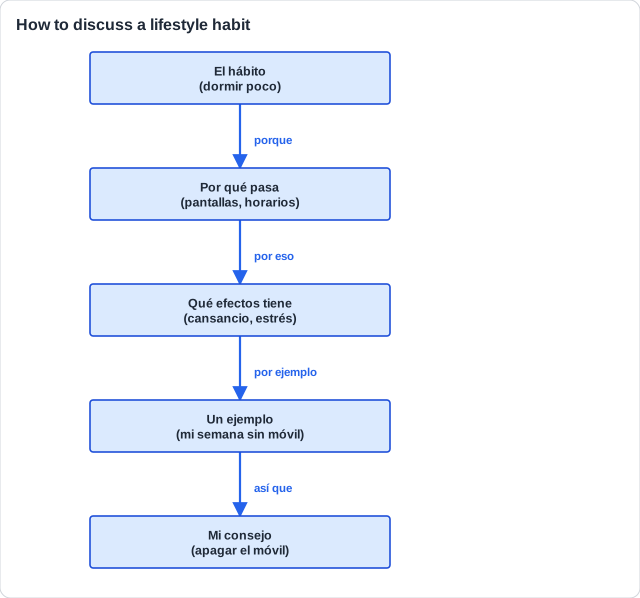
Link your ideas: Connectors lift your answer from a list into an argument: además (besides), sin embargo (however), por lo tanto (therefore), aunque (although). Use at least two or three in any written answer.
See how examiners mark answers
Answer exam-style questions with model answers. Learn exactly what earns marks and what doesn't.
Read like Paper 2: Here is a short blog — the kind of text Paper 2 (Reading) gives you. Then we'll do one exam question together.
How to read it
Read once for the gist
Read it once just for the general idea; don't worry about every word.
Listen
Tap the audio button to hear it.
Stuck?
Tap Ver traducción if you get stuck.
Gist → listen → translation if stuck
Una semana sin pantallas: Hace un mes decidí pasar una semana sin redes sociales. Al principio fue difícil: cada cinco minutos cogía el móvil por costumbre.
Pero pronto todo cambió. Empecé a dormir mejor porque ya no miraba la pantalla antes de acostarme, y tenía más tiempo para mi familia. Me di cuenta de que pasaba horas mirando vídeos sin querer.
Una semana sin pantallas (continuación)
Ahora apago el móvil después de cenar y lo dejo en otra habitación. No he renunciado a la tecnología, pero he aprendido a llevar una vida más equilibrada.
- por costumbre
- out of habit
- acostarse
- to go to bed
- darse cuenta (de)
- to realise
- renunciar a
- to give up
- equilibrado/a
- balanced
IB-style task — una pregunta de Paper 2
Una pregunta, paso a paso
- The question — Según el texto, ¿qué hace la persona con el móvil después de cenar?
- Find it in the text. Look for después de cenar: Ahora apago el móvil después de cenar y lo dejo en otra habitación.
- The answer — Apaga el móvil y lo deja en otra habitación.
Reading technique: For a según el texto (according to the text) question, find the exact line that proves your answer — don't rely on memory or general knowledge.
La tarea — your task: Tu colegio organiza una campaña sobre la vida sana. Escribe un blog para otros/as estudiantes: describe tu estilo de vida y da consejos para vivir de forma más equilibrada.
Escribe entre 450 y 600 palabras.
Blog structure — 5 steps
Catchy title
A title, often a question. ¿Vives con prisa?
Greeting + topic
Greet the reader and say what the post is about. ¡Hola a todos! Hoy quiero hablaros de…
Your experience
Describe your old routine in the past (imperfect). Antes vivía muy estresada…
Two or three tips
Give advice using the imperative. Dormid bien, cuidad la alimentación, desconectad del móvil.
Motivating close
Finish with an encouraging line. ¡Empezad hoy! Os sentiréis mejor.
Title → Greeting → Experience → Tips → Close
Modelo: los 5 pasos en ~100 palabras
El blog escrito, paso a paso
- ¿Vives con prisa? Yo también, hasta hace poco.
- ¡Hola a todos! Soy Marta y hoy quiero hablaros de algo importante: nuestro estilo de vida.
- Antes vivía muy estresada: madrugaba, comía cualquier cosa y pasaba horas en el móvil. No tenía ningún equilibrio.
- Por eso os doy tres consejos: primero, dormid bien; segundo, cuidad vuestra alimentación; y tercero, desconectad de las pantallas un rato cada día.
- Sin embargo, lo más importante es no obsesionarse: llevar una vida sana es encontrar el equilibrio. ¡Empezad con un pequeño cambio esta semana y os sentiréis mucho mejor!
Por qué funciona — why it works: A strong blog does this for each of the three Paper 1 criteria:
A — Language /12
- Range of tenses: imperfecto vivía, imperativo dormid
- Connectors: sin embargo, por eso
- Topic vocabulary, used accurately
B — Message /12
- Task fully done: describes a lifestyle AND gives advice
- Ideas developed with concrete examples
C — Conceptual /6
- Blog conventions: a catchy title
- Direct address: os doy, empezad
- A persuasive, personal tone
Ready to ace Lifestyles?
You've seen the preview. Here's what you'll unlock:
Bite-Sized Study Notes
Full syllabus broken into chunks that stick
Exam Practice
See exactly how to score full marks
AI Feedback
Know exactly what examiners want
Smart Study Plan
Know exactly what to study next