Informal email: same craft at HL: The warm greetings, friendly tú register and casual sign-offs of an informal email are the same at HL and SL. You are in the right place.
The informal email/letter: An informal email or letter (correo o carta informal) is a personal message to someone you know well — a friend, a relative, a pen-pal.
In Paper 1
- You choose it when the task tells you to write to a friend or family member.
- It's part of Unit 2: Text Types.
- The marks come from getting its conventions and register right (Criterion C), not just the message.
What HL adds later
- This chatty voice has to stretch across a 450–600-word Paper 1 answer.
- You use it again when you discuss your two literary works.
- Nail the tone now and the rest follows.
- el correo (electrónico) / la carta
- the email / the letter
- el destinatario
- the recipient (who you write to)
- el saludo
- the greeting
- la despedida
- the sign-off / closing
- el registro informal
- informal register (with a friend you use tú)
- el tono cercano
- a friendly, close tone
Spot it in the task: The task names your reader. "Escribe a tu amigo/a…", "Escríbele a tu primo/a…" → a friend or relative → informal. If it said "Escribe al director" you'd switch to a formal letter (a different text type). Always read who the reader is first.
Tasks where it fits
- Telling a friend about a trip, a course or a first day at work
- Encouraging a best friend who is moving abroad
- Warning a friend about fake news or online scams
Conventions the examiner checks
- A greeting with the name: «¡Hola, Marta!»
- tú (or vosotros) from start to finish
- A friendly close: «Un abrazo», «Escríbeme pronto»
Traps that cost Criterion C
- Slipping into usted halfway through
- «Estimado/a» or «Atentamente»: that is a formal letter
- No greeting or no sign-off at all
Free preview
Reading it is one thing — hearing it is another
You're reading the free notes. Aimnova Pro unlocks the full study experience — and you can try it with your first topic free to keep:
- Audio on every wordTap any vocabulary word or example to hear it read aloud in natural Spanish.
- FlashcardsLock in vocabulary and key terms with spaced repetition.
- Practice questionsAnswer exam-style questions and get instant AI marking.
- Mock exams & past-paper vaultSit full mocks and see exactly how examiners award marks.
- Personalised study planA daily plan built around your exam date and weak areas.
Keep it informal: Use tú (or vosotros for more than one friend), a warm, personal tone, and everyday language.
Show closeness
- Ask how they are.
- Use exclamations.
- Add a friendly question.
Consistency matters: Slipping into formal usted or stiff phrasing breaks the register and costs you Criterion C.
Informal — do this
- ¡Hola, Marta! ¿Qué tal?
- Te escribo para contarte…
- Un abrazo, / Besos,
Formal — avoid here
- Estimada señora:
- Le escribo para informarle…
- Atentamente,
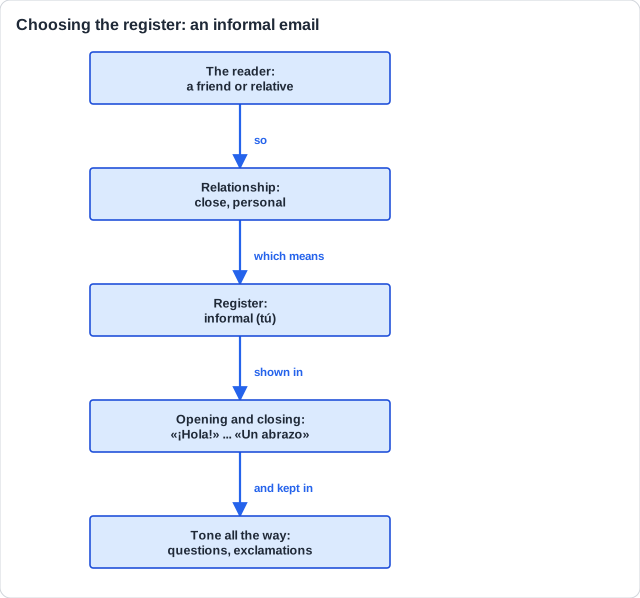
Stay consistent: Pick tú and keep it from the greeting to the sign-off. Verbs, pronouns (te, tu, contigo) and the closing all have to agree with that choice.
Get feedback like a real examiner
Submit your answers and get instant feedback — what you did well, what's missing, and exactly what to write to score full marks.
The five parts: Every informal email/letter follows the same shape. Hit all five parts and you've covered the conventions the examiner is looking for.
Informal email — 5 parts
Greeting
A friendly greeting + the reader's name. ¡Hola, Marta!
Opening
Ask how they are and say why you're writing. ¿Qué tal? Te escribo porque…
Body
Your news/message, in a warm, personal tone — the longest part. ¿Te acuerdas de…? ¡Pues…!
Wrap-up
Round off, often with an invitation or a question back. ¿Te apetece que quedemos?
Sign-off
An informal closing + your name. Un abrazo, / Besos, [tu nombre]
Greeting → Opening → Body → Wrap-up → Sign-off
Don't skip the frame: Students lose easy Criterion C marks by forgetting the greeting or sign-off. They take seconds and show you know the text type — never leave them out.
A model, part by part: Here's a complete informal email built from the five parts above. Read it once for the message, then tap Ver traducción to check the English or the audio button to hear it.
Modelo: las 5 partes en acción
El correo escrito, parte por parte
- ¡Hola, Marta!
- ¿Qué tal todo? Te escribo porque por fin tengo una noticia que contarte.
- ¿Te acuerdas del concurso de fotografía del que te hablé? ¡Pues he ganado el primer premio! Todavía no me lo creo.
- Me encantaría celebrarlo contigo. ¿Te apetece que quedemos el sábado para tomar algo?
- Bueno, te dejo. ¡Escríbeme pronto y cuéntame cómo estás! Un abrazo muy fuerte, Lucía
Por qué puntúa — why it scores: This short email earns marks on all three Paper 1 criteria — here's how:
A — Language /12
- Friendly, accurate language; tú throughout
- Connectors & variety: por fin, todavía
- Correct verbs (he ganado, quedemos)
B — Message /12
- Clear purpose: shares news AND invites
- Ideas developed (the contest, the plan)
C — Conceptual /6
- Email conventions: greeting + sign-off
- Consistent informal register (tú)
- Warm, personal tone
Learn what examiners really want
See exactly what to write to score full marks. Our AI shows you model answers and the key phrases examiners look for.
A toolkit you can reuse: Learn a few ready-made phrases for each part. They make your email sound natural and save time in the exam. Tap the audio button to hear them.
Para empezar (openings)
- ¡Hola, [nombre]! ¿Qué tal? — Hi, [name]! How are you?
- ¿Cómo estás? ¡Cuánto tiempo! — How are you? Long time no see!
- Te escribo para contarte que… — I'm writing to tell you that…
Para el cuerpo (linking your news)
- ¿Te acuerdas de…? — Do you remember…?
- Por cierto… / Además… — By the way… / Also…
- ¡No te lo vas a creer! — You won't believe it!
Para terminar (closings)
- Bueno, te dejo. ¡Escríbeme pronto! — Anyway, I'll leave it there. Write soon!
- Cuéntame cómo te va. — Tell me how things are going.
- Un abrazo (muy fuerte), / Besos, — A (big) hug, / Kisses,
Use one from each: One opener, one or two linkers in the body, and one closer is plenty — and instantly makes the email feel like the real text type.