Scientific innovation for HL: No need to overthink it: the innovación científica vocabulary for science, research and new discoveries is shared with SL exactly, so this is genuinely your material.
Same as SL
- Science
- Research
- New discoveries
What HL adds later
- These technical words have to survive denser Paper 2 texts
- They also face a longer written response
- Build a clear, confident science vocabulary now and you will handle the heavier HL reading and the 450–600-word essay with far less strain
What 'la innovación científica' covers: Scientific innovation (la innovación científica) is part of the theme Human ingenuity. You need vocabulary to talk about inventions, technology, research, artificial intelligence and how science changes our lives — and to give your opinion about them. Learn the words below as a deck, then use them in the reading and writing sections.
- la innovación científica
- scientific innovation
- el invento / inventar
- invention / to invent
- el avance (tecnológico)
- (technological) advance
- el descubrimiento / descubrir
- discovery / to discover
- la inteligencia artificial
- artificial intelligence
- la investigación / investigar
- research / to research
- el científico / la científica
- scientist
- el laboratorio
- laboratory
- mejorar la vida
- to improve life
- resolver un problema
- to solve a problem
- sostenible
- sustainable
- el riesgo / arriesgado/a
- risk / risky
- la ética
- ethics
| Useful expression (Spanish) | English |
|---|---|
| La inteligencia artificial está cambiando el mundo. | Artificial intelligence is changing the world. |
| Este invento puede resolver problemas reales. | This invention can solve real problems. |
| La investigación científica salva vidas. | Scientific research saves lives. |
| Hay que usar la tecnología de forma responsable. | We have to use technology responsibly. |
| Me interesan los avances que son sostenibles. | I'm interested in advances that are sustainable. |
Why this matters: This vocabulary turns up in every skill — a reading text about a new invention, a listening interview with a scientist, a Paper 1 article about technology, or your oral. Reusing the right topic words is how you score Criterion A (Language).
Free preview
Reading it is one thing — hearing it is another
You're reading the free notes. Aimnova Pro unlocks the full study experience — and you can try it with your first topic free to keep:
- Audio on every wordTap any vocabulary word or example to hear it read aloud in natural Spanish.
- FlashcardsLock in vocabulary and key terms with spaced repetition.
- Practice questionsAnswer exam-style questions and get instant AI marking.
- Mock exams & past-paper vaultSit full mocks and see exactly how examiners award marks.
- Personalised study planA daily plan built around your exam date and weak areas.
Have something to say: Examiners reward developed ideas, not just vocabulary. Around scientific innovation, the common debates are: progress vs the risks of new technology, artificial intelligence replacing jobs, and the ethics of research. Take a position and back it up.
Opinion phrases (use these to introduce a view)
- En mi opinión… / Desde mi punto de vista… — In my opinion… / From my point of view…
- Me parece que… / Creo que… — It seems to me that… / I think that…
- Lo más importante es… — The most important thing is…
- Por un lado… por otro lado… — On the one hand… on the other hand…
- Estoy (totalmente) de acuerdo con… — I (completely) agree with…
Riesgos del avance (drawbacks)
- Algunos inventos pueden quitar puestos de trabajo.
- La inteligencia artificial plantea problemas de ética y privacidad.
- No toda la innovación llega a todo el mundo por igual.
Beneficios de la ciencia (benefits)
- La investigación médica salva muchas vidas.
- La tecnología puede ayudar al medio ambiente.
- Los avances resuelven problemas reales y mejoran la vida.
Inventions from waste
- el Piñatex: un cuero hecho con hojas de piña
- bolsas con cáscaras de plátano
- bacterias que comen plástico
Science for real problems
- un trigo que resiste la sequía
- medir la contaminación lumínica con el móvil
- un filtro de agua con arena y carbón
Learning to innovate
- empezar a investigar en la universidad
- aprender de los fracasos
- la feria de ciencias, la ciencia ciudadana
Big questions behind this topic (IB guide, theme Human ingenuity)
- ¿Cómo influyen los avances científicos en nuestras vidas?
- ¿Debe tener límites la ciencia?
- ¿Qué papel tiene el fracaso en la innovación?
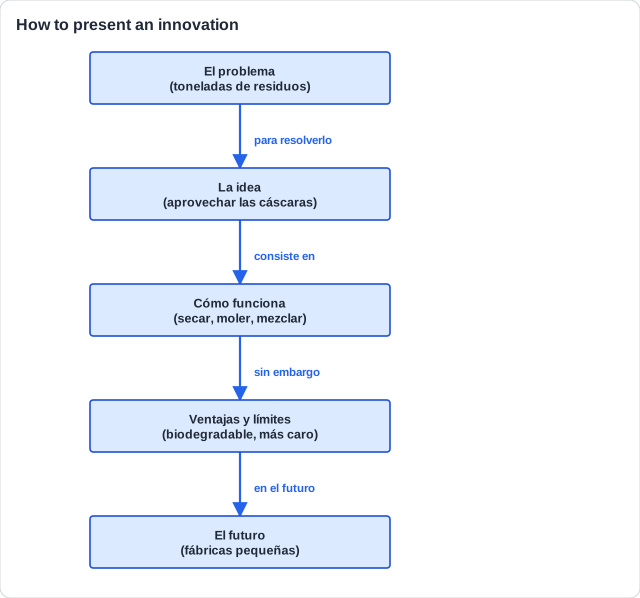
Link your ideas: Connectors lift your answer from a list into an argument: además (besides), sin embargo (however), por lo tanto (therefore), aunque (although). Use at least two or three in any written answer.
Stop wasting time on topics you know
Our AI identifies your weak areas and focuses your study time where it matters. No more overstudying easy topics.
Read like Paper 2: Here is a short blog, the kind of text Paper 2 (Reading) gives you. Read it once just for the general idea; don't worry about every word.
How to use the text
- Tap the audio button to hear it.
- Tap Ver traducción if you get stuck.
- Then we'll do one exam question together.
Un día en el museo de la IA: El fin de semana pasado visité un museo de inteligencia artificial que acaba de abrir en mi ciudad. La verdad es que fui un poco escéptica, pero salí encantada.
En la primera sala, un robot guía nos explicaba cada invento en varios idiomas.
Un día en el museo de la IA (continuación)
Después probé una aplicación que diagnostica enfermedades a partir de una foto, y me quedé sorprendida por su rapidez. Lo que más me gustó fue un taller donde un científico nos mostró cómo la tecnología puede ayudar al medio ambiente. Salí pensando que la innovación no da miedo: bien usada, mejora nuestra vida y resuelve problemas reales.
- escéptico/a
- sceptical
- el robot guía
- the robot guide
- diagnosticar
- to diagnose
- el taller
- the workshop
- el medio ambiente
- the environment
IB-style task — una pregunta de Paper 2
Una pregunta, paso a paso
- The question — Según el texto, ¿qué hacía la aplicación que probó la persona?
- Find it in the text. Look for una aplicación: probé una aplicación que diagnostica enfermedades a partir de una foto, y me quedé sorprendida por su rapidez.
- The answer — Diagnostica enfermedades a partir de una foto.
Reading technique: For a según el texto (according to the text) question, find the exact line that proves your answer — don't rely on memory or general knowledge.
La tarea — your task: Tu clase visitó un museo de ciencia e inteligencia artificial. Escribe un informe para el director o la directora del colegio: explica el objetivo de la visita, qué observasteis y qué recomiendas para el futuro.
Escribe entre 450 y 600 palabras.
Report structure — 4 steps
Title
Say exactly what the report is about. Informe: visita al Museo de la Ciencia
Purpose
One sentence on why the report exists. Objetivo: el presente informe resume…
Findings
Facts and figures, in the past, no personal anecdotes. El 85 % dijo que…
Recommendations
Concrete next steps, often impersonal. Se recomienda…
Title → Purpose → Findings → Recommendations
Modelo: los 4 pasos en ~100 palabras
El informe, paso a paso
- Informe: visita al Museo de la Ciencia y la Innovación
- Objetivo: el presente informe resume la visita de 2.º de Bachillerato del 10 de marzo y valora su utilidad para la clase de ciencias.
- Resultados: los estudiantes probaron una aplicación que detecta enfermedades con una foto y conocieron inventos que reducen la contaminación. El 85 % dijo que la visita le ayudó a entender mejor la ciencia. No obstante, el tiempo en cada sala fue demasiado corto.
- Recomendaciones: se recomienda repetir la visita cada año, dedicar más tiempo a los talleres y preparar las preguntas en clase antes de ir.
Por qué funciona — why it works: A strong report does this for each of the three Paper 1 criteria:
A — Language /12
- Preterite for findings: probaron, conocieron
- Impersonal se: se recomienda
- Connector of contrast: no obstante
B — Message /12
- Task fully done: purpose, observations AND recommendations
- Findings backed by a figure and examples
C — Conceptual /6
- Report conventions: a precise title and headed sections
- Formal, impersonal style; facts, not feelings
- Recommendations as clear next steps
Ready to ace Scientific innovation?
You've seen the preview. Here's what you'll unlock:
Bite-Sized Study Notes
Full syllabus broken into chunks that stick
Exam Practice
See exactly how to score full marks
AI Feedback
Know exactly what examiners want
Smart Study Plan
Know exactly what to study next