Key idea: Stress can harm health in two ways: directly through stress hormones, and indirectly by changing what people do.
Two routes from stress to illness
The body route
The HPA axis releases cortisol. Short bursts help; months of it raise appetite, blood pressure and blood sugar, and weaken the immune system.
The behaviour route
Stressed people often eat more sweet food, smoke, drink more and sleep less.
Body · Behaviour
Stress: Epel and colleagues (2001) found women who released more cortisol under stress ate more, especially sweet food, afterwards. The 59 women were given a hard task in a laboratory.
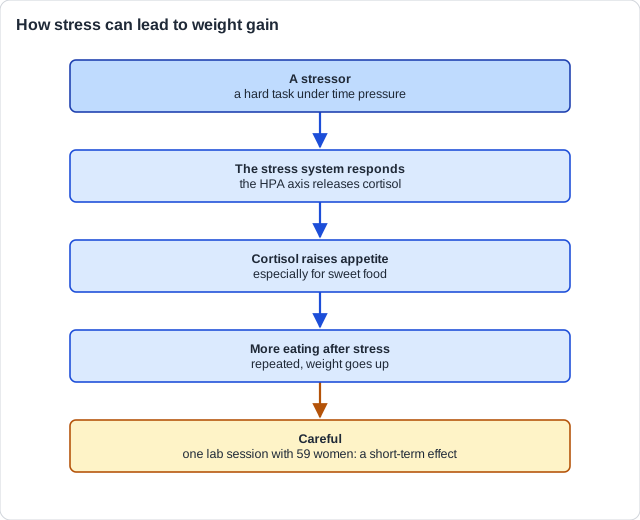
Go further: higher-level insight: Cortisol is a chemical messenger (see 2.1.4). Short bursts help us cope; it is the long-term, repeated release that harms health.
Free preview
This is the free notes preview
You're reading the free notes. Aimnova Pro unlocks the full study experience — and you can try it with your first topic free to keep:
- FlashcardsLock in vocabulary and key terms with spaced repetition.
- Practice questionsAnswer exam-style questions and get instant AI marking.
- Mock exams & past-paper vaultSit full mocks and see exactly how examiners award marks.
- Personalised study planA daily plan built around your exam date and weak areas.
Key idea: The same pressure makes some people ill and leaves others well. Risk and protective factors explain the difference.
Risk factors
- Long-term strain: debt, caring, conflict
- Few people to turn to
- Poor sleep and smoking
Protective factors
- Social support
- Coping skills, such as problem-solving
- Exercise and enough sleep
Cohen and colleagues (1991) gave 394 healthy adults nasal drops containing a cold virus. The more stress people had reported, the more likely they were to catch a cold: from about 27% at the lowest stress to about 47% at the highest.
Watch out: Stress raises risk; it rarely acts alone. Say what else is going on: sleep, smoking, support.