Key idea: Prevalence is how common a health problem is. It changes over time and differs between populations, and each change has causes.
Risk factors
- Genes that affect appetite
- Stress and comfort eating
- Cheap, energy-dense food nearby
Protective factors
- Social support
- Good coping skills
- Safe places to walk and play
Worldwide, obesity has nearly tripled since 1975 (World Health Organization), too fast for genes to explain: food and activity changed.
Go further: higher-level insight: Prevalence changes over time point to environmental causes; differences between countries point to culture, wealth and food supply.
Free preview
This is the free notes preview
You're reading the free notes. Aimnova Pro unlocks the full study experience — and you can try it with your first topic free to keep:
- FlashcardsLock in vocabulary and key terms with spaced repetition.
- Practice questionsAnswer exam-style questions and get instant AI marking.
- Mock exams & past-paper vaultSit full mocks and see exactly how examiners award marks.
- Personalised study planA daily plan built around your exam date and weak areas.
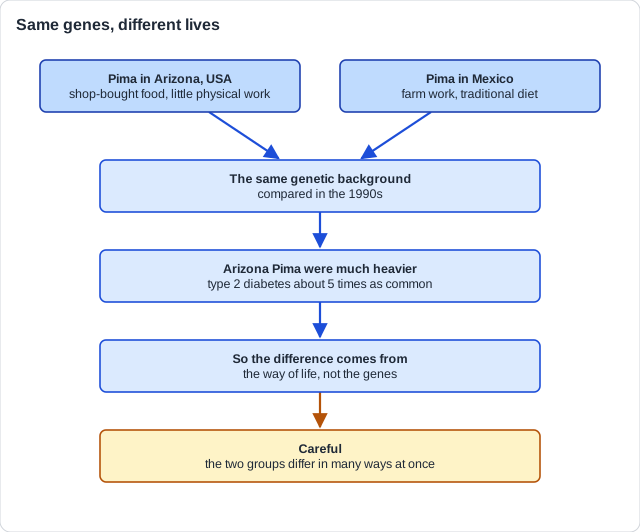
Key idea: Differences between populations point to causes. If two groups share their genes but not their lives, the difference comes from the way they live.
Schulz and colleagues (2006) compared Pima Indians living in Arizona, USA, with Pima living in a remote area of Mexico, who share their genetic background. Type 2 diabetes, closely tied to obesity, was about five times as common in the Arizona Pima, who were also much heavier.
What differs between populations
Food
Cheap, energy-dense food and large portions.
Activity
Desk work and car travel instead of farm work and walking.
Money
Healthy food costs more; poorer groups often have higher rates.
Norms
What a group sees as a normal meal or a normal body size.
Food · Activity · Money · Norms
Watch out: Changes and differences are two questions. A change over time asks what changed; a difference between groups asks how they differ.