Key idea: Conditioning explains simple learning by pairing and by consequences. Operant conditioning has been applied to teach new skills.
Two kinds of conditioning
Classical conditioning
Learning by pairing: a neutral signal comes to trigger a response, such as feeling anxious at the sound of the dentist's drill.
Operant conditioning
Learning by consequences: behaviour that is reinforced is repeated, behaviour that is punished or ignored fades.
Applying it
Change the consequences, such as praise, tokens or attention, and behaviour changes.
Pair · Consequence
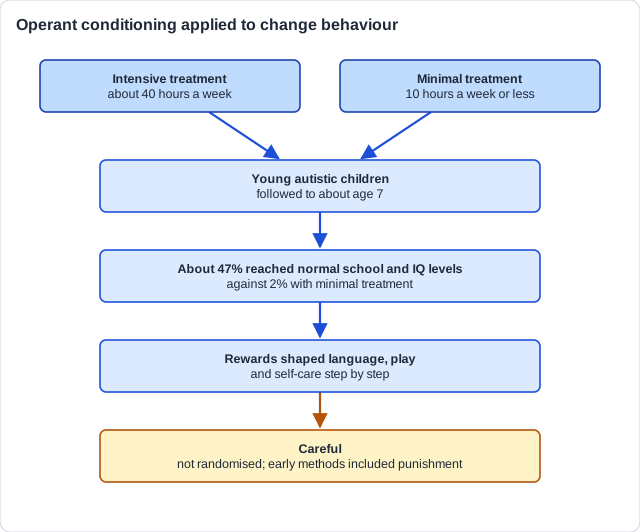
Lovaas (1987) gave young autistic children about 40 hours a week of treatment that rewarded small steps in language, play and self-care. About 47% reached normal school and IQ levels by around age 7, against 2% with minimal treatment.
What HL adds: The motivation extension: reinforcement is one theory of motivation. HL essays can weigh it against theories in which people act for their own goals, not for rewards.
Free preview
This is the free notes preview
You're reading the free notes. Aimnova Pro unlocks the full study experience — and you can try it with your first topic free to keep:
- FlashcardsLock in vocabulary and key terms with spaced repetition.
- Practice questionsAnswer exam-style questions and get instant AI marking.
- Mock exams & past-paper vaultSit full mocks and see exactly how examiners award marks.
- Personalised study planA daily plan built around your exam date and weak areas.
Key idea: Applied conditioning can produce large changes, but the best-known study has design and ethical problems.
Strengths
- Large differences between groups
- Skills built step by step
- Same principle in classrooms
Limitations
- Not randomised
- Early methods used punishment
- Compliance may not meet the child's needs
Modern programmes use rewards, not punishment, and are tested more carefully, but the debate about aims continues.
Watch out: Effectiveness and ethics are both evaluation. Weigh what changed against how it was done.