Key idea: Whether people work harder or less hard in a group can depend on their culture.
Cultural dimensions
1
Individualism and collectivism
Is the self defined alone, or through the group?
2
Power distance
How far people accept that power is unequal.
3
Uncertainty avoidance
How far people prefer clear rules to ambiguity.
Individualism and collectivism · Power distance · Uncertainty avoidance
Earley (1989) gave US and Chinese managers work tasks, alone or in a group. US managers did less in the group, social loafing; Chinese managers did not.
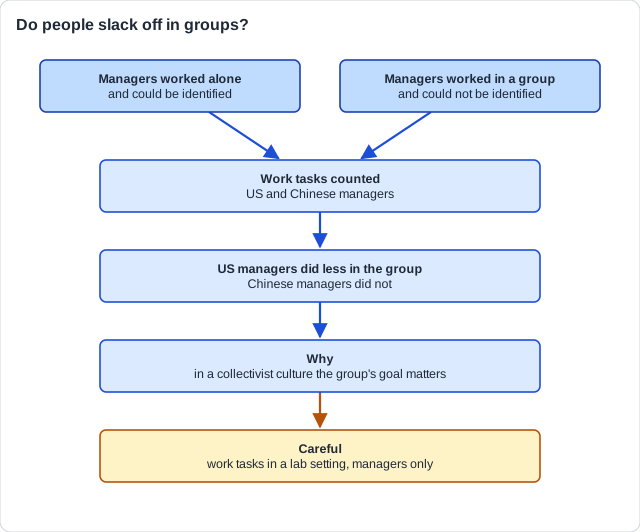
What HL adds: The culture extension: Earley measured collectivism in each person rather than assuming it from nationality, a stronger test of a cultural dimension.
Free preview
This is the free notes preview
You're reading the free notes. Aimnova Pro unlocks the full study experience — and you can try it with your first topic free to keep:
- FlashcardsLock in vocabulary and key terms with spaced repetition.
- Practice questionsAnswer exam-style questions and get instant AI marking.
- Mock exams & past-paper vaultSit full mocks and see exactly how examiners award marks.
- Personalised study planA daily plan built around your exam date and weak areas.
Start Studying Free Full access to Aimnova Pro · cancel anytime
Key idea: Cross-cultural studies link collectivism to group behaviour; country labels can hide individuals.
Strengths
- Direct comparison of cultures
- Collectivism measured, not assumed
- Same pattern for conformity
Limitations
- Managers in a work task
- Individuals differ within countries
- Tasks may mean different things
Culture also changes over time: conformity fell in the USA between the 1950s and 1990s (Bond and Smith).
Watch out: A dimension is a tendency. Do not use it as a stereotype.