Key idea: Conformity shapes what groups do. Brain scans ask whether it also changes what people see.
Why people conform
1
Normative influence
Going along to be liked and accepted by the group.
2
Informational influence
Going along because the group seems to know better.
3
Pluralistic ignorance
Everyone privately disagrees but thinks the others agree.
Normative influence · Informational influence · Pluralistic ignorance
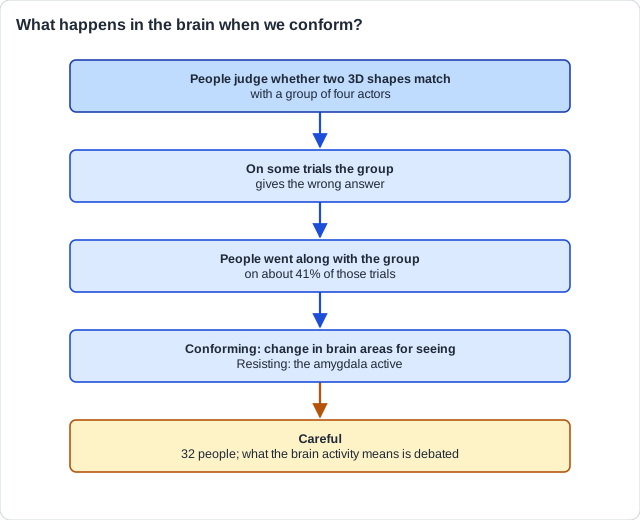
Berns and colleagues (2005) asked people to judge whether 3D shapes matched, alongside a group of four actors who sometimes gave the wrong answer. People went along with the group on about 41% of those trials.
What HL adds: The culture extension: conformity is higher in more collectivist countries (Bond and Smith, 1996, see 3.3.4), so the same group pressure has different effects.
Free preview
This is the free notes preview
You're reading the free notes. Aimnova Pro unlocks the full study experience — and you can try it with your first topic free to keep:
- FlashcardsLock in vocabulary and key terms with spaced repetition.
- Practice questionsAnswer exam-style questions and get instant AI marking.
- Mock exams & past-paper vaultSit full mocks and see exactly how examiners award marks.
- Personalised study planA daily plan built around your exam date and weak areas.
Start Studying Free Full access to Aimnova Pro · cancel anytime
Key idea: Lab, brain and field studies agree that conformity is strong; each method has limits.
Strengths
- Brain imaging adds a biological level
- Field data from real students
- Consistent across methods
Limitations
- 32 people, artificial task
- Brain activity is open to interpretation
- Self-report in the field
Resisting the group was linked to emotion, which suggests why conformity is hard to resist.
Watch out: Activity is not proof. Say what else the brain data could mean.