Key idea: Health habits spread through the people around us: that is social learning at the scale of a whole network.
Risk factors
- Genes that affect appetite
- Stress hormones and comfort eating
- Friends and family who gain weight
Protective factors
- Social support
- Coping skills
- Active friends and family
Christakis and Fowler (2007) followed 12,067 people over 32 years. When a person's friend became obese, their own chance of becoming obese rose by 57%: eating and activity spread through social networks, a social learning explanation.
Go further: higher-level insight: Network data are correlational: friends may share a neighbourhood or simply choose similar people.
Free preview
This is the free notes preview
You're reading the free notes. Aimnova Pro unlocks the full study experience — and you can try it with your first topic free to keep:
- FlashcardsLock in vocabulary and key terms with spaced repetition.
- Practice questionsAnswer exam-style questions and get instant AI marking.
- Mock exams & past-paper vaultSit full mocks and see exactly how examiners award marks.
- Personalised study planA daily plan built around your exam date and weak areas.
Start Studying Free Full access to Aimnova Pro · cancel anytime
Key idea: Models do not have to be in the room. Children copy people they like on screens too, and an experiment can test this directly.
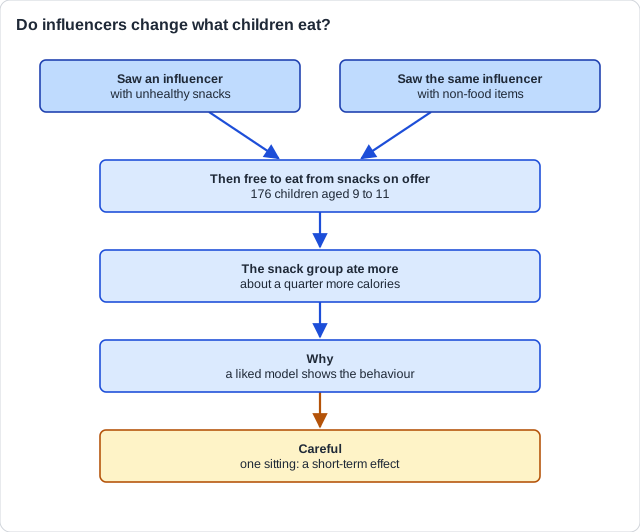
Coates and colleagues (2019) showed 176 children aged 9 to 11 in England posts from a popular influencer with unhealthy snacks, healthy snacks or non-food items. Children who saw the unhealthy snacks then ate about a quarter more calories than those who saw non-food items.
What this adds
- Random allocation: a cause can be shown
- A liked model changes eating
- Supports limits on food adverts
Where to be careful
- One sitting, not long-term weight
- Snacks were on hand at once
- One country, one age group
What HL adds: The technology extension: social media makes models constant and personal. Christakis and Fowler show links in networks; Coates and colleagues test the cause in an experiment.