The report: The report (le rapport) is a testable Paper 1 text type. You write it to present facts, then to recommend action.
What it does
- It presents information objectively — usually the findings of a survey, an investigation or an activity.
- It recommends what should be done.
Tone is the point: The whole point is a neutral, factual, impersonal tone: you give data, not feelings. That objective tone — plus a title, clear section headings and recommendations at the end — is exactly what Criterion C (conceptual understanding) rewards.
| Question | Report answer |
|---|---|
| Who reads it? | A committee, a council, a head teacher, an organisation — readers who want facts. |
| What pronoun? | Impersonal on / passive il est recommandé… — not je, rarely tu/vous. |
| What tone? | Neutral, objective, factual — data and findings, never personal feelings. |
| What must it have? | A title, section headings (Constats, Recommandations) and recommendations. |
| Typical purpose | Present findings and recommend action — objectively. |
Real tasks where it was an option
- Report on the beach clean-up you organised (May 2021)
- Report on your class's work placement (May 2021)
- Report on pigeons fouling the neighbourhood (Nov 2024)
- Report on a new environmental project (May 2026)
Conventions the examiner checks
- Titre, destinataire, auteur, date
- Introduction, headed sections, facts and figures
- Conclusion et recommandations
Traps that cost Criterion C
- Telling a personal story with "je" all through
- No headings
- No recommendations at the end
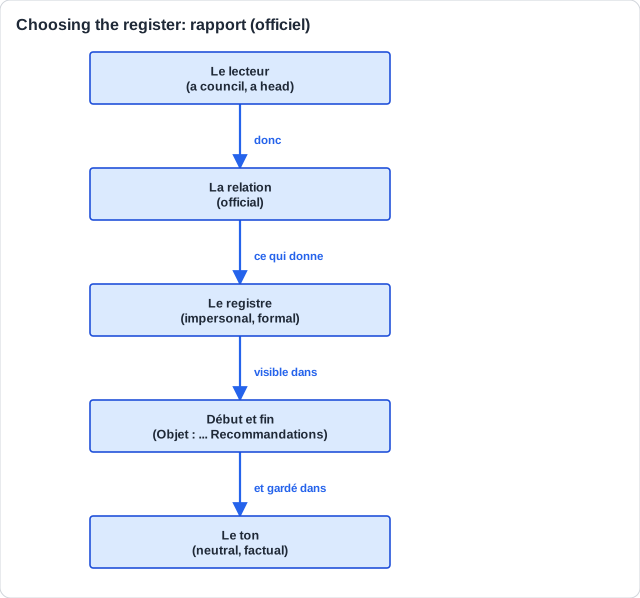
Don't confuse it with a BLOG or a diary: A blog or a diary tells your personal experience with je and feelings (J'ai adoré…). A report presents facts with the impersonal on (On observe que…) and ends with recommendations. Choosing the personal register is the fastest way to lose Criterion C — decide your purpose before you start writing.
Free preview
Reading it is one thing — hearing it is another
You're reading the free notes. Aimnova Pro unlocks the full study experience — and you can try it with your first topic free to keep:
- Audio on every wordTap any vocabulary word or example to hear it read aloud in natural French.
- FlashcardsLock in vocabulary and key terms with spaced repetition.
- Practice questionsAnswer exam-style questions and get instant AI marking.
- Mock exams & past-paper vaultSit full mocks and see exactly how examiners award marks.
- Personalised study planA daily plan built around your exam date and weak areas.
Stay neutral, stay impersonal: Everything in a report points to one register: neutral and impersonal.
How to keep it: Use the on form and impersonal constructions (il est recommandé de…); present facts, not opinions. A single je pense que… or an exclamation breaks the objective tone — and the marks.
Personal / informal (WRONG here)
- Je trouve la cantine nulle, c'est horrible !
- Salut à tous, je vais vous raconter…
- Il faut absolument tout changer !!
- À mon avis, c'est la pire cantine du monde.
Neutral / objective (RIGHT here)
- D'après les données du sondage, on observe que…
- Ce rapport a pour but d'analyser…
- Il est recommandé d'élargir le menu.
- En somme, le service est satisfaisant mais perfectible.
Markers of the neutral, objective tone
- Impersonal on and the passive: on observe que… / il est constaté que…
- Impersonal recommendation: il est recommandé de… / il conviendrait de…
- Data-led phrasing: d'après les données / selon le sondage / la majorité des…
- No slang, no exclamations, no je trouve que… — facts, not feelings
- Connectors of analysis: en effet, par conséquent, en somme
Objectivity is the test: Examiners look for a consistent objective register. Replace je pense que c'est nul with on observe que le service est insuffisant. A report that slips into personal opinion or Salut ! loses Criterion C even if the French is otherwise correct.
Stop wasting time on topics you know
Our AI identifies your weak areas and focuses your study time where it matters. No more overstudying easy topics.
Title → Introduction → Constats → Recommandations → Conclusion: A report follows a fixed, reliable shape with headings. Hit each part and you secure the conventions marks (Criterion C); the title, the section headings and the recommendations are the parts examiners check first.
The 5 parts of a report
Title
A clear title that names the subject. Rapport sur la cantine du lycée.
Introduction
State the aim impersonally. Ce rapport a pour but d'analyser… et de proposer…
Constats (findings)
Present data objectively under a heading. D'après les données, on observe que…
Recommandations
Recommend action impersonally. Il est recommandé de… / il conviendrait de…
Conclusion
Sum up briefly, no new data. En somme, le service est satisfaisant mais perfectible.
Title → Introduction → Constats → Recommandations → Conclusion
| Part | Ready-to-use French |
|---|---|
| Title | Rapport sur [le sujet]. — names the subject at the top |
| Introduction | Ce rapport a pour but d'analyser… et de proposer des améliorations. |
| Constats | D'après les données du sondage, on observe que… / On constate que… |
| Recommandations | Il est recommandé de… / Il conviendrait de… / Il serait souhaitable de… |
| Conclusion | En somme, … / Pour conclure, … (résume sans ajouter de données nouvelles) |
Headings are part of the form: Unlike a letter, a report is organised under headings (Constats, Recommandations). Use them — they make your structure obvious and score easy Criterion C marks. Even when you run short on time, keep the title and a clear recommendation at the end.
See it all in one short report: Here is a complete report — short, but with every part in place. Read it once (tap Voir la traduction if you get stuck), then notice the labelled features below: that's exactly what an examiner ticks off.
Un rapport — modèle (1/3): Rapport sur la cantine du lycée. Introduction. Ce rapport a pour but d'analyser la qualité du service de la cantine et de proposer des améliorations.
Un rapport — modèle (2/3)
Constats. D'après les données d'un sondage, on observe que la majorité des élèves jugent l'offre de plats végétariens insuffisante. On constate également des files d'attente trop longues à l'heure du déjeuner.
Un rapport — modèle (3/3)
Recommandations. Il est recommandé d'élargir le menu et de mieux organiser le service afin de réduire l'attente. Conclusion. En somme, la cantine rend un bon service, mais son appréciation s'améliorerait avec ces changements.
- Title
- Rapport sur la cantine du lycée. — a clear title naming the subject at the very top. Sets the report frame at once.
- Introduction
- Ce rapport a pour but d'analyser… et de proposer des améliorations. — states the aim impersonally, no je.
- Register
- on / passive throughout (on observe, il est recommandé) — never je or personal opinion. One consistent objective register.
- Constats
- D'après les données d'un sondage, on observe que… — findings presented as data, under a heading.
- Recommandations
- Il est recommandé d'élargir le menu… — impersonal recommendations, the core purpose of a report.
- Conclusion
- En somme, la cantine rend un bon service, mais… — a short objective close, no new data. The report is framed.
How to analyse a model: To analyse any report, look at three things: the title + headings (Constats, Recommandations), the impersonal phrasing (on observe, il est recommandé), and the presence of recommendations at the end. Those three reveal the register instantly — and they're the parts you must reproduce in your own answer.
See how examiners mark answers
Answer exam-style questions with model answers. Learn exactly what earns marks and what doesn't.
A toolkit for each part: Keep a small bank of phrases for each part of the report. Reusing them accurately is straight Criterion A (Language) — and it stops you freezing on the introduction or the recommendations.
| For… | Useful French phrase | English |
|---|---|---|
| Title | Rapport sur… / Compte rendu de… | Report on… / Account of… |
| Introduction | Ce rapport a pour but d'analyser… / L'objectif de ce rapport est de… | The aim of this report is to analyse… / The objective of this report is to… |
| Findings | D'après les données, on observe que… / On constate que… / La majorité des… | According to the data, it is observed that… / It is found that… / The majority of… |
| Recommendation | Il est recommandé de… / Il conviendrait de… / Il serait souhaitable de… | It is recommended to… / It would be advisable to… / It would be desirable to… |
| Conclusion | En somme, … / Pour conclure, … / En conclusion, … | In short, … / To conclude, … / In conclusion, … |
Connectors to keep it objective and flowing
- d'abord… ensuite… enfin — first… then… finally (order your findings)
- en effet / d'après les données — indeed / according to the data (back a fact)
- par conséquent / c'est pourquoi — consequently / that is why (link finding to recommendation)
- par ailleurs / de plus — moreover / in addition
- toutefois / cependant — however (a measured contrast, no mais alone)
Impersonal, not personal: Use the impersonal on and the passive to stay objective: On observe que…, Il est recommandé de… sound far more like a report than Je pense que…. A couple of analytical connectors lift you from a list into a real, objective report — and that's rewarded in Criterion A.