Every new estate is built on something: When a city spreads, farmland, forest and wetland are covered by buildings and roads. The ecosystems that are left are split up and cut off. Each change follows from a part of the expansion: roads, concrete, fences, lights.
What expansion does to land and wildlife
- Building covers farmland, forests and wetlands: habitats and food sources are lost.
- Roads and estates fragment what is left into small patches, so edge effects reach further in.
- Roads and fences block wildlife corridors: animals cannot roam, find mates or migrate.
- Small, cut-off populations lose genetic diversity, so species decline or die out locally.
- Concrete seals the soil; gardens bring invasive species; light and noise change animal behaviour.
Remember it as: Cover it, cut it up, cut it off.
Real example: Los Angeles has spread around the Santa Monica Mountains, and freeways cut its mountain lions off from other populations. Inbreeding has lowered their genetic diversity. Since 2022 the Wallis Annenberg Wildlife Crossing has been built over the 101 freeway so that they can move again.
Link each impact to the expansion: Write 'new roads split the woodland into small patches, so species that need a large territory decline'. 'Sprawl reduces biodiversity' on its own does not count, and nor do costs to people such as house prices. Only one positive impact, such as gardens giving habitat, can count.
Free preview
This is the free notes preview
You're reading the free notes. Aimnova Pro unlocks the full study experience — and you can try it with your first topic free to keep:
- FlashcardsLock in vocabulary and key terms with spaced repetition.
- Practice questionsAnswer exam-style questions and get instant AI marking.
- Mock exams & past-paper vaultSit full mocks and see exactly how examiners award marks.
- Personalised study planA daily plan built around your exam date and weak areas.
Covering the ground changes where the rain goes. Less of it soaks in and more of it rushes over the surface into the rivers, carrying dirt with it.
What expansion does to water
- Roofs, roads and car parks are impermeable: rain cannot soak in.
- More runoff, reaching rivers faster, so rivers peak sooner and higher: flash floods.
- Less infiltration means less groundwater, so rivers run lower in dry weather.
- Rivers are straightened or put in concrete channels: flows and river habitats change.
- Water quality falls: sewage from too few or faulty sewers, oil and metals from roads, silt from building sites.
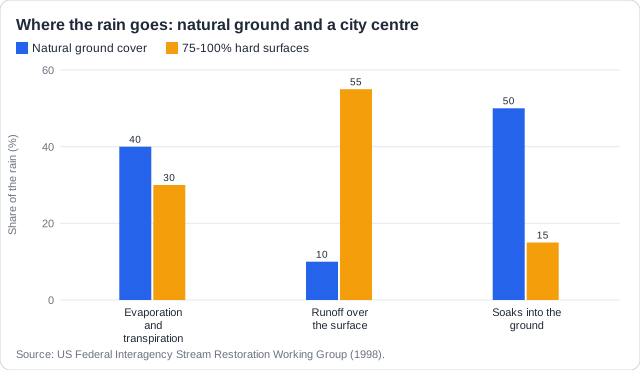
Read the figure with numbers: Runoff rises from 10% to 55% of the rain, and soaking-in falls from 50% to 15%.
Real example: after the flood of 1938, much of the Los Angeles River was put in a concrete channel. Water now rushes through the city after storms, and most of the river's natural habitat was lost.
Practice with exam-style questions
Answer exam-style questions and get AI feedback that shows you exactly what examiners want to see in a full-marks response.
A bigger city means more journeys, more building and more hard surfaces, and the air around it changes.
What expansion does to air and climate
- More cars and longer commutes: more exhaust (nitrogen oxides, particulates) and smog.
- Construction dust, factories and burning fuel or waste add particulates.
- Concrete stores heat and fewer plants cool the air: an urban heat island.
- Cleared forests and soils release carbon, and less carbon is taken up afterwards.
- Light and noise spread into the countryside around the city.
Spread out
- Homes far from jobs and shops.
Drive more
- Longer car journeys every day.
Dirtier air
- Nitrogen oxides and ozone smog.
Real example: Los Angeles, built around the car, has had the worst ozone pollution of any US city in most years of the American Lung Association's 'State of the Air' reports.
Name the pollutant and its source: 'More traffic on longer commutes releases nitrogen oxides' scores. 'Pollution increases' does not.
How this comes up: Paper 2, Section B (a) (May 2026): identify four impacts of urban sprawl on the ecosystems around a city [4]. Each impact must be linked to a part of the sprawl.
Los Angeles has spread outwards around the Santa Monica Mountains.
Identify four possible impacts of urban sprawl on the surrounding terrestrial ecosystems.
Model answer plan
See the mark-by-mark plan — for / against / judgement, with marking guidance — in study mode.