What adds people to a population: Think of a population as a tank of people. Two taps fill it: babies being born, and people moving in, called immigration.
The points to remember
- A human population is a system: people are added and lost every year.
- The inputs add people: births and immigration.
- Immigration = people moving into a place to live there.
- More births or more immigrants make the population grow, unless outputs rise as much.
- Births add babies; immigrants are often young adults, who may then have children there.
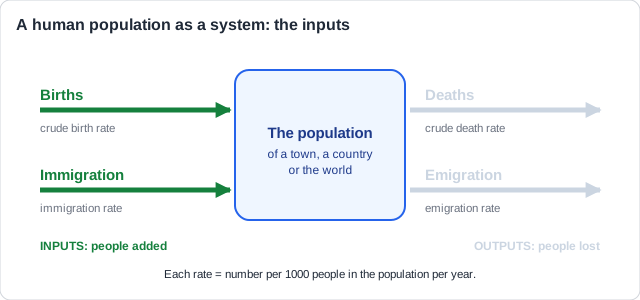
Remember it as: Born here or moved here: both are inputs.
Real example: in Germany in 2022 about 0.74 million babies were born, but about 2.67 million people moved in, over 1 million of them from war-torn Ukraine. Immigration was by far the bigger input.
Free preview
This is the free notes preview
You're reading the free notes. Aimnova Pro unlocks the full study experience — and you can try it with your first topic free to keep:
- FlashcardsLock in vocabulary and key terms with spaced repetition.
- Practice questionsAnswer exam-style questions and get instant AI marking.
- Mock exams & past-paper vaultSit full mocks and see exactly how examiners award marks.
- Personalised study planA daily plan built around your exam date and weak areas.
Counting births is not enough to compare places: a big country has more births just because it has more people. So births are turned into a rate, the crude birth rate.
Crude birth rate
- Crude birth rate (CBR) = the number of live births per 1000 people in a population per year.
- Formula: CBR = births ÷ total population × 1000.
- Always give the unit: per 1000 (per thousand) people per year.
- It is crude: it counts the whole population, men, children and old people too.
- So it shows how fast births add people, not how many children each woman has.
Worked example: South Korea, 2024: 238,343 babies were born in a population of about 51 million.
CBR = births ÷ population × 1000 = 238,343 ÷ 51,000,000 × 1000 = 4.7 per 1000 per year.
Real example: South Korea's 4.7 per 1000 is among the lowest birth rates in the world. In Niger, where women have about six children each, the birth rate is many times higher.
Do not forget the unit: A rate with no unit is just a number. Write 'per 1000' (or per thousand) every time.
Never wonder what to study next
Get a personalized daily plan based on your exam date, progress, and weak areas. We'll tell you exactly what to review each day.
People moving in are measured the same way: the immigration rate. An immigrant}} is counted in the place they arrive.
Immigration rate
- Immigration rate = the number of immigrants per 1000 people in the population per year.
- Formula: immigration rate = immigrants ÷ total population × 1000.
- Immigrants are counted where they arrive: they are an input there.
- People move in for jobs, family, study, or to escape war and disasters.
- A high immigration rate can make a population grow even when few babies are born.
Worked example: Germany, 2022: about 2.67 million immigrants arrived; the population was about 84.3 million.
Immigration rate = 2,670,000 ÷ 84,300,000 × 1000 = about 32 per 1000 per year.
Births
- New people, born in the place
- Measured by the crude birth rate
- Adds babies, who need schools first
Immigration
- People who move in
- Measured by the immigration rate
- Often adds young adults, who can work at once
Real example: Germany's immigration rate in 2022 was about seven times its birth rate (about 32 v about 9 per 1000).
The rates are used at every scale, from a small town to the whole planet. Because each is 'per 1000 people', a town of 48,000 can be compared fairly with a country of 84 million.
Using the rates
- The same rates work for a town, a country, a region or the whole world.
- Per 1000 lets you compare places of very different size fairly.
- Totals mislead: a big country has more births just because it has more people.
- Both rates are averages (mean values) for one year.
- The world has no immigration: births are its only input.
| Scale | Inputs | Example |
|---|---|---|
| A town | Births + people moving in from other towns or countries | A new factory brings workers |
| A country | Births + immigrants from abroad | Germany 2022: refugees from Ukraine |
| The world | Births only: nobody moves in from outside | 8.2 billion people in 2024 |
No immigration for the world: For the global population, migration does not count: people only move from one country to another. Births are the world's only input.
Real example: Niger's high birth rate and Germany's high immigration rate both add people, in very different ways.
Stop wasting time on topics you know
Our AI identifies your weak areas and focuses your study time where it matters. No more overstudying easy topics.
How this comes up: Calculate a crude birth rate or an immigration rate from a fact file [1]; read births and immigrants from a chart [1-2]; outline why rates are given per 1000 [2]; compare two rates [4].
In 2022 Germany had a population of about 84.3 million. About 738,000 babies were born and about 2.67 million immigrants arrived.
Calculate the crude birth rate and the immigration rate of Germany in 2022.
Model answer plan
See the mark-by-mark plan — for / against / judgement, with marking guidance — in study mode.