Soil takes centuries to form, and years to lose: Soil forms at only a few millimetres a century, but bare, overworked fields can lose it in a few storms. Soil conservation keeps soil in place and fertile, and prevention is cheaper than repair.
Stop erosion
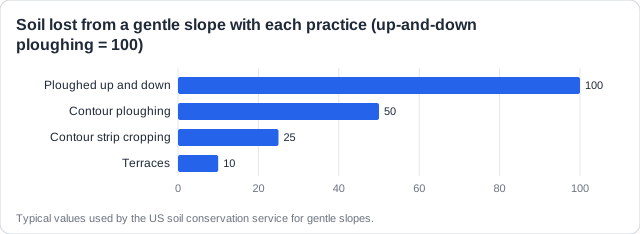
- Water: terraces, contour ploughing, bunds, drainage, cover crops.
- Wind: tree and hedge windbreaks, cover crops.
Keep it fertile
- Soil conditioners: lime, compost, manure, green manure.
Farm it gently
- Avoid marginal land, overgrazing and overcropping.
- Strip cultivation, mixed cropping, crop rotation, reduced tillage, agroforestry, lighter machines.
The points to remember
- Environmental benefits: less erosion, cleaner rivers, more soil carbon and wildlife.
- Economic benefits: higher, steadier yields; less spent on fertilizer.
- Sociocultural benefits: food security, farms passed on, fewer people forced to move.
Example (SL): the Dust Bowl, USA, 1930s. Farmers had ploughed up the grass of the Great Plains for wheat. In the drought of the 1930s the bare soil blew away in huge dust storms, and hundreds of thousands of people left. In 1935 the USA set up the Soil Conservation Service, which taught contour ploughing, strip cropping and tree windbreaks.
Free preview
This is the free notes preview
You're reading the free notes. Aimnova Pro unlocks the full study experience — and you can try it with your first topic free to keep:
- FlashcardsLock in vocabulary and key terms with spaced repetition.
- Practice questionsAnswer exam-style questions and get instant AI marking.
- Mock exams & past-paper vaultSit full mocks and see exactly how examiners award marks.
- Personalised study planA daily plan built around your exam date and weak areas.
Rain loosens soil and runoff carries it downhill. Every water technique works by slowing the water, helping it soak in, or covering the soil.
The points to remember
- Terracing: flat steps on a slope slow runoff and let water soak in.
- Contour ploughing: furrows run across the slope, each one catching the water.
- Bunds and stone lines: low walls of earth or stones along the contour trap water and soil.
- Cover crops and mulch: plants or crop waste shield the soil from raindrops.
- Buffer strips of plants by streams catch soil before it reaches the water.
- Drainage and drip irrigation: less water running over the surface.
Remember it as: Slow it, sink it, cover it.
Example (SL): the Banaue rice terraces, Philippines. For about 2000 years the Ifugao people have farmed rice on terraces carved into steep mountainsides. Each flat, walled step holds water and soil, so the slopes have been farmed without washing away.
Name it AND say how it works: 'Terracing' alone does not score in an outline. 'Terracing makes flat steps on a hillside, which slows runoff' does.
Practice with exam-style questions
Answer exam-style questions and get AI feedback that shows you exactly what examiners want to see in a full-marks response.
Wind lifts dry, loose, bare soil, mostly on flat, open land. The answer is to slow the wind and keep the soil covered.
The points to remember
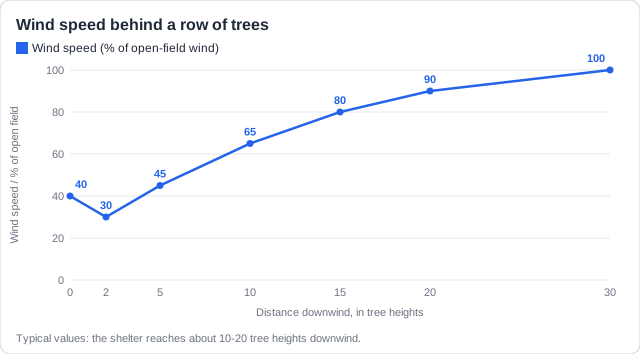
- Windbreaks (shelterbelts): rows of trees or hedges slow the wind for about 10-20 tree heights downwind.
- Cover crops and stubble: roots and stalks hold the soil after harvest.
- Strip cultivation: strips of crop between strips of grass, so no wide bare field.
- Keep soil moist and rich in organic matter, so it clumps and does not blow.
Example (SL): shelterbelts in Jutland, Denmark. Western Jutland's sandy soils blew so badly in the 1800s that sand covered farms. Since the late 1800s, farmers have planted thousands of kilometres of tree and hedge shelterbelts across the wind, and the land is now farmed for crops.
Some soils erode or fail because they are poor, acidic or worn out. Soil conditioners put that right.
The points to remember
- Lime raises the pH of acidic soils, so nutrients become available again.
- Compost and manure add organic matter: better structure, water-holding and soil life.
- Green manure: a crop such as clover is ploughed back in, adding organic matter and nitrogen.
- Gypsum improves the structure of salty, sodic soils.
- Use organic fertilizer rather than synthetic, which can leave salt residues.
Crop rotation also keeps soil fertile: a different crop is grown in the field each year.
Crop rotation: four benefits
- Different crops use different nutrients, so none is used up.
- It breaks pest and disease cycles: pests of one crop cannot build up.
- Legumes in the rotation add nitrogen.
- Different root depths improve soil structure.
Example (SL): velvet bean in Honduras. Hillside farmers in northern Honduras grow velvet bean between maize seasons. It covers the soil, fixes nitrogen and is cut and left as a mulch, and maize yields on these fields roughly doubled.
Feeling unprepared for exams?
Get a clear study plan, practice with real questions, and know exactly where you stand before exam day. No more guessing.
How the land is worked matters as much as what is added. Less disturbance means more soil stays put.
The points to remember
- Reduced or no tillage: seeds are drilled into last year's crop residue, so the soil is never bare.
- Lighter machines, used less often, avoid compaction, so water soaks in.
- Avoid overgrazing: fewer animals, fencing and rotational grazing let grass recover.
- Avoid overcropping and farming marginal land (steep, dry or thin soils).
- Biological pest control and IPM avoid pesticides that kill soil organisms.
Example (SL): no-till in Parana, Brazil. In the 1970s, heavy rain was washing away the red soils of Parana's soybean farms. Farmers began planting straight into the straw of the last crop, without ploughing. The idea spread, and Brazil now farms over 30 million hectares this way.
Link it to the soil: Water saving or pest control alone does not answer a soil question. Say what it does for the soil: 'drip irrigation stops runoff washing soil away'.
Growing several crops, or trees and crops, together keeps the ground covered and spreads the risk.
The points to remember
- Mixed cropping / intercropping: two or more crops in one field at the same time.
- Benefits: legumes fix nitrogen; more plant waste adds nutrients; less erosion.
- Farmers gain: more crops per hectare, less risk of total crop failure, fewer pests, varied income.
- Agroforestry: tree roots hold soil, the canopy breaks the rain, leaf litter adds organic matter.
- Unlike slash-and-burn, agroforestry keeps the land in use for good with no burning.
Remember it as: Many plants, one field: cover, nitrogen, insurance.
Example (SL): the milpa, Mexico. For thousands of years Maya and other farmers have grown maize, beans and squash together. The beans fix nitrogen and climb the maize, and the squash leaves cover the soil, shading out weeds and keeping it moist.
Memorize terms 3x faster
Smart flashcards show you cards right before you forget them. Perfect for definitions and key concepts.
When soil is already damaged, it can be restored, but slowly and at a cost. That is why prevention comes first.
The points to remember
- Add organic matter: compost, manure, biochar.
- Lime for acidic soils; gypsum for sodic soils.
- Replant: trees and grass stabilize the soil and add organic matter.
- Rest the land, fenced from animals, so plants return.
- Sustainability means meeting today's needs without harming the soil for the future.
A bare fallow can harm soil: Leave a field bare and unplanted and roots no longer hold it: wind and rain erode it, rain leaches minerals, and soil life declines. A fallow needs a cover.
Example (SL): Iceland. After settlers cut the birch woods and grazed sheep, Iceland lost much of its soil. Its Soil Conservation Service, founded in 1907, fences eroded land and sows lyme grass and lupins, but a century on, the soil is still only slowly coming back.
To evaluate a strategy, name it, give its advantages and its disadvantages, then judge.
Advantages to look for
- Less soil lost to wind or water.
- Keeps nutrients and water in the soil.
- Higher, steadier yields and incomes.
Disadvantages to look for
- Cost of building or buying (walls, trees, machines).
- Labour and knowledge needed.
- Land lost to walls, hedges or strips; lower yields at first.
Example (SL): terraces in Rwanda. On Rwanda's steep hills, the government has paid farmers to dig 'radical' bench terraces. Soil loss fell and yields rose where manure and lime were added, but the digging is costly and turns up poor subsoil, so new terraces yield little at first.
The points to remember
- Strategy named first.
- Up to two advantages and up to two disadvantages.
- A conclusion that weighs them, using the case.
Know your predicted grade
Take timed mock exams and get detailed feedback on every answer. See exactly where you're losing marks.
How this comes up: Paper 2 Section B (a) asks for four named strategies, each with how it helps [4]; Paper 1 asks you to state, describe or evaluate a strategy for the case study [1-4].
In the middle hills of Nepal, farmers grow rice, maize and millet on steep slopes that receive heavy monsoon rain.
With reference to four named agricultural strategies, outline how they could improve the sustainable use of these soils.
Model answer plan
See the mark-by-mark plan — for / against / judgement, with marking guidance — in study mode.