Put back what the harvest takes: Every harvest carries nitrogen (N), phosphorus (P) and potassium (K) off the farm. Intensive farms that crop the same land every year, with no animals, replace them with synthetic fertilizer to keep their high commercial yields.
The points to remember
- Crops take N, P and K from the soil; selling the crop removes them for good.
- Intensive systems crop every year, with no fallow and often no manure.
- Synthetic fertilizer (made in factories) puts nutrients back fast and in exact amounts.
- It keeps commercial productivity high, but at the expense of sustainability.
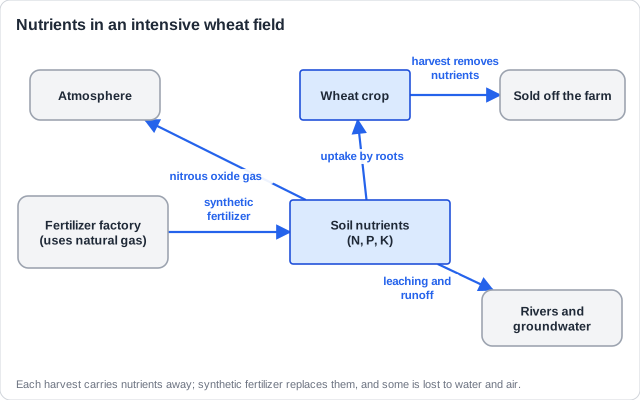
Example (SL): wheat in the UK. British farmers grow about 8 tonnes of wheat on each hectare, among the highest yields in the world. To do it they spread about 190 kg of nitrogen fertilizer on each hectare every year.
Free preview
This is the free notes preview
You're reading the free notes. Aimnova Pro unlocks the full study experience — and you can try it with your first topic free to keep:
- FlashcardsLock in vocabulary and key terms with spaced repetition.
- Practice questionsAnswer exam-style questions and get instant AI marking.
- Mock exams & past-paper vaultSit full mocks and see exactly how examiners award marks.
- Personalised study planA daily plan built around your exam date and weak areas.
Synthetic fertilizer keeps yields up, but much of it never reaches the crop. What is lost harms water, soil and air.
The points to remember
- Water: runoff and leaching add nitrate and phosphate to rivers: eutrophication.
- Drinking water: nitrate in wells and rivers must be removed at a cost.
- Soil: acidification, salt build-up, less organic matter and fewer soil organisms.
- Air and climate: soils release nitrous oxide, a powerful greenhouse gas.
- Energy: making it burns natural gas, so it is fossil-fuel dependent.
Remember it as: Fertilizer lost = algae in water, acid in soil, gas in air.
Farms
- Brittany, in France, is crowded with pig and dairy farms that spread fertilizer and manure.
Runoff
- Rain washes nitrate from the fields into rivers and out to the bays.
Algae
- Sea lettuce grows into thick mats on the beaches.
Harm
- Rotting mats give off toxic hydrogen sulfide gas; beaches have been closed, and a horse died in 2009.
See how examiners mark answers
Answer exam-style questions with model answers. Learn exactly what earns marks and what doesn't.
Synthetic fertilizer is part of a wider intensive system. That system affects soil, water and wildlife too. In the exam, link each cause to its effect.
Soil
- Bare fields lose topsoil to wind and rain: erosion.
- Cropping the same field every year depletes nutrients.
- Heavy machines compact the soil, so water cannot soak in.
- Ploughing speeds decay: organic matter falls.
Water
- Fertilizer runoff: eutrophication.
- Irrigation drains rivers, lakes and aquifers: water scarcity.
- Irrigation in dry areas leaves salt: salinization.
- Pesticides wash into streams and groundwater.
Wildlife
- Clearing land for farms is the biggest cause of biodiversity loss.
- Monocultures leave little habitat; hedges are removed.
- Pesticides kill non-target species, such as bees.
Example (SL): Iowa, USA. Iowa's maize and soybean fields have lost a large part of their original topsoil since ploughing began. Nitrate from the fields is so high in the rivers that the city of Des Moines runs one of the world's largest nitrate-removal plants for its drinking water.
Cause, then effect: Write each impact as a chain: the farming activity, what it does to the environment, the result. 'Fertilizer runoff adds nitrate to rivers, causing algal blooms and oxygen loss' scores; 'pollution' alone does not.
Food production releases about a quarter of the world's greenhouse gases. Each gas has its own farm source. Cattle make methane by enteric fermentation.
The points to remember
- Methane: cattle and sheep belching (enteric fermentation), rotting manure, flooded rice paddies.
- Nitrous oxide: released from soils given synthetic fertilizer or manure.
- Carbon dioxide: fuel for tractors, irrigation pumps, processing and transport.
- Land-use change: clearing forest for pasture removes a carbon sink.
- Eroding and ploughed soils release their carbon as CO2.
Remember it as: Cows and rice: methane. Fertilizer: nitrous oxide. Machines and clearing: CO2.
Example (SL): Ireland. Farming produces about 38% of Ireland's greenhouse gases, far more than in most rich countries. Most comes from the methane of its 7 million cattle and the nitrous oxide from fertilized grassland.
Study smarter, not longer
Most students waste 40% of study time on topics they already know. Our AI tracks your progress and optimizes every minute.
Sustainable farms keep soils fertile in ways that rebuild natural productivity, rather than buying it in a bag. One is humanure.
The points to remember
- Fallowing: rest a field for a season or more so nutrients and organic matter build up again.
- Organic fertilizer: manure from farm animals, compost, or humanure.
- Legumes (beans, peas, clover): bacteria in their roots fix nitrogen from the air.
- Crop rotation: change the crop each year so no nutrient is used up and pests cannot build up.
- Herbal mixed leys: a field of grasses, clovers and herbs grazed for a few years before crops.
Remember it as: Rest it, feed it, fix it, rotate it.
Example (SL): the Norfolk four-course rotation. From the 1700s, English farmers grew wheat, then turnips, then barley, then clover. The clover fixed nitrogen, and sheep fed on the turnips and clover spread manure, so the land never needed a bare fallow year.
Fallow must not be bare: A field left bare between seasons can lose soil to wind and rain and nutrients to leaching. A fallow helps only if plants, crop stubble or a cover crop protect the soil.
Some methods work with living things in and above the soil, so the soil stays covered and fed all year. Mycorrhizae are one of them.
The points to remember
- Mycorrhizae: root fungi that pass phosphorus and water to the plant in return for sugars.
- Ploughing and heavy phosphate fertilizer harm mycorrhizae; less disturbance helps them.
- Continuous cover forestry: trees are cut singly or in small groups, so the soil is never bare.
- Agroforestry: trees grown with crops or animals; leaves add organic matter and roots hold soil.
Example (SL): continuous cover forests in Germany. In parts of the Black Forest, foresters take single trees instead of clear-felling whole hillsides. The canopy and leaf litter stay, so the soil keeps its organic matter and fungi and is never left open to erosion.
Practice with exam-style questions
Answer exam-style questions and get AI feedback that shows you exactly what examiners want to see in a full-marks response.
Synthetic fertilizer
- Fast, exact, high yields; easy to spread.
- Feeds the crop, not the soil: organic matter and soil life decline.
- Losses cause eutrophication and nitrous oxide.
- Made with natural gas; price follows gas prices.
Natural methods
- Build organic matter, soil life and water-holding.
- Use local, cheap inputs: manure, legumes, trees.
- Release nutrients slowly; yields are often lower at first.
- Need more land, labour and knowledge.
The points to remember
- To evaluate, give both sides, then a conclusion.
- A sudden switch can cut yields and food supply.
- Many farms combine them: less fertilizer, plus manure, legumes and rotation.
Example (SL): Sri Lanka, 2021. The government banned synthetic fertilizer imports almost overnight to go fully organic. Farmers had too little manure and compost to replace it, rice and tea harvests fell sharply, and the ban was lifted within months.
How this comes up: Paper 2 Section B can ask you to outline four ways of keeping soil fertile [4]; Paper 1 asks for an impact of farming on soil [1] or on climate [2] from a case study.
A cereal farm in northern France spreads about 170 kg of synthetic nitrogen on each hectare every year.
Outline four methods the farm could use to keep its soil fertile while using less synthetic fertilizer.
Model answer plan
See the mark-by-mark plan — for / against / judgement, with marking guidance — in study mode.