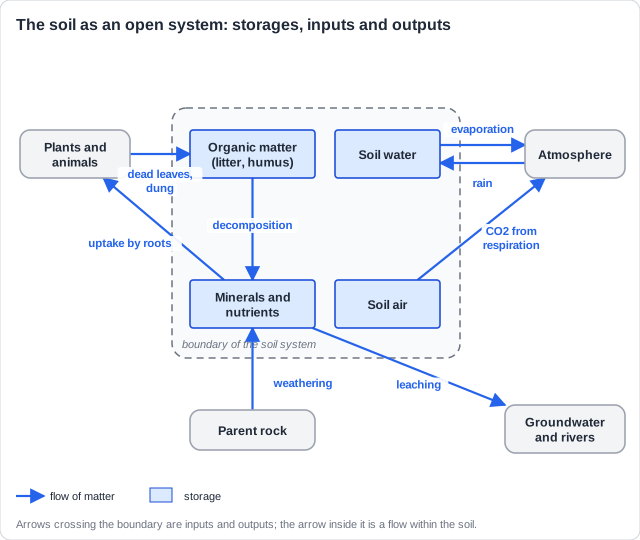
Soil is a system: A system has inputs, outputs, storages and flows. Soil has all four, so it can be studied as a system.
The points to remember
- Soil is an open system: matter and energy cross its boundary.
- Inputs: rain, dead leaves and dung, minerals from weathering of rock, gases from the air.
- Outputs: water lost by evaporation, minerals lost by leaching and erosion, nutrients taken up by plants.
- Storages: organic matter (humus), minerals and nutrients such as nitrates, water, air.
- Flows inside the soil: decomposition turns dead matter into nutrients; water moves down the soil.
- In an answer, name the process and what it moves: 'minerals are lost by leaching', not just 'minerals'.
Remember it as: In, out, kept, moved: inputs, outputs, storages, flows.
Name the thing, then the process: An output to the air is the carbon dioxide or the nitrogen gas, not 'respiration' or 'denitrification' on their own. And an input or output is not a transfer: water seeping down to the B horizon stays inside the soil.
Real example: in the Broadbalk field at Rothamsted, wheat has been grown every year since 1843. Plots given farmyard manure every year (a big input) now hold more than twice as much organic matter as plots given none.
Free preview
This is the free notes preview
You're reading the free notes. Aimnova Pro unlocks the full study experience — and you can try it with your first topic free to keep:
- FlashcardsLock in vocabulary and key terms with spaced repetition.
- Practice questionsAnswer exam-style questions and get instant AI marking.
- Mock exams & past-paper vaultSit full mocks and see exactly how examiners award marks.
- Personalised study planA daily plan built around your exam date and weak areas.
An ecosystem has living and non-living parts that interact. Soil has both, so it is an ecosystem in its own right.
Why soil is an ecosystem
- Like any ecosystem, soil has biotic parts: bacteria, fungi, earthworms, insects, plant roots.
- ... and abiotic parts: sand, silt, clay, water, air and heat.
- The parts interact: decomposers recycle minerals; bacteria in bean roots fix nitrogen.
- Soil supports other systems: plants grow in it, animals burrow in it, people farm and build on it.
- For each feature, add an example of it: 'biotic parts, such as earthworms'.
Biotic: living
- Bacteria and fungi (decomposers)
- Earthworms, mites, insects
- Plant roots
Abiotic: non-living
- Sand, silt and clay
- Water and air in the gaps
- Heat from the Sun
Real example: Charles Darwin studied earthworms for about 40 years. His last book (1881) showed that they drag dead leaves into the soil and carry soil up to the surface, mixing it: living things shaping the non-living soil.
One feature, one example: Write each feature in its own sentence, then give its example: 'soil has abiotic parts, such as clay and water'. A list of examples with no feature named does not show how soil is like an ecosystem.
Practice with exam-style questions
Answer exam-style questions and get AI feedback that shows you exactly what examiners want to see in a full-marks response.
A system that keeps changing: Soil is a dynamic system: its storages grow or shrink as the balance of inputs and outputs changes. It is also part of a bigger system, the ecosystem above and around it.
The points to remember
- Dynamic: the soil is always changing, as inputs and outputs change its storages.
- If inputs are bigger than outputs, a storage grows: more humus, a deeper soil.
- If outputs are bigger, it shrinks: erosion or leaching drain the soil.
- Soil sits within the larger ecosystem: changes in plants, climate or farming change the soil.
- Soils are a resource for life and they vary widely from place to place.
Remember it as: Inputs bigger: the soil builds. Outputs bigger: the soil drains.
Real example: in the 1930s Dust Bowl, farmers on the US Great Plains had ploughed up the grassland. A long drought dried the bare soil and winds blew the topsoil away in huge dust storms: outputs far bigger than inputs.
Soils vary widely
- Deep and dark under grassland
- Thin and stony on mountains
- Red and leached in the wet tropics
... and are a resource for life
- Most of our food grows in soil
- Soil stores and cleans water
- Soil is home to countless species
How this comes up: Paper 2, Section B (a): two inputs and two outputs of the soil system, each as a process.
The Canterbury Plains in New Zealand are farmed for wheat and sheep. Rain falls through the year and the soils lie on gravel washed down from the mountains.
Outline two input processes and two output processes that occur to and from the soil system.
Model answer plan
See the mark-by-mark plan — for / against / judgement, with marking guidance — in study mode.