More food from the same fields: The Green Revolution (also called the Third Agricultural Revolution) began in the 1950s and 1960s. New high-yielding varieties were grown with irrigation, synthetic fertilizer and pesticides, so poorer countries could grow far more food and improve their food security.
The points to remember
- When: the 1950s and 1960s, spreading through Asia and Latin America.
- What: high-yielding crops plus irrigation, synthetic fertilizer and pesticides.
- Aim: more food per hectare, to increase food security as populations grew.
- Criticized for its environmental, economic and sociocultural consequences.
- It did not happen in all developing countries.
Remember it as: New seeds, plus water, plus fertilizer, plus spray.
Example (SL): wheat in Mexico. From 1944 the scientist Norman Borlaug bred short, disease-resistant wheat in Mexico. Mexico stopped importing wheat in 1956, and by 1963 its wheat harvest was about six times larger than in 1944.
Free preview
This is the free notes preview
You're reading the free notes. Aimnova Pro unlocks the full study experience — and you can try it with your first topic free to keep:
- FlashcardsLock in vocabulary and key terms with spaced repetition.
- Practice questionsAnswer exam-style questions and get instant AI marking.
- Mock exams & past-paper vaultSit full mocks and see exactly how examiners award marks.
- Personalised study planA daily plan built around your exam date and weak areas.
Each part of the package removed a limiting factor. Together they raised the yield: the crop harvested from each hectare.
Seeds
- In 1966 India brought in about 18 000 tonnes of Mexican dwarf wheat seed; short stems carry heavy heads of grain without falling over.
Water
- Farmers drilled tube wells, so crops were watered even in dry months.
Fertilizer
- Synthetic fertilizer gave the new wheat the nitrogen it needed to fill its heavy heads.
Sprays
- Pesticides cut the share of the crop lost to insects, fungi and weeds.
Machines
- Tractors and threshers let fewer people farm bigger areas, and plant a second crop the same year.
The points to remember
- High-yielding varieties: more grain per plant, short stems, faster growth, more harvests a year.
- Irrigation: water is no longer the limiting factor.
- Synthetic fertilizer: soil nutrients are no longer limiting.
- Pesticides: less of the crop lost to pests and weeds.
- Machines: more work on bigger areas with fewer people.
- Soil conservation methods cut soil degradation on the more intensively used land.
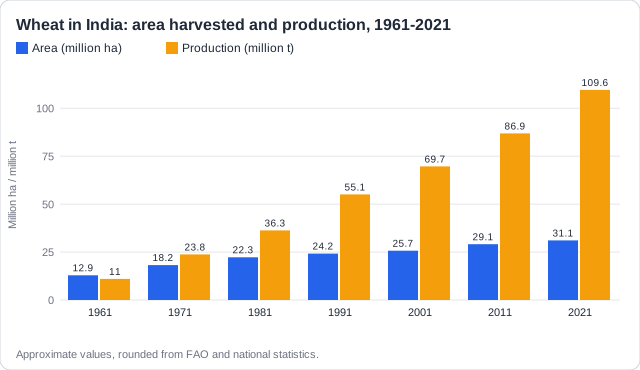
- So production rose far faster than the area farmed.
See how examiners mark answers
Answer exam-style questions with model answers. Learn exactly what earns marks and what doesn't.
The Green Revolution's supporters point to what it achieved for people and for land.
The points to remember
- More food: cereal harvests in Asia rose fast and famines were avoided.
- Food security: countries that imported grain became self-sufficient.
- Cheaper food: bigger harvests lowered grain prices for poor buyers.
- Land spared: more food from the same area, so less forest was cleared for farms.
- Incomes: farmers who could afford the package earned more; rural jobs in trade grew.
Remember it as: More food, less hunger, less land.
Example (SL): India after 1965. Two droughts in 1965 and 1966 left India relying on about 10 million tonnes of food aid a year, and famine was feared. With the new wheat, India's harvest roughly doubled in six years and imports fell. Norman Borlaug won the Nobel Peace Prize in 1970.
The same inputs that raised yields put pressure on water, soil and wildlife.
The points to remember
- Groundwater pumped faster than rain refills it: water tables fall.
- Irrigation in dry areas leaves salt behind: salinization; poor drainage causes waterlogging.
- Fertilizer runs off into rivers: eutrophication; soils lose organic matter.
- Pesticides kill non-target species, poison people and breed resistant pests.
- Monocultures of a few varieties: old local varieties lost, less genetic diversity.
- More burning of crop waste and fuel: air pollution and greenhouse gases.
Remember it as: Water down, salt up, runoff out, resistance in.
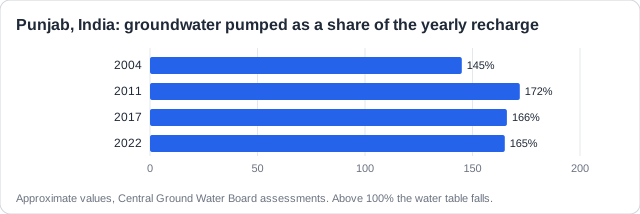
Example (SL): Punjab, India. Farmers pump about 1.6 times more groundwater than rain puts back, so many wells must be dug deeper each year. After the rice harvest, millions of tonnes of stubble are burned to clear fields fast, adding to the autumn smog over Delhi.
Study smarter, not longer
Most students waste 40% of study time on topics they already know. Our AI tracks your progress and optimizes every minute.
Critics also point to who gained, who lost, and who was left out.
Economic
- Seed, fertilizer, pesticide and pumps must be bought every year.
- Farmers with land, credit and irrigation gained most; small farmers fell into debt.
- Machines replaced landless labourers.
Sociocultural
- Gaps between rich and poor farmers, and between regions, grew.
- Traditional knowledge and local seeds were lost.
- Diets narrowed: wheat and rice replaced millets and pulses.
The points to remember
- It did not happen in all developing countries.
- Much of sub-Saharan Africa missed out: rain-fed farms, little irrigation.
- Its main crops (cassava, sorghum, millet) had few new varieties at first.
- Poor roads, little credit, and high fertilizer prices held it back.
Example (SL): small farmers in Punjab. Many farmers took loans for tube wells, tractors and fertilizer. When harvests failed or prices fell, debts grew, and farmer debt has become a serious social problem in the state.
Plants need nitrogen, but most of it is in the air as a gas they cannot use. The Haber-Bosch process fixes it into fertilizer.
The points to remember
- Higher yields depended on fixing nitrogen into synthetic fertilizer.
- The hydrogen comes mostly from natural gas, and the process needs high heat and pressure.
- So fertilizer production is fossil-fuel dependent and releases carbon dioxide.
- Tractors, pumps and pesticides add more oil and electricity use.
- If gas becomes scarce or costly, fertilizer and food prices rise.
Remember it as: Gas in, ammonia out, food up, carbon up.
Example (SL): 2022. When natural gas prices jumped in 2021-2022, fertilizer prices roughly tripled, and some European factories cut their ammonia output. Farmers around the world paid more for fertilizer, and food prices rose.
Practice with exam-style questions
Answer exam-style questions and get AI feedback that shows you exactly what examiners want to see in a full-marks response.
How this comes up: Paper 1 gives a graph of the area harvested and the grain produced, then asks you to describe the relationship [2] and outline reasons for it [2].
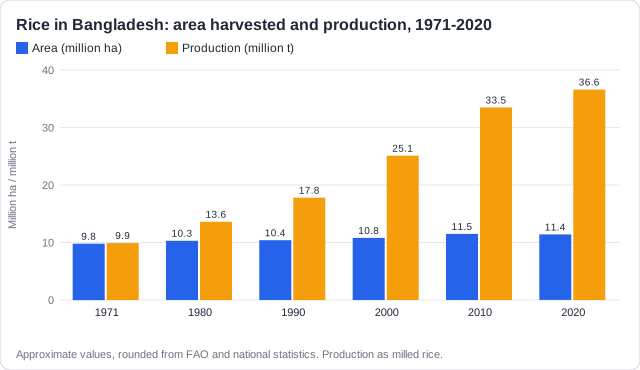
The figure shows the area of rice harvested and rice produced in Bangladesh from 1971 to 2020.
(a) Describe the relationship between the area harvested and rice production. [2]
(b) Outline two reasons for this relationship. [2]
Model answer plan
See the mark-by-mark plan — for / against / judgement, with marking guidance — in study mode.