Moving with the herds: Nomadic pastoralism is one of the oldest ways of farming. It works where land is too dry, cold or steep for crops.
The points to remember
- Herders keep cattle, goats, sheep, camels, yaks or reindeer.
- They move with the seasons, following grass and water.
- Moving on lets each pasture rest and regrow.
- It suits drylands, mountains and tundra, where crops fail.
- It supports only a low population density: many hectares per person.
Example (SL): the Maasai of Kenya and Tanzania. Maasai families keep cattle, goats and sheep on the savanna. In the dry season they take herds to wetter grazing near rivers and hills, and return when the rains bring new grass. Cattle are food, wealth and status.
Free preview
This is the free notes preview
You're reading the free notes. Aimnova Pro unlocks the full study experience — and you can try it with your first topic free to keep:
- FlashcardsLock in vocabulary and key terms with spaced repetition.
- Practice questionsAnswer exam-style questions and get instant AI marking.
- Mock exams & past-paper vaultSit full mocks and see exactly how examiners award marks.
- Personalised study planA daily plan built around your exam date and weak areas.
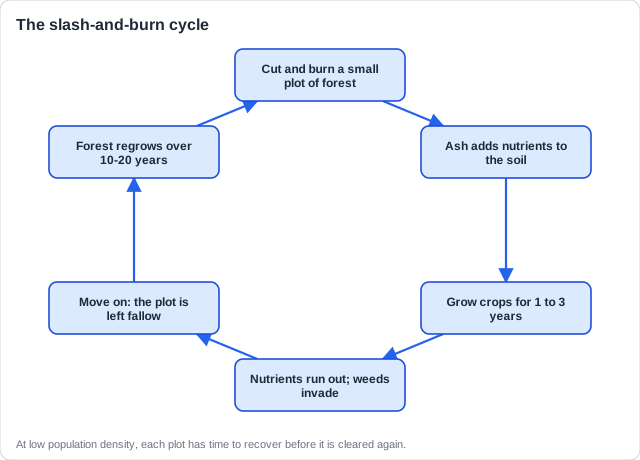
Slash-and-burn farming, also called shifting cultivation, is common in tropical forests.
The points to remember
- Burning releases nutrients from the trees as ash, fertilizing the poor soil.
- Crops grow well for only 1-3 years: rain leaches the nutrients and weeds invade.
- The plot is left fallow while farmers clear another.
- With a long fallow, 10-20 years or more, the forest and its soil recover.
Example (SL): Dayak farmers in Borneo. Dayak families clear a patch of forest, burn it and plant hill rice in the ash. After a harvest or two they move to another plot, and the old one grows back into forest.
Know your predicted grade
Take timed mock exams and get detailed feedback on every answer. See exactly where you're losing marks.
For thousands of years, both techniques have sustained low-density populations: they fed people without destroying the land.
The points to remember
- Few people, lots of land: each plot or pasture gets time to recover.
- No synthetic inputs: no fertilizer, pesticide or fuel is needed.
- Mixed crops and mixed herds spread the risk of failure.
- Local knowledge of soils, plants, rain and grazing guides every move.
- Small clearings in a large forest are quickly recolonized by plants and animals.
Remember it as: Few people, lots of land, long rest.
Example (SL): Maasai grazing. Traditionally, Maasai elders set aside some pastures in the wet season, saving them for the dry season. Grazing in turns kept the grass from being eaten to the roots.
As indigenous cultures modernize, live at higher population densities or in fixed locations, these practices become less sustainable.
The points to remember
- More people on the same land: fallows get shorter, so the soil cannot recover.
- Fixed homes, schools and borders stop herders moving, so pastures are overgrazed.
- Land is lost to farms, ranches, parks and mines, squeezing herds onto less land.
- Selling animals or crops for cash means bigger herds or more clearing.
- The results: soil erosion, deforestation, overgrazing and desertification.
Examples (SL): Madagascar and the Maasai. In Madagascar, more people mean tavy plots are now left fallow for only 4-6 years, too short for the forest to return; the island lost about 44% of its natural forest between 1953 and 2014. Many Maasai group ranches have been divided into fenced family plots, so herds can no longer move.
Get feedback like a real examiner
Submit your answers and get instant feedback — what you did well, what's missing, and exactly what to write to score full marks.
How this comes up: Paper 1 gives a diagram of a slash-and-burn system and asks why a change may be more sustainable and why it is hard [2 + 2]; Paper 2 Section B can ask for a named example [4].
Traditional farming techniques have fed people in some regions for thousands of years.
With reference to a named example, outline how nomadic pastoralism has sustained low-density populations.
Model answer plan
See the mark-by-mark plan — for / against / judgement, with marking guidance — in study mode.