One species, or its whole home?: Species-based conservation saves particular species, usually ex situ. Habitat-based conservation protects the place they live, usually in situ.
The points to remember
- Species-based conservation protects particular species, one at a time.
- It tends to use ex situ strategies: away from the wild.
- Habitat-based conservation protects a whole habitat and every species in it.
- It tends to use in situ strategies: in the wild, where the species lives.
- 'Tends to' matters: some species measures work in the wild, and a mix of both is common.
Remember it as: Species: take it out to save it. Habitat: save the place, save them all.
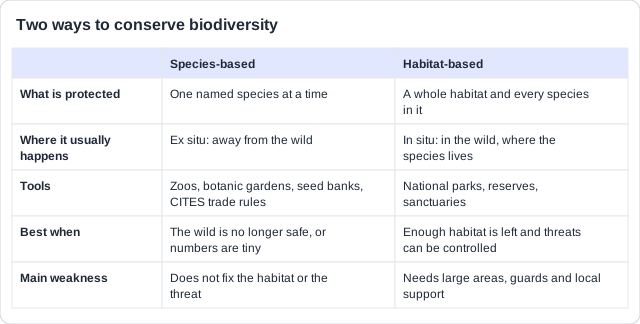
Real example: the Svalbard Global Seed Vault saves crop species one by one, away from the fields (species-based, ex situ). Serengeti National Park in Tanzania protects the plains where wildebeest, zebras, lions and hundreds of other species live (habitat-based, in situ).
Free preview
This is the free notes preview
You're reading the free notes. Aimnova Pro unlocks the full study experience — and you can try it with your first topic free to keep:
- FlashcardsLock in vocabulary and key terms with spaced repetition.
- Practice questionsAnswer exam-style questions and get instant AI marking.
- Mock exams & past-paper vaultSit full mocks and see exactly how examiners award marks.
- Personalised study planA daily plan built around your exam date and weak areas.
Ex situ measures protect a species outside its natural habitat, like moving a rare painting into a museum for safety. The four to know are zoos, botanic gardens, seed banks and CITES.
The points to remember
- Zoos and wildlife parks: captive breeding, then reintroduction to the wild.
- Botanic gardens: living plant collections, grown and returned to the wild.
- Seed banks: seeds dried and frozen, keeping genetic diversity for decades.
- Tissue culture and freezing (cryopreservation) store genetic material.
- CITES: controls international trade in a threatened species, wherever it lives.
- Ex situ is an emergency back-up when the wild is no longer safe.
Ex situ example 1
- Svalbard Global Seed Vault, Norway, opened 2008
- Holds more than 1.2 million seed samples of crops
- In 2015 Syria's seed bank, lost in the war, took seeds back out to regrow its collection
Ex situ example 2
- Arabian oryx: hunted out of the wild by 1972
- A 'World Herd' was bred in zoos from 1962
- Zoo-bred oryx were released from 1982; about 1,200 now live wild
CITES in action: in 1989 CITES banned the international trade in ivory, so poachers had fewer places to sell tusks. It protects the elephant wherever it lives: a species-based measure.
Why it is used: Ex situ is an emergency back-up when survival in the wild is impossible or very risky.
Know your predicted grade
Take timed mock exams and get detailed feedback on every answer. See exactly where you're losing marks.
In situ measures protect species by protecting where they live. Because the whole habitat is protected, every species in it gains, including ones nobody has studied yet.
The points to remember
- National parks: large areas protected by law, often open to visitors.
- Reserves: areas set aside mainly for wildlife, with stricter limits on people.
- Sanctuaries: protected places for particular animals, often guarded.
- In situ protects whole ecosystems, natural behaviour and interactions between species.
- It needs large areas, guards and local support.
In situ example 1
- Serengeti National Park, Tanzania, about 14,750 km²
- Protects the migration of over a million wildebeest
- Lions, cheetahs and hundreds of bird species protected in the same plains
In situ example 2
- Yellowstone National Park, USA, 1872
- The world's first national park
- Protects bison, grey wolves, bears and hot springs together
More on protected areas: How reserves are managed and designed (fences against pests, size, shape, corridors) is taught in 3.3.5 and 3.3.6. Here, learn which measures are in situ and why they suit habitat-based conservation.
Papers often give a fact file on one species and ask you to evaluate zoos, or to compare a zoo's approach with a habitat approach. Learn the points for both sides.
The points to remember
- Zoos give a safe haven, a chance to breed and to research the species.
- They educate visitors and raise funds for conservation in the wild.
- But zoos are expensive, hold few individuals, and cannot copy the natural habitat.
- Captive animals may suffer stress or lose survival skills; some say captivity is wrong.
- Zoo money could go to habitat protection; zoos do not remove the cause of decline.
- The habitat approach helps many species at once, is often cheaper, and needs no captivity.
Remember it as: Zoos: safe, breed, teach, fund. But: costly, few, captive, cause untouched.
Advantage of the zoo (species-based)
- Specialised, safe conditions for one species
- Breeds a critically endangered species for release
- Keeps genetic diversity in a managed programme
- Education, money and popular flagship species
Advantage of the habitat approach
- Conserves whole ecosystems and food webs
- Keeps species in their natural environment
- Often cheap and simple to set up
- More ethical: no animals kept in captivity
Real example: fewer than 40 Amur leopards were left in the wild in 2007. Zoos keep a safe back-up population of about 200, but the wild recovery to more than 100 came from protecting their forest in Russia's Land of the Leopard National Park, created in 2012.
Two answers that score nothing: 'Zoos prevent extinction' on its own is too vague: say how (safe breeding for release, a back-up population). And 'the habitat approach does not need much space' is wrong: it needs a lot.
Get feedback like a real examiner
Submit your answers and get instant feedback — what you did well, what's missing, and exactly what to write to score full marks.
Most ex situ programmes aim to breed a species and then return it to the wild, by reintroduction. Reintroduction only works if the ecosystem is ready to support the species again.
The points to remember
- Reintroduction works when the original threat is removed (poaching, predators, poison).
- The habitat must be protected or restored, with enough space and food.
- Captive populations are small: low genetic diversity and inbreeding.
- Hand-reared animals may lack survival skills, so many die soon after release.
- Judge a programme by the numbers and by whether the threats are gone.
Remember it as: Fix the threat, fix the habitat, then release.
More likely to succeed
- The original threat is removed
- Habitat restored, with enough space and food
- Many founders: good genetic diversity
- Released animals trained and monitored
More likely to fail
- Threats continue (poaching, predators, poison)
- Habitat too small or fragmented
- Few founders: inbreeding
- Hand-reared animals lack survival skills
Real example: zoo-bred Arabian oryx released in Oman rose to about 450 by 1996. Then poachers caught them to sell alive, and in 2007 the sanctuary was cut by 90%; only about 65 were left. The breeding worked, but the threat and the habitat were not fixed.
Evaluating a programme: Pros from the data (numbers up, extinction prevented, targeted methods). Cons from the threats still there (invasive predators, habitat loss, low genetic diversity, cost). Then judge: 'overall...'.
How this comes up: Paper 1: a fact file on one species. Evaluate the role of zoos in its conservation [4]: two points each way at most, then a balanced judgement.
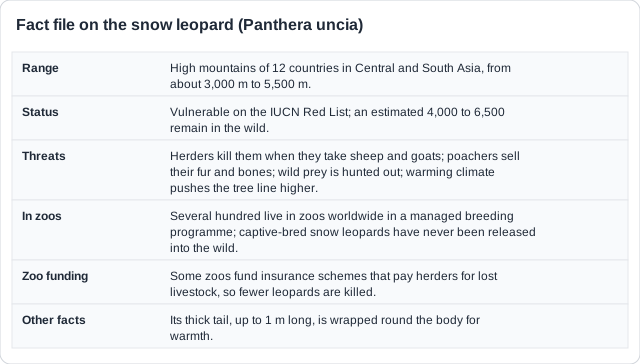
Figure 1 is a fact file on the snow leopard.
With reference to Figure 1, evaluate the role of zoos in the conservation of the snow leopard.
Model answer plan
See the mark-by-mark plan — for / against / judgement, with marking guidance — in study mode.