Save the species and its home: Sometimes both the habitat and particular species are protected together. A flagship species or a keystone species is used to justify protecting the whole landscape it lives in.
The points to remember
- A mixed approach protects both a habitat and particular species in it.
- It usually uses a flagship or keystone species to justify protecting intact habitats and landscapes.
- In situ measures can focus on one species, while reserves protect its whole habitat.
- Species measures raise numbers; habitat measures give them somewhere to live.
Remember it as: The species opens the wallet; the habitat keeps it alive.
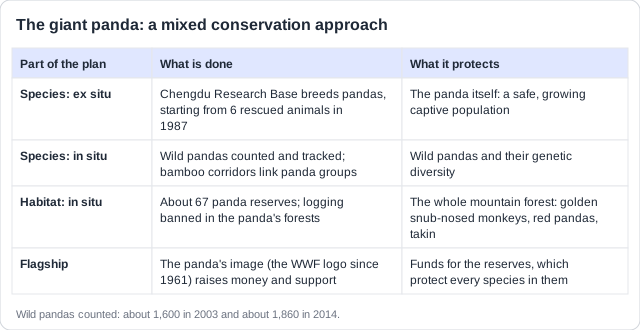
Real example: the Chengdu Research Base of Giant Panda Breeding in China began in 1987 with 6 rescued pandas. Its breeding is in China, close to the panda's own mountains, while about 67 reserves protect the forests. Wild pandas rose from about 1,600 in 2003 to about 1,860 in 2014, and in 2016 the panda moved from Endangered to Vulnerable.
Free preview
This is the free notes preview
You're reading the free notes. Aimnova Pro unlocks the full study experience — and you can try it with your first topic free to keep:
- FlashcardsLock in vocabulary and key terms with spaced repetition.
- Practice questionsAnswer exam-style questions and get instant AI marking.
- Mock exams & past-paper vaultSit full mocks and see exactly how examiners award marks.
- Personalised study planA daily plan built around your exam date and weak areas.
A flagship species is chosen for how people feel about it, not for its role in the ecosystem. Papers ask you to outline its role, give an advantage of using it, or pick the best one from a list of species.
The points to remember
- A flagship species is popular and charismatic: the face of a campaign.
- It has wide public appeal: attractive, cute, or closely related to humans.
- It may be a national symbol, or have cultural or spiritual value.
- It is used to raise awareness, educate and raise funds, and can draw ecotourists.
- Protecting it protects its whole habitat and the other species in it.
- Limit: money may go to popular species while less appealing ones are ignored.
Remember it as: Loved, used, protects the rest.
Picking an animal from a list
- Wide public appeal: cute, striking, or a primate like us
- Found only in that country (unique)
- Critically endangered: the most urgent
- Draws ecotourists; good for posters and soft toys
- Its habitat holds many other species
Traps
- Choosing a plant when the question asks for an animal
- 'It is endangered' with no link to support
- Describing its role in the food web (that is a keystone)
- Two reasons that say the same thing
Real example: the polar bear is the face of campaigns about melting Arctic sea ice. People who will never see the Arctic give money to protect it, which helps seals, Arctic foxes and the whole sea-ice ecosystem.
Memorize terms 3x faster
Smart flashcards show you cards right before you forget them. Perfect for definitions and key concepts.
A keystone species justifies a mixed approach for a different reason: it holds the ecosystem together, so it cannot survive, or do its job, unless its habitat is protected too.
The points to remember
- A keystone species has a disproportionate effect on its community.
- Protecting it keeps the food web and the structure of the ecosystem working.
- It needs an intact habitat, so saving it means saving the habitat.
- Keystones may be unpopular (predators, 'pests'), so they are harder to fund than flagships.
- Some species are both: the tiger is a flagship and an apex predator.
Flagship
- Chosen for its appeal to people
- Wins money and support
- Protects its habitat as a result
Keystone
- Chosen for its role in the ecosystem
- Found by scientific study
- Protecting it keeps the food web working
Real example: African elephants in Amboseli National Park, Kenya, push over trees and shrubs, which keeps the savanna open for grazing animals. Protecting the elephants means protecting the whole savanna, and the elephants also bring in the tourists who pay for it.
Keystone or flagship?: 'It controls its prey' alone does not make a keystone: say it is integral to the food web. And 'it is popular' describes a flagship, not a keystone.
Which approach is best depends on the case. This checklist decides it, and most answers end with a mix: reduce the threats, protect the habitat, keep a back-up population, then release and monitor.
The decision checklist
- How urgent is the risk? Very few left: add a species measure (breeding) at once.
- How much habitat is left, and in what condition? Can the threats be controlled?
- Is there space for a viable population, with enough genetic diversity?
- What will it cost, and do local people support it?
- Species measures alone fail if the habitat is lost; habitat measures alone may be too slow.
- A species raised in captivity survives only if its habitat is conserved and restored.
Back-up
- Zoos bred tamarins from the 1970s, when fewer than about 200 were left.
Release
- Zoo-bred tamarins were released into Brazil's Atlantic Forest from 1984.
Habitat
- Forest fragments were protected and linked by corridors and bridges.
Result
- About 3,700 by 2014; yellow fever then killed about a third, so vaccination began.
Habitat or species first? The [9] answer: Give named examples of both, with where each fails. Conclude: it depends on the threats and how few are left, but a species raised by species methods cannot survive in the wild unless its habitat is kept.
Know your predicted grade
Take timed mock exams and get detailed feedback on every answer. See exactly where you're losing marks.
How this comes up: Paper 1: a panel of a country's species. Justify your choice of one animal as the most suitable to promote conservation [2].
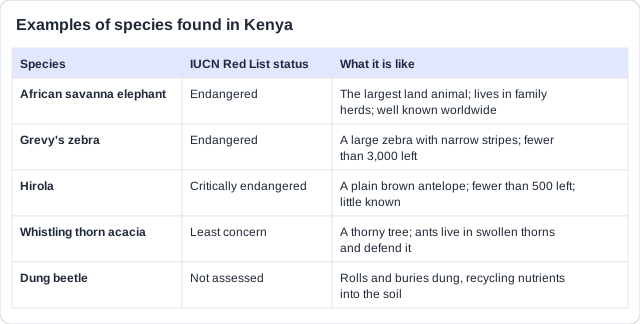
Figure 1 shows examples of species found in Kenya, with their IUCN Red List status.
With reference to Figure 1, justify your choice of one animal as the most suitable to promote conservation.
Model answer plan
See the mark-by-mark plan — for / against / judgement, with marking guidance — in study mode.