Five reasons to keep it: People argue for preserving species and habitats in five ways: for their beauty, for how ecosystems work, for money, for what is right, and for people's lives.
The points to remember
- There are five kinds of argument for preserving species and habitats.
- Aesthetic: nature is beautiful and inspiring.
- Ecological: nature gives ecosystem services that keep ecosystems and people alive.
- Economic: nature earns money: ecotourism, genetic resources, products from natural capital.
- Ethical: species have a right to exist (intrinsic value), or are useful to us (instrumental value).
- Social: nature's goods and services support human well-being, culture and health.
Remember it as: Beauty, balance, business, beliefs, belonging.
Aesthetic
- A 2,300 km reef, listed as World Heritage in 1981 for its beauty.
Ecological
- It breaks the waves, protecting the coast, and is a nursery for fish.
Economic
- Worth about A$6.4 billion a year and 64,000 jobs, mostly tourism (2017).
Ethical
- More than 1,600 kinds of fish, each with a right to exist.
Social
- Sea Country of more than 70 Aboriginal and Torres Strait Islander groups.
Name the kind of argument: When a question asks for different values or arguments, give each a different kind AND an example: 'economic: coral reef tourism', not just 'it is valuable'.
Free preview
This is the free notes preview
You're reading the free notes. Aimnova Pro unlocks the full study experience — and you can try it with your first topic free to keep:
- FlashcardsLock in vocabulary and key terms with spaced repetition.
- Practice questionsAnswer exam-style questions and get instant AI marking.
- Mock exams & past-paper vaultSit full mocks and see exactly how examiners award marks.
- Personalised study planA daily plan built around your exam date and weak areas.
The ecological argument: nature does jobs for us. These ecosystem services keep ecosystems stable and keep people alive, and they are lost when habitats are lost.
The points to remember
- Ecosystem services: pollination, clean water, flood control, fertile soil, a stable climate.
- Intact habitats store carbon and regulate climate; wetlands and mangroves absorb floods.
- More species means more links in the food web, so the ecosystem is more stable and resilient.
- Each species fills a niche; losing one (e.g. a keystone) can make others decline.
- Protecting a habitat protects every species in it and the services they give.
Remember it as: Nature works for free until it is gone.
Real example: in 1997 New York City chose to protect the forests of the Catskill Mountains, which clean its drinking water, for about US$1.5 billion. A filtration plant to do the same job would have cost US$6-8 billion to build.
Link the service to the habitat: Say which service the habitat gives and what is lost without it: 'mangroves absorb storm waves, so coasts flood less', not just 'mangroves are important'.
Know your predicted grade
Take timed mock exams and get detailed feedback on every answer. See exactly where you're losing marks.
The economic argument puts a money value on nature. Its natural capital earns through ecotourism, through its genetic resource and through products that can be harvested without using it up.
The points to remember
- Ecotourism: live wildlife earns money again and again from visitors.
- Genetic resources: wild genes breed disease-resistant crops and give new medicines.
- Commercial natural capital: timber, fish, fruit and fibre can be harvested sustainably.
- Putting a money value (valuation) on nature helps it compete with farming or logging.
- Limit: species with no price may be ignored, and prices can change.
Worth more alive
- A gorilla-trekking permit in Rwanda costs US$1,500 for one hour with a gorilla family.
- Visitors come back year after year to see the same gorillas.
Worth less dead
- A poached gorilla earns money only once.
- Its family group may break up, so tourists stop coming.
Real example: in the 1970s rice breeders tested thousands of rice types and found resistance to a virus, grassy stunt, in a wild rice from India. Its genes were bred into rice grown across Asia. Lose wild relatives of crops, and genes like these are lost too.
A common exam task: a graph shows tourism rising, and you say how it may affect conservation. It can help or harm, and one clear effect, with its cause, is what counts.
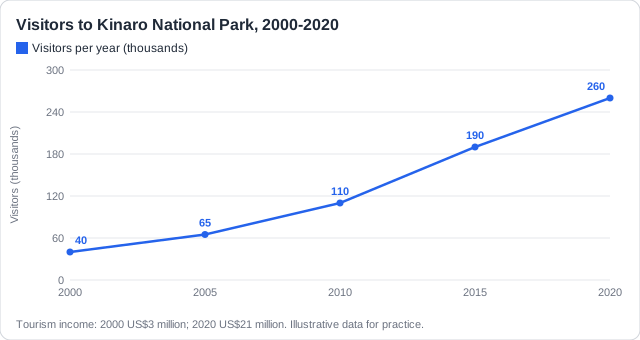
How more tourists can help
- Income from visitors can be invested back into conservation (rangers, research).
- Wildlife is seen as an asset worth looking after, so it is protected.
- Local jobs as guides mean less need for damaging farming, logging or fishing.
- Visitors gain awareness and support conservation.
How more tourists can harm
- Hotels, roads and paths clear or fragment habitat.
- Noise and crowds disturb animals, e.g. during breeding.
- Tourists use scarce water that wildlife needs.
- Easier access can raise poaching or the pet trade.
- Litter that animals eat or get caught in harms them.
Say how it harms: 'Tourism causes pollution' or 'tourists trespass' is not enough. Name the harm to wildlife: 'litter is eaten by animals', 'new hotels clear the forest the birds nest in'.
Real example: Rwanda shares 10% of the income from its gorilla parks with the villages around them, so people gain from gorillas alive. But at Maya Bay in Thailand, up to 5,000 visitors a day damaged the coral, and the bay was closed from 2018 to 2022 to let it recover.
Get feedback like a real examiner
Submit your answers and get instant feedback — what you did well, what's missing, and exactly what to write to score full marks.
Ethical arguments are about what is right, and people disagree. Some say a species has intrinsic value; others value it for its instrumental value. The two can apply to the same species.
The points to remember
- Intrinsic value: a species is worth protecting for its own sake, useful or not.
- Bio-rights: every species has a right to exist; people have no right to wipe it out.
- Instrumental value: a species is worth protecting because it is useful to people.
- Stewardship: people should care for nature for future generations.
- Religious or spiritual beliefs can make places or species sacred.
- One species can have both intrinsic and instrumental value.
| Intrinsic value | Instrumental value | |
|---|---|---|
| Meaning | Worth in itself | Worth because it is useful to us |
| Giant panda | A native species with a right to exist | Draws visitors; the logo of WWF raises money |
Real example: in 1978 the US Supreme Court stopped the nearly finished Tellico Dam in Tennessee because it threatened the snail darter, protected by law. It ruled that the law protects a species whatever its usefulness: an intrinsic value. Congress later let the dam open.
Both at once: A question may ask how intrinsic and instrumental value are not exclusive. Give one of each for the SAME species: tourism money is instrumental; being native, wild or a cultural symbol is intrinsic.
Aesthetic and social arguments are about people: the beauty of nature and what it gives our lives. Education is how these arguments reach people and change what they do.
The points to remember
- Aesthetic: beautiful landscapes and wildlife inspire art, writing and photography.
- Social: nature supports well-being: recreation, mental and physical health.
- Nature holds culture and identity: traditions, languages and sacred sites.
- Nature gives livelihoods and food, and places to learn and do research.
- Education turns arguments into action: it builds stewardship and motivates people to act.
- Education also brings money for conservation and protects nature for future generations.
Real example: John Muir's writing and, later, Ansel Adams' photographs of Yosemite's cliffs and waterfalls in California helped win and defend its protection. In Japan, forest bathing, calm walks in woodland, has been promoted for health since 1982.
Why education matters: Jane Goodall's Roots & Shoots groups (from 1991) get young people doing projects for wildlife. Say what education leads to: care for nature (stewardship), action, money, protection for future generations. 'It spreads awareness' alone is not enough.
Learn what examiners really want
See exactly what to write to score full marks. Our AI shows you model answers and the key phrases examiners look for.
Which argument persuades depends on a person's value system: economic and social arguments win over people who see nature as a resource; ethical ones win over ecocentrics. A [9] essay weighs them, as in: is conservation more urgent in the tropics?
More urgent in the tropics
- Tropical rainforests and coral reefs hold most species and many endemics; many are hotspots.
- They are highly productive and store huge amounts of carbon.
- They supply medicines and other genetic resources, and are home to indigenous peoples.
- They are being lost fast, often in poorer countries with little money for conservation.
Urgent everywhere
- Ecocentric view: every species has equal worth, wherever it lives.
- Other biomes are threatened too: temperate grasslands, tundra, boreal forest.
- Tundra and boreal peat store vast amounts of carbon.
- Local ecosystem services matter to people everywhere.
Real example: tropical rainforests cover about 6% of the land but hold about half of all land species; coral reefs cover under 1% of the sea floor but hold about a quarter of sea species.
End with a judgement: Conclude with 'to a large extent, because...' and a reason from your analysis, e.g. 'every species matters, but the tropics hold the most species and the least money to protect them'.
How this comes up: Paper 2, Section B (c): a [9] essay on why and where conservation matters, marked in bands. Also Paper 1: one way a tourism trend may affect conservation [1].
Tropical rainforests and coral reefs are being lost faster than most other ecosystems.
To what extent is the need for conservation more significant in tropical biomes?
Model answer plan
See the mark-by-mark plan — for / against / judgement, with marking guidance — in study mode.