Life changes over time: Biodiversity exists because life evolves. Evolution slowly builds new features, and in time new species.
The points to remember
- Evolution is cumulative change in the heritable characteristics of a population or species.
- Heritable: passed from parents to offspring in their genes, e.g. the shape of a beak.
- Cumulative: small changes add up over many generations.
- Populations evolve, not single animals: an individual cannot change its genes.
- A change gained in one lifetime (big muscles, a scar) is not heritable, so it is not evolution.
Remember it as: Heritable, cumulative, population: evolution in three words.
Real example: in 1977 a drought hit Daphne Major, a small Galapagos island. Small, soft seeds ran out, so finches with deeper beaks, able to crack big hard seeds, survived best. Their chicks inherited deeper beaks: the next generation's beaks were about 4% deeper on average.
Not evolution: A horse that gets fitter with training, or a plant that grows taller with fertiliser, has not evolved. The change is not in its genes, so it is not passed on.
Free preview
This is the free notes preview
You're reading the free notes. Aimnova Pro unlocks the full study experience — and you can try it with your first topic free to keep:
- FlashcardsLock in vocabulary and key terms with spaced repetition.
- Practice questionsAnswer exam-style questions and get instant AI marking.
- Mock exams & past-paper vaultSit full mocks and see exactly how examiners award marks.
- Personalised study planA daily plan built around your exam date and weak areas.
Over millions of years, evolution splits one species into many. Every living thing shares one common ancestor.
The points to remember
- Over long periods, evolution produces new species: this is where biodiversity comes from.
- All living things share one common ancestor, from at least 3.5 billion years ago.
- One species reaching a place with empty niches can split into many: adaptive radiation.
- Each new species suits a different food or habitat, so species diversity rises.
- Species also go extinct: today's biodiversity is new species formed minus species lost.
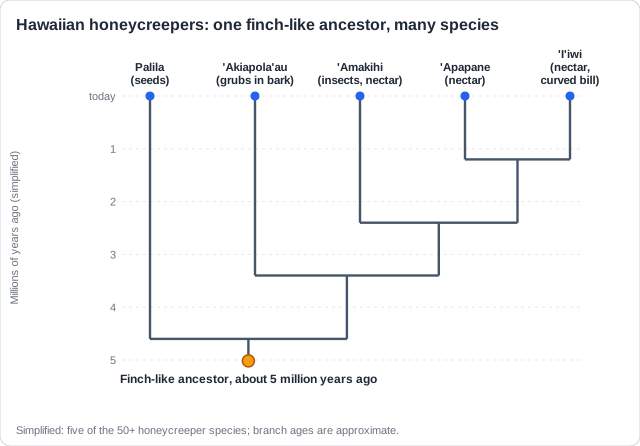
Real example: a finch-like bird reached Hawaii about 5 million years ago. Its descendants became more than 50 species of honeycreeper: seed-crackers, nectar-drinkers with long curved bills, and grub-diggers. This is adaptive radiation.
Link evolution to biodiversity: Say the link in full: 'evolution produces new species, so species diversity increases'.
Get feedback like a real examiner
Submit your answers and get instant feedback — what you did well, what's missing, and exactly what to write to score full marks.
Evolution adds to all three levels of biodiversity: genetic, species and habitat.
The points to remember
- Genetic diversity is the raw material: evolution needs differences between individuals.
- Evolution turns those differences into new species: species diversity.
- Living things build and change habitats (reefs, forests), adding habitat diversity.
- More biodiversity gives more ways to cope with change: higher resilience.
Remember it as: Genes vary, species split, habitats grow, systems cope.
Genetic
- Finches on one island differ in beak depth.
Species
- About 18 species of Darwin's finch, from one ancestor.
Habitat
- Cactus finches depend on cactus scrub, a habitat that cactus species built.
Real example: Darwin's finches show all three levels: variation in beaks within one species, about 18 species across the Galapagos, and each species tied to its own habitat and food.
From evolution to resilience: For a longer answer, carry the chain on: evolution creates species, speciation raises biodiversity, and higher biodiversity makes ecosystems more resilient.
How this comes up: Paper 2, Section B (a): outline, with a named example, how evolution produces biodiversity [4].
The Galapagos Islands are home to about 18 species of Darwin's finch, all descended from one ancestor that arrived from South America.
Outline how evolutionary processes have produced this biodiversity.
Model answer plan
See the mark-by-mark plan — for / against / judgement, with marking guidance — in study mode.