The environment chooses: Natural selection is the mechanism that drives evolution. A selection pressure filters each generation: what fits, passes.
The points to remember
- Natural selection is the mechanism that drives evolutionary change.
- A selection pressure (a predator, drought, disease, cold) decides who survives.
- Individuals better adapted survive and reproduce more, so their genes become more common.
- It is not deliberate: nothing plans it; the environment keeps what works there.
- 'Fittest' means best suited to that environment, not the strongest.
Remember it as: The environment is the filter: what fits passes through.
Real example: in Florida, soapberry bugs fed on a native vine with large fruit. From the 1950s many fed on an introduced tree with smaller fruit. Short-beaked bugs fed best on it, so bugs on that tree now have much shorter beaks.
Nobody chooses: Do not write that animals 'try to adapt' or 'decide to change'. The variation is already there; the selection pressure decides which individuals survive to breed.
Free preview
This is the free notes preview
You're reading the free notes. Aimnova Pro unlocks the full study experience — and you can try it with your first topic free to keep:
- FlashcardsLock in vocabulary and key terms with spaced repetition.
- Practice questionsAnswer exam-style questions and get instant AI marking.
- Mock exams & past-paper vaultSit full mocks and see exactly how examiners award marks.
- Personalised study planA daily plan built around your exam date and weak areas.
Natural selection never stops, and it has had a very long time to work.
The points to remember
- Natural selection works continuously: in every generation, in every population.
- It can act over billions of years: life has evolved for at least 3.5 billion years.
- Environments keep changing (a drought kills food plants, the climate shifts), so the 'best' trait changes too.
- Adapting takes many generations; if change is too fast, a species can go extinct.
- Small changes add up until whole new body parts (lungs, legs) appear: the biodiversity of life.
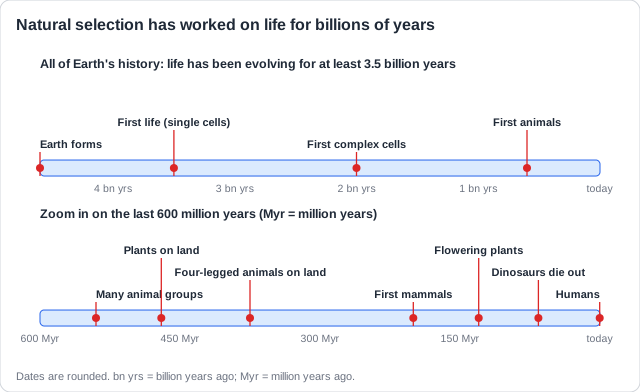
Real example: Tiktaalik, found in the Canadian Arctic, lived about 375 million years ago. It had gills and lungs, and sturdy fins with wrist bones: a step on the way from fish to four-legged land animals.
Too fast to adapt: Selection needs many generations. If the environment changes faster than that, for example a warming climate or a new predator, a species may die out instead of adapting.
Feeling unprepared for exams?
Get a clear study plan, practice with real questions, and know exactly where you stand before exam day. No more guessing.
One favourite exam question: how could a land animal evolve from an ancestor that lived in water? The answer is natural selection, step by step.
Water to land, step by step
- The ancestors had genetic variation, from mutations built up over many years.
- Some features gave an advantage on land: sturdy fins, simple lungs.
- Individuals with them could colonise land, with less competition and new food.
- They were more likely to survive and reproduce (natural selection).
- Their offspring inherited the features, which became more common each generation.
- In time the land group could not breed with the water group: a new species.
Variation
- Lobe-finned fish varied in fin strength and in simple lungs.
Advantage
- In warm, shallow, low-oxygen swamps, gulping air and pushing on fins helped.
Colonise
- Fish like Tiktaalik moved into the shallows and onto land, with few competitors.
Inherit
- They survived and bred more; their young inherited stronger limbs.
New species
- Over millions of years, four-legged land animals that could not breed with fish.
Finish with the new species: The last mark is often for speciation: say the land group became unable to breed with the water group, so a new species formed.
Why does natural selection increase the number of species? Because it can take groups of one species in different directions.
The points to remember
- Natural selection acts on existing genetic variation, made by mutations over long periods.
- It raises the survival of the fittest variations.
- These traits are heritable: selected individuals reproduce more and pass them on.
- Their share rises in later generations, so species adapt to different environments.
- With reproductive isolation this leads to speciation, so species diversity increases.
Remember it as: Variation in, fittest survive, traits spread, groups split, species multiply.
Real example: Hawaii's silverswords come from one small Californian daisy-like plant that arrived about 5 million years ago. Selection in deserts, bogs and forests produced about 30 species: rosettes, shrubs, even trees.
Two marks, two linked points: For 'the role of natural selection in increasing species diversity', link selection to adaptation, then adaptation plus isolation to new species. Stopping at 'the fittest survive' is not enough.
Memorize terms 3x faster
Smart flashcards show you cards right before you forget them. Perfect for definitions and key concepts.
A population's genetic diversity is not fixed: it goes up and down over time.
Can increase it
- Mutation makes new genotypes.
- Migration mixes populations and brings new genes.
- A changing climate can select new genotypes.
- Tectonic barriers split populations, which then diverge.
- Escaped farmed or bred animals add new genes to wild ones.
Can reduce it
- Natural selection removes less fit genotypes.
- Hunting, pollution, habitat loss, alien species shrink it to a bottleneck.
- Genetic drift: genes lost by chance in small populations.
- A changing climate can wipe out some genotypes.
Say how, not just what: 'Mutation' alone is only half an answer. Write the factor and its effect: 'mutation creates new genotypes, so genetic diversity increases'. Four bare factors get at most half the marks.
Real example: hunting cut northern elephant seals to perhaps 20-100 animals by the 1890s. Protected, they now number over 200,000, but their genetic diversity is very low: a bottleneck.
How this comes up: Paper 2, Section B (a): outline the mechanisms by which one kind of species evolved from another [4].
Fossils such as Tiktaalik show that four-legged land animals descended from fish.
Outline the mechanisms by which a terrestrial species may have evolved from an aquatic ancestor.
Model answer plan
See the mark-by-mark plan — for / against / judgement, with marking guidance — in study mode.